

Two-person watchkeeping depends on attentive lookout, useful handoffs and an honest assessment of rest. The crew’s size alone does not establish whether a passage is manageable.
A practical routine makes responsibility clear and gives both people permission to raise concerns early. It also recognizes when the route or crew arrangements need to change.
What a Proper Lookout Demands Under Rule 5
Under USCG navigation rules, Rule 5 requires a proper lookout by sight and hearing, together with all available means appropriate to the circumstances, at all times. Electronic equipment can support that appraisal but does not replace sight and hearing.
Discuss how the operating arrangement will meet that duty in the actual conditions. Visibility, distractions, sound, traffic and equipment limitations all matter. Rule 6 also requires safe speed appropriate to the circumstances; it does not define a universal speed for a single watchstander.
Matching Passage Length to Crew Readiness
Before departure, review the passage against both people’s abilities and condition. Daylight, visibility, traffic, route complexity, weather and the opportunity for real rest can change the workload.
Ask:
- Can the crew maintain the lookout and other necessary duties throughout the leg?
- Where might both people need to be available?
- Does the plan allow enough rest before and after demanding sections?
- What alternatives are feasible if the crew becomes tired or conditions change?
Our guide weather-window planning for pacific northwest coastal hops develops the related route and forecast questions. A favorable forecast does not remove the crew-readiness decision.
No fixed watch schedule proves that two people can sustain an overnight passage. Seek qualified guidance when planning beyond your established experience, and change the route, timing or crew arrangements when needed.
The Structured Watch Handoff
A useful handoff preserves the situation picture. Allow the incoming person enough time to understand it and explicitly accept responsibility before the outgoing person withdraws.
| Handoff subject | Information to share |
|---|---|
| Position and movement | Current position, course, speed and navigation context |
| Traffic | Vessels being monitored and unresolved situations |
| Conditions | Visibility, weather, sea state and observed changes |
| Next decision | Upcoming turn, arrival or other demanding event |
| Equipment | Relevant alarms, limitations or readings needing attention |
| Readiness | Whether the incoming person understands the picture and is ready |
Choose timing that suits the situation rather than handing over in the middle of an unresolved task. Neither a fixed advance arrival time nor a particular phrase establishes that the transfer is complete.
Protecting Rest and Managing Early Fatigue
Plan for rest as an operating need. Discuss where the off-watch person can rest and which duties or disturbances can be deferred. Observe the actual berth conditions rather than assuming that a particular location guarantees sleep.
Heavy eyelids, difficulty concentrating, missed information or confusion are reasons to take fatigue seriously. Agree in advance how to call for help when tired, uncertain about traffic or concerned about equipment or conditions.
If rest and lookout cannot be maintained, revise the voyage plan. The appropriate immediate action depends on the vessel’s position and circumstances; a generic instruction to idle, turn away or anchor could create another hazard.
Evaluating Helm Layout and Rest Accommodations
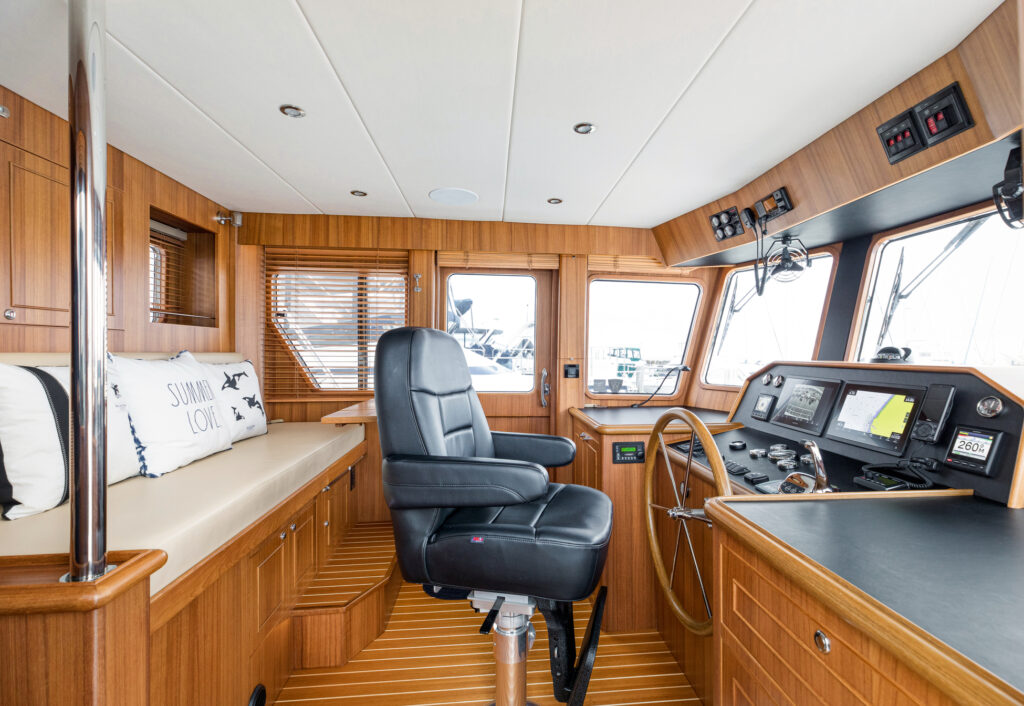
A sea trial checklist for a long-range trawler: what to feel, hear, and measure helps organize observations about the helm and living spaces. During suitable walkthrough and trial conditions, explore:
- Sightlines from both operators’ normal positions.
- Glare, reflections and instrument readability.
- Reach to controls and communication equipment.
- Access routes without losing responsibility for the lookout.
- Noise and movement where a person would rest.
For example, our 49 Pilothouse is a model you can assess through those questions. Discuss the installed layout and equipment without treating them as proof of two-person passage capability.
Establishing Honest Operating Limits
Agree on responsibilities, handoffs, rest opportunities and when assistance or a change of plan is needed. Review the arrangement as the route, conditions and crew readiness change.
When you want to evaluate helm layouts and living arrangements, talk with us about your intended operating routine and the yacht you are considering.