

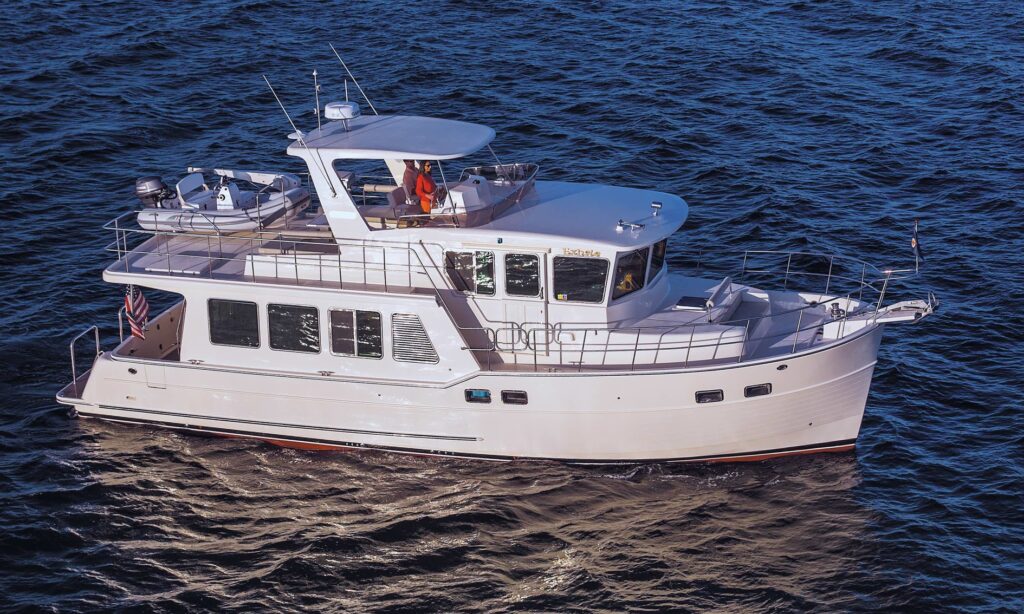
A tender setup is a daily routine as well as a piece of equipment. If launch, recovery or boarding feels awkward, shore trips can become work the crew would rather postpone.
For cruising couples, evaluating the complete routine together reveals more than a lifting-capacity figure. The question is whether the installed system suits your abilities and the trips you actually expect to make.
Define the Real-World Shore Mission Before Sizing Equipment
Describe your likely shore use: passengers, bags, pets, trip distance, landing locations and frequency. Different trips create different needs, but no generic tender category establishes suitability for a particular wind, wave or payload condition.
Use the exact tender’s capacity and operating guidance when discussing that fit. Consider alternatives when conditions do not suit the trip rather than treating daily shore access as an obligation.
Anchorage choice affects the routine too. Our guide anchoring a heavy cruising yacht in tidal harbors: setup decisions that reduce stress overnight develops the separate decisions about the overnight location and changing conditions.
Tracing the Launch Sequence from Chocks to Water
Ask an experienced demonstrator to show the complete manufacturer-approved sequence. Start with storage, covers and securing gear, then observe the lifting or launching process from the safe positions directed by the demonstrator.
Record practical questions:
- Can each person reach the controls and securing points they need?
- Where are loose gear and lines staged?
- Can the operator see the working area or communicate clearly with the other person?
- Which deck routes must remain clear?
- How can the documented operation be paused or stopped?
For example, our 49 Pilothouse is a model you can discuss in that context. Evaluate the actual tender arrangement rather than assuming a feature or launch method from the model name.
Giving Recovery Equal Weight in Your Routine
A calm launch demonstration is only part of the evaluation. Ask to see recovery and securing for travel as well. Notice reach, footing, visibility and how many tasks require coordinated movement.
Discuss the limits of the demonstration. Conditions at anchor may differ, and an easy dockside routine does not establish that recovery is suitable in swell or when the crew is tired.
Technical questions about lifting points, rigging, rated loads and suspended-load control belong with the equipment documentation and qualified installer. Keep clear of suspended loads and the pinch points identified for the system.
Managing Transfers for Crew, Stores, and Gear
Treat boarding as a distinct task. People need suitable footing and handholds; bags and other items should not occupy the hands needed for balance.
Agree on the transfer arrangement with someone qualified to demonstrate it for the exact yacht and tender. Relative movement, mobility and the fitted access determine what is workable. Do not improvise a line arrangement or attempt a transfer because the boat is already alongside.
Our guide boarding safety in rain, swell, and floating docks: a practical routine for cruising couples explores those access questions in more detail.
Comparing the Routine Across Systems
Compare observations rather than assigning a universal procedure to a crane, davit or platform label.
| Phase | Question to record for each installed system |
|---|---|
| Preparation | What must be removed, checked or secured? |
| Launch | Where does each person stand and what do they operate? |
| Transfer | Where are the footing, handholds and controlled access? |
| Recovery | What reach and coordination does it require? |
| Travel storage | How is the tender secured and how does it affect other deck use? |
Our guide tender and davit planning for trawler owners owns the broader equipment-selection discussion. Here, the task is deciding whether the repeated workflow fits the people who will use it.
Evaluating Deck Layouts on the Water
Walk through the routine with the demonstrator and make a written list of awkward reaches, unclear roles and questions. Discuss those before committing to equipment or a yacht.
If you want to examine stowage and tender integration, talk with us about your actual shore-access needs and the configuration you are considering.