

Boarding deserves a deliberate routine. Wet surfaces, a moving gap, unfamiliar access and bags in hand can turn an ordinary transfer into a difficult one.
A useful plan fits the yacht, dock, conditions and individual. It does not rely on a timed jump between moving surfaces.
Assess the Transfer Before Committing
Check relative movement, the gap, footing and accessible handholds before moving. The boat needs to be secured and the transfer controlled; having lines attached does not necessarily remove surge or a changing gap.
Our guide docking a single-screw trawler in wind and current without drama addresses the separate preparation for positioning and securing the yacht. Boarding should not become an improvised method of stopping a moving boat.
If you cannot establish suitable access, wait and seek assistance or another arrangement. Reassess after wake, weather or water-level changes rather than assuming the previous transfer remains appropriate.
Managing Footing and Visibility in Wet Conditions
Prepare the route before anyone crosses. Clear lines, hoses and other trip hazards, identify wet or damaged surfaces and make sure the access is visible. Use footwear appropriate to the surface and leave hands available for support.
Fixed and floating docks present different geometry. A fixed dock’s height relative to the boat changes with water level; a floating dock can still move differently from the yacht. Neither label establishes an easy transfer.
| Access question | What to check |
|---|---|
| Footing | Surface condition, steps and clear space |
| Visibility | Lighting at both ends of the transfer |
| Support | Secure handholds within the person’s reach |
| Relative movement | Gap and height changes at that moment |
| Readiness | Whether the individual is comfortable with the arrangement |
Coordinating Crew, Guests, and Gear
Agree on a clear plan before anyone moves. Keep the person’s transfer separate from handling bags, pets and other items that could occupy the hands needed for support.
Visitors may need explanation and assistance tailored to their mobility. Identify the access and handholds together; do not assume that an experienced owner’s routine suits every guest.
If an item cannot be handled safely from stable positions, arrange another method. Avoid adding reach or load to an already difficult transfer.
Dedicated Routines for Tender Transfers and Swim Platforms
A tender and yacht can move independently, so their transfer needs its own assessment. Relative movement and pinch points remain relevant even when the tender is secured alongside.
USCG boarding and platform guidance recommends establishing rules for swim-platform and boarding-ladder use and highlights propeller hazards. Agree on propulsion isolation and access with the qualified operator for the exact arrangement; neutral alone should not be treated as a universal safeguard.
Our guide tender storage and launch workflow for cruising couples: what gets old fast and what actually works covers the distinct launch and recovery workflow. Treat that machinery operation separately from moving people between boats.
Walkthrough Evaluation: Testing Boarding Geometry Before You Buy
At a safely secured yacht, evaluate the access both operators expect to use. Look at gate locations, steps, platform-to-cockpit changes and handhold reach. Discuss how your usual marina or shore-access arrangements might differ from the demonstration berth.
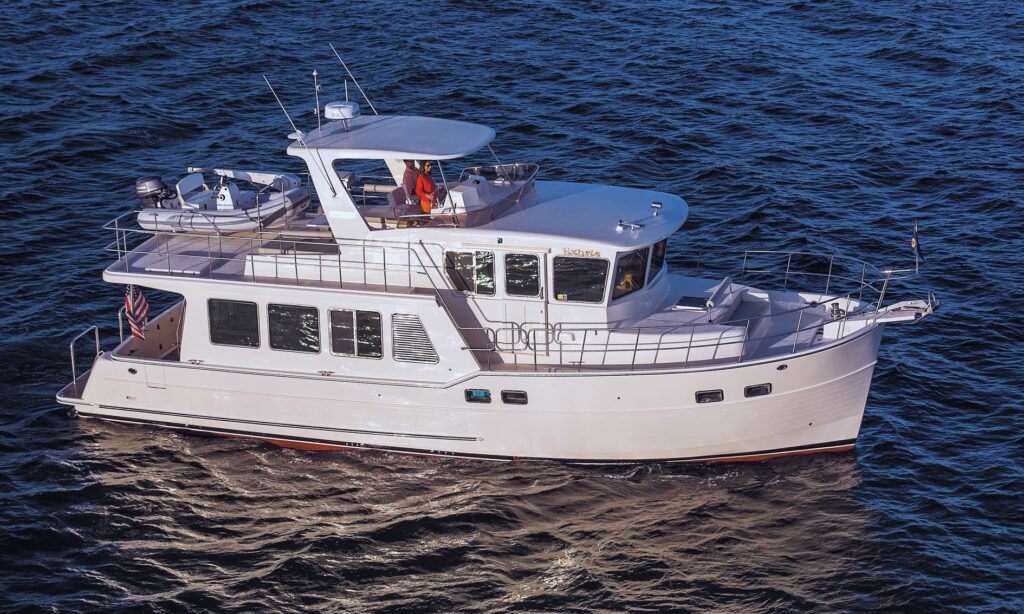
For example, our 49 Pilothouse is a yacht you can assess in that context. Ask about its actual configuration and test the access under suitable conditions; do not infer a universal boarding advantage from a model description.
Developing Your Shipboard Access Plan
A good access routine makes the setup and communication explicit, accommodates the individual and allows the transfer to be deferred. Review it whenever the berth or conditions change.
To discuss boarding arrangements, talk with us about your crew’s needs, home slip and intended shore access.