

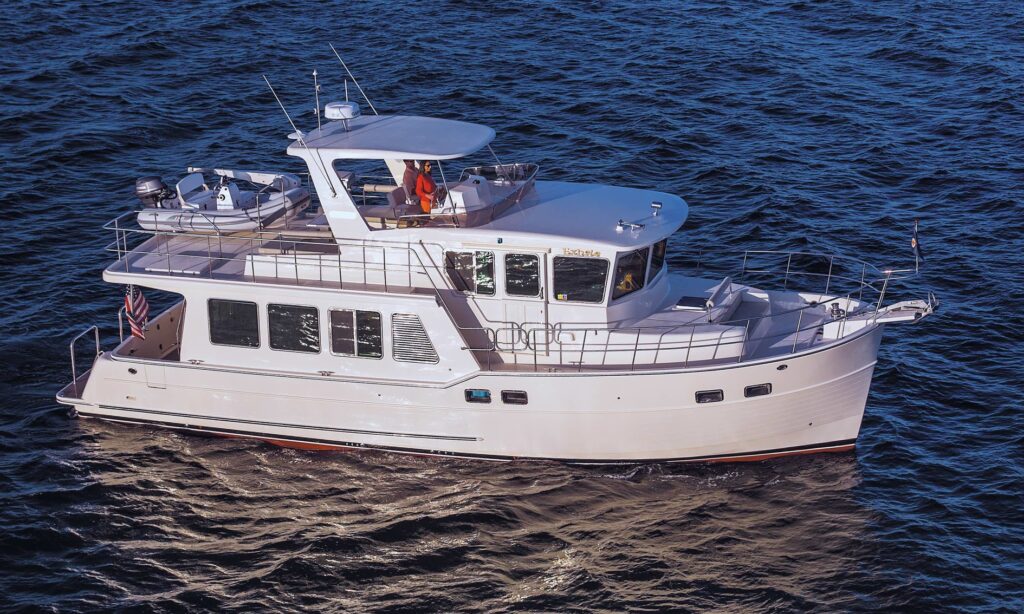
A tidal anchorage needs to work through the stay, not just at arrival. Water level, wind, current and nearby boats can change the depth, exposure and room available overnight.
For a heavy cruising yacht, a useful plan combines the location, documented ground-tackle setup and crew routine. No single scope figure or equipment label replaces that assessment.
Evaluating Harbor Selection Across the Complete Tide Cycle
Review the anchorage’s depth, bottom information, permission to anchor, exposure and departure access. Consider the expected low water for depth and higher water for scope, along with the weather forecast and its uncertainty.
Tide predictions and observed water levels are different information. Use the relevant chart notes and local water-level sources; do not assume a universal datum or that a distant station describes the anchorage exactly.
Our guide trawler draft explained: why a deeper draft can mean a better yacht helps interpret the yacht’s underwater dimension. For the anchorage itself, establish the exact boat’s loaded draft and depth reference rather than adding an arbitrary allowance.
Establishing the Scope Reference: Roller-to-Seabed Geometry
Scope relates rode length to the vertical distance from its attachment or lead at the bow to the seabed. BoatUS anchoring guidance includes the height above the water in that reference. A sounder reading alone may not represent it, depending on the instrument’s offset.
As water rises, that vertical distance changes. Consider the highest expected water during the stay when evaluating the setup, while also considering swing room and the installed equipment’s guidance.
| Planning input | What to establish |
|---|---|
| Depth | Location, time and stated reference |
| Boat’s depth display | Its offset and what the reading represents |
| Bow reference | Relevant height above water for the rode geometry |
| Water-level change | Expected range and uncertainty through the stay |
| Ground tackle | Exact anchor, rode and system guidance |
Select scope with qualified instruction and the exact equipment guidance, considering holding conditions and space. There is no universal ratio for every heavy yacht and harbor.
Swing Room, Current Reversals, and Harbor Neighbors
Wind and current changes can alter how the yacht lies. Nearby boats may have different hulls, windage and rode arrangements, so matching one boat’s position or rode length does not establish suitable spacing.
Review the whole possible movement area, surrounding hazards and access routes. Observe neighbors and communicate where useful, while retaining responsibility for your own setup. A tidal shift does not guarantee that every vessel swings in the same way or that every anchor resets.
Our guide tender storage and launch workflow for cruising couples: what gets old fast and what actually works is relevant when the overnight location also needs to support shore access. Keep shore trips within the capabilities of the tender, crew and conditions.
Foredeck Operations and System Readiness for Short-Handed Crews
Before arrival, agree on roles and communication. Review the installed windlass, load-transfer equipment and emergency procedures with a qualified demonstrator. Equipment manuals and the exact installation determine their use; a generic snubber or chain-stopper instruction may not fit.
During a yacht walkthrough, consider visibility, footing, reach and access to the ground tackle. For example, our 49 Pilothouse can be discussed through those questions without assuming that a model feature establishes short-handed capability.
Keep people clear of loaded lines, moving chain and pinch points, using the safe positions identified for the installation.
Confirming the Set and Managing Overnight Monitoring
Use a documented setting routine appropriate to the yacht and tackle, learned with qualified instruction. Confirm the yacht’s position and whether the observations indicate holding; one moment of resistance does not guarantee the overnight result.
Plan how the crew will recheck position and surroundings as conditions change. Alarms can support that routine, but their settings and limitations need to be understood. A depth change alone cannot diagnose dragging because water level and instrument behavior can also affect it.
Our guide weather-window planning for pacific northwest coastal hops develops the broader forecast and route decisions. Reassess the anchorage if the expected conditions change, with a departure or alternative plan that is feasible for the crew.
Reviewing Ground Tackle for Your Cruising Grounds
Ask an appropriate professional to evaluate the exact tackle and installation for your intended use. Simply choosing a larger anchor or heavier chain does not independently establish suitable loads, compatibility or holding.
If you are evaluating deck arrangements and cruising plans, talk with us about the exact yacht and the ground-tackle questions you want to resolve.