

A trawler’s draft is an access constraint. It helps determine whether a particular channel, anchorage or marina can accommodate the boat, but it does not tell you how that boat will behave offshore. A useful comparison starts with the places you want to use and the condition in which you will load the yacht.
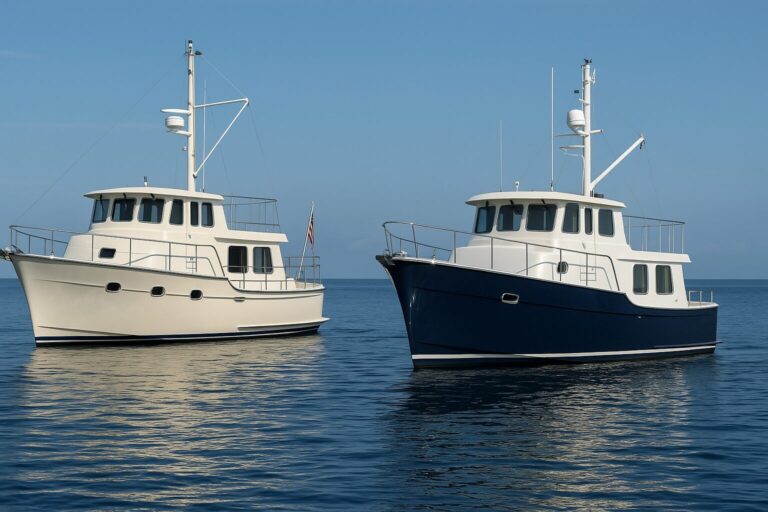
A smaller draft can give you more choices where depth is limited. A larger draft may still fit your plans comfortably if your regular routes and moorages have adequate depth. The decision is to establish which differences actually matter on your itinerary.
What the Draft Specification Actually Measures
Draft is the vertical distance from the waterline to the vessel’s lowest underwater point. Ask which point establishes the quoted measurement: the hull, keel, rudder, propeller or another appendage. Two yachts with similar advertised draft can have very different underwater arrangements.
A published number also needs a loading context. Fuel, water, stores, passengers and equipment affect how the boat sits in the water. Do not assume that a brochure figure describes the boat when fully provisioned, or add an arbitrary allowance and call it verified.
Our 49 Pilothouse has a published draft of 4 feet 10 inches. Use that as a specification to discuss with us, then establish the loading basis and the actual configuration of the yacht you are considering. A measured or documented loaded draft is more useful for your access decision than comparing brochure numbers alone.
Match Hull Depth to Real Routes, Slips and Anchorages
Cruising limits are defined by local bottlenecks, not regional averages. A deep bay does not resolve a shallow entrance, and the depth in a marina’s approach does not establish the depth of its individual slips.
Route Bottlenecks and Low-Water Moorage
Start with your home berth, regular fuel stop and the shallowest entrance on the routes you expect to use. Obtain current chart information and ask the marina about its berth and approach depths, the date of those measurements and any known shoaling. Consider the water level when you would arrive, depart and remain overnight.
For anchorages, inspect the available depth across the intended swinging area. Shallower draft may expand the suitable area, but it does not automatically permit anchoring close to shore. Holding ground, exposure, other boats and room to swing remain separate questions.
Loading and the Clearance Decision
Charted depths and water-level information use reference elevations. NOAA’s explanation of tidal datums shows why those references are local and must be matched correctly. A tide prediction from another location, or a depth sounder reading with an unknown offset, can confuse the comparison.
Clearance also has to account for uncertainty and the boat’s movement. Waves and trim can change the distance between the lowest point and the seabed. Establish an appropriate margin and procedure for the particular vessel and waterway with the people responsible for its operation; there is no universal margin in this comparison.
Overhead clearance is a different measurement. Air Draft Planning for Trawler Owners: Bridges, Radar Arches, and Covered Slips addresses that separate constraint.
What Draft Does Not Tell You About Seakeeping
Do not use deeper draft as shorthand for greater stability, a gentler ride or ocean readiness. Hull geometry, weight distribution, loading, equipment, condition and sea conditions all contribute to the result. A keel’s arrangement may help protect some running gear, but no draft number makes grounding harmless.
Likewise, fuel capacity and range require their own evidence. A boat that draws less water does not necessarily carry less fuel, and a deeper boat is not necessarily more efficient. Compare documented fuel use at the intended speed and the actual tank capacities rather than infer either from draft.
A Destination-First Framework for Comparing Candidate Boats
Use the same questions for both candidates:
| Access question | Information to obtain | How it affects the choice |
|---|---|---|
| Can I use my home berth at the relevant water levels? | Berth and approach depths, their reference and measurement date | A depth constraint may limit timing or rule out the berth |
| Can I use my regular entrances? | Current controlling depths, local notices and water-level information | A small draft difference may matter at a specific bottleneck |
| What does the boat draw ready to cruise? | Loading basis, appendage profile and loaded-draft evidence | The advertised comparison may change once both boats are loaded |
| What happens if an appendage is damaged? | Arrangement drawings, condition and repair access | Protection and serviceability need separate assessment |
A buyer-commissioned marine survey can examine the actual underwater arrangement and its condition. Agree the scope and coordinate the necessary haulout rather than assume that every survey establishes every measurement.
Bring us your destinations, berth information and expected cruising load. Plan Your Yacht around those real constraints, then compare the other qualities you want without asking draft to answer questions it cannot settle.