

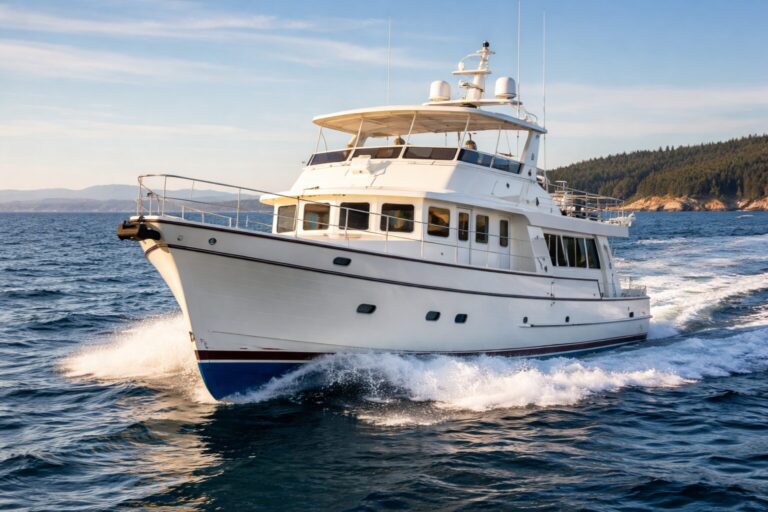
A trawler’s keel profile helps a buyer ask informed questions about running-gear protection, draft, tracking and low-speed handling. It does not, by itself, predict how every boat will behave or whether it can tolerate a grounding. A deeper keel also does not establish a more stable or seaworthy vessel.
Underwater geometry is always an exercise in naval architecture trade-offs. Examining the profile, deadwood, and running-gear placement gives you realistic expectations before committing to an offer or leaving the dock.
Physical Protection vs. Grounding Realities
A keel and skeg can provide a protective boundary around running gear, depending on their actual geometry. Inspect the profile and component positions on the exact configuration rather than assuming every single-engine trawler has the same arrangement.
If the keel extends below the running gear, it may be the first point of contact with a level bottom. Shape of the obstruction, direction of contact and structural loads still matter. In the single-engine North Pacific 49 equipment arrangement, keel and skeg protect the propeller, shaft and rudder; that is not immunity from impact damage.
- Locate the keel’s lowest point.
- Compare it with propeller, shaft and rudder positions.
- Check what lies exposed from the side or astern.
- Ask how the actual structure and rudder support are arranged.
Physical geometry should not be confused with impact immunity:
- Fouling: Protected geometry does not guarantee that lines, nets or debris cannot reach the propeller or rudder. Treat fouling as an operating risk rather than a feature the keel eliminates.
Understanding this balance helps you evaluate a boat during a haul-out. Look at the profile to see whether the running gear is fully recessed above the keel baseline, but treat that design as mechanical shielding rather than an excuse to ignore the depth sounder.
Separating Tracking and Draft from Vessel Stability
A deep keel helps a boat hold its line, but keel depth alone does not dictate stability or motion comfort. Confusing hydrodynamic tracking with static or dynamic stability is one of the most common mistakes prospective buyers make.
Underwater lateral area influences resistance to sideways movement and turning. Keel shape is one contributor alongside hull form, rudder, propulsion and loading. Confirm the tracking and maneuvering behavior on a representative trial rather than inferring it from depth alone.
The trade-off comes in hydrodynamic drag and waterway access. Deeper drafts restrict passage through shallower areas like the Intracoastal Waterway, the Bahamas, and secondary canals. More wetted surface area also demands more power to push through the water at displacement speeds.
| Inspection subject | What it can help you assess | What it cannot establish alone |
|---|---|---|
| Keel/skeg and gear positions | Protective geometry | Impact tolerance or freedom from fouling |
| Draft | Clearance and waterway access | Stability or comfortable motion |
| Underwater profile | Questions about tracking and turning | Exact handling of the loaded boat |
Assess Stability Separately From Keel Depth
Hull form, weight distribution and loading together affect stability and motion. Keel depth alone cannot establish either. When assessing bluewater readiness, ask the surveyor or naval architect what design and loading information is needed for the exact boat and intended use, rather than treating a deeper draft as proof.
Maneuvering Dynamics and Hull Inspection Checkpoints
Keel shape directly influences how a trawler handles around the docks and where stresses reveal themselves in boatyards.
At the Helm: Low-Speed Behavior
Observe low-speed response with the operator and survey team. Note turning behavior, stopping, response when backing and how wind or current affects the loaded boat. During a trawler sea trial, ask the operator to demonstrate maneuvers appropriate to the boat and available water. Avoid abrupt gear changes or experimental handling as a buyer test.
In the Slings: Structural Checkpoints
When the vessel is out of the water, use the opportunity to inspect structural condition and past load history:
- Damage and repair history: Ask the surveyor to assess fairing changes, cracks, corrosion and repairs in the keel/skeg area.
- Rudder support: Confirm the design, condition and appropriate inspection of supports and bearings.
- Running-gear clearance: Have the survey team evaluate propeller, shaft and rudder relationships using the installation’s requirements.
Record observations and unresolved questions; do not treat a visible mark or hand movement as a structural diagnosis.
Evaluating Specific Hull and Running Gear Layouts
Because keel profiles vary significantly across different model lines, buyers should always evaluate the exact lines drawings and propulsion layouts of their target vessels.
On our 49 Pilothouse, the single-engine configuration has keel/skeg protection for the propeller, shaft and rudder. Use that bounded example to compare the actual underwater profile and propulsion arrangement of the boat you are considering.
Weight management within that profile directly influences cruising behavior and displacement waterline:
- Our 49 Pilothouse has a standard fuel capacity of 700 gallons, with 920 gallons optional. Use the North Pacific 49 specifications to compare the selected configuration.
- Carrying full fuel, full water, and liveaboard stores depresses the waterline, changing how deeply the deadwood bites and subtly shifting both the center of buoyancy and the roll response.
- Published range curves for this hull form are measured in calm water configurations with a 10% reserve margin. In real-world seas, the keel’s wetted surface area and lateral resistance against waves will affect overall efficiency.
Before buying, ask us or the broker for the underwater profile drawing. Check the draft at both dry weight and full displacement, confirm whether the lowest structural point is fiberglass deadwood or a replaceable metallic shoe, and verify how the rudder is supported at its base.
Aligning Geometry with Your Cruising Plans
Keel design involves tradeoffs among protective geometry, draft and handling. The useful buying test combines drawings, a condition survey and a sea trial of the configuration you intend to own. Keep stability and operating limits as separate questions requiring the appropriate design evidence.
When you are ready to evaluate hull lines, interior machinery spaces, and deck layouts for your intended route, talk with us to review how different hull profiles match your cruising style.