

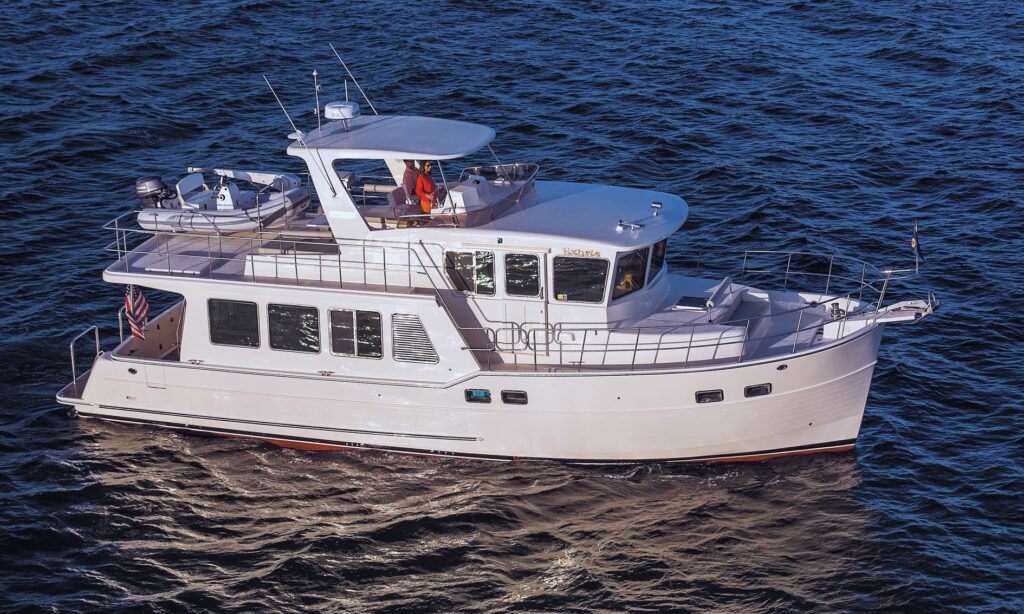
Air draft connects two measurements: the height of the yacht above the water and the opening available beneath a bridge or roof. A useful planning record describes both clearly, including their configuration, water-level reference and date.
The published height is a starting point. Installed antennas, lights and other equipment can change the highest point, while loading changes where the yacht sits in the water.
Establishing Your Overhead Height Above the Waterline
Identify the actual highest installed point in the yacht’s intended cruising configuration. Include the hardtop, arch, antennas, lights, radar and any later additions. Keep the equipment list with the height record so that a change is easy to recognize.
Arrange a suitable measurement method with the builder, yard or qualified professional. Reaching high equipment or standing on a gunwale creates a separate risk; the measurement should not require an improvised climb.
Record the waterline and loading condition along with the measurement. Full and lightly loaded boats can sit differently, but do not estimate the change from tank capacity alone. Underwater draft is a separate dimension, discussed in trawler draft explained: why a deeper draft can mean a better yacht.
Folding Arches, Hinged Masts, and Secondary Equipment
A folding arch does not establish a reduced height until the whole installed profile is considered. Some equipment may move with it; other fittings may remain higher. What can be lowered, and how it is secured, depends on the documented installation.
Follow the installed assembly’s instructions and ask for a demonstration. Confirm clearance for cables, lights and other equipment without assuming that every antenna or mount has the same operating method.
Keep distinct records for normal and documented reduced configurations:
| Yacht configuration | What to record |
|---|---|
| Normal cruising profile | Loading condition, equipment positions, highest point, measured height and date |
| Documented reduced profile | Arch and equipment positions, highest remaining point, measured height and date |
Measure the complete profile rather than subtracting an assumed arch dimension. Revisit the record after equipment changes.
Interpreting Bridge Clearance Datums and Water-Level Variations
Read the vertical reference stated for the particular bridge. NOAA Coast Pilot bridge information includes clearance tables with reference notes; a datum used in one area should not be assumed for another.
Keep charted clearance, predicted water level and current observations separate. They may use different references or describe different times and locations. Tide predictions also cannot represent every effect of weather or river conditions.
Current navigation notices, the bridge authority and local observations can help resolve uncertainty. Clearance boards, where present, add information but need to be read for the correct location and opening. They do not automatically override official restrictions or establish a safe transit.
For a movable bridge, confirm its operating requirements and current availability as part of the plan. Resolve unknowns before reaching a constrained approach.
Evaluating the Approach and Structural Limits of Covered Slips
Ask the marina to identify the lowest obstruction along the entire intended path, including entry beams, braces, lights and other fittings. The roof height alone may not describe the limiting point.
Establish how the structure relates to water-level changes. A fixed roof and a floating roof can behave differently, and the specific marina arrangement determines what changes with tide, river stage or loading.
Record the slip identity, obstruction location, measured clearance, water reference and date. A photograph can help explain the path, but cannot replace a current dimension.
Building a Verified Clearance Record: NP49 Case Evaluation
For example, our 49 Pilothouse has an air draft of 17 feet 4 inches to the top of the hardtop, or 15 feet with the optional folding radar arch. These figures appear in the 49 Pilothouse specifications. They describe the stated configurations, not an invented allowance for later equipment on any particular boat.
Use the dimensions to begin a discussion about the exact yacht. Then keep a clearance record containing:
- The measured yacht height and its complete configuration.
- The loading condition and measurement date.
- The bridge or slip’s limiting obstruction and stated reference.
- Current water-level information and its source.
- Operating restrictions or opening arrangements.
- Any unresolved information and who can confirm it.
A complete record makes uncertainty visible; it does not supply a universal clearance margin. If air draft is central to your route or berth choice, talk with us about the documented configuration and the information needed for your exact yacht.