

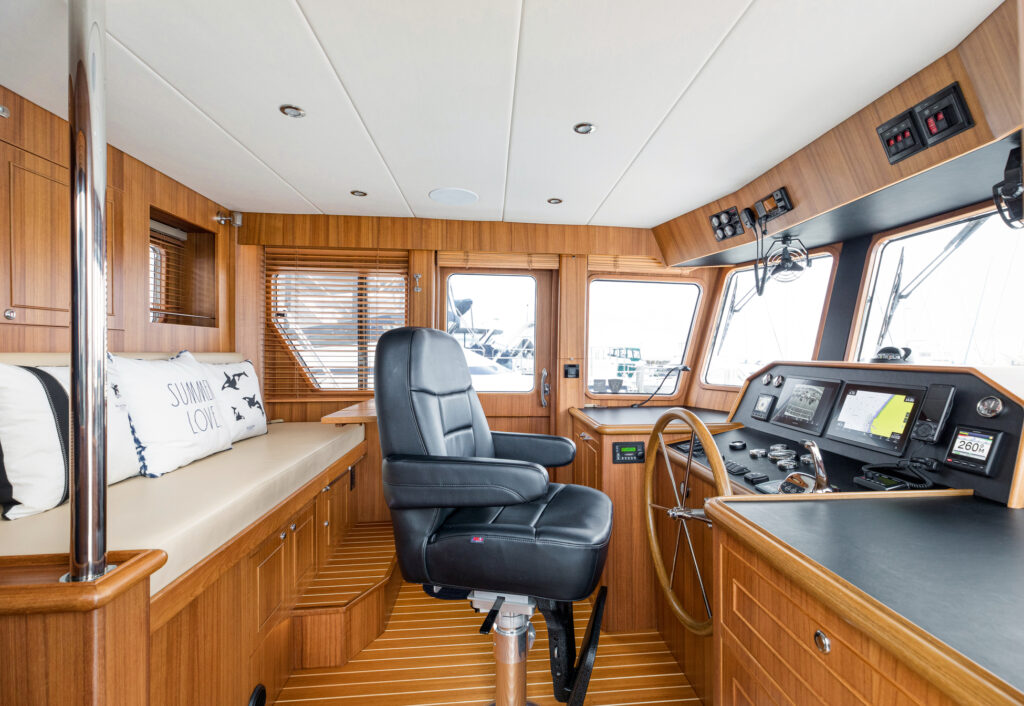
Calm docking begins with understanding the exact yacht, the berth and the conditions. A single-screw boat’s response depends on its installed propulsion, rudder, hull and equipment; memorizing one maneuver does not establish how it will behave.
Preparation is useful because it makes the unknowns visible before close quarters. Hands-on instruction remains the place to learn and practice the operating response.
Learn the Yacht’s Handling Characteristics Before Entering Close Quarters
Work with a qualified instructor familiar with the yacht. Ask to explore its stopping response, astern behavior, directional control and fitted thrusters under suitable practice conditions.
Propeller rotation and the underwater arrangement can influence transverse response, but do not assume a direction or strength of prop walk from the single-screw label alone. Thruster operating limits likewise depend on the installed equipment, power supply and manufacturer guidance.
Keep a record of what you observe and the instructions that apply to the exact boat. Familiarity should include the limits of the equipment as well as what it can do.
Read the Berth, Current, and Local Space
Before approaching, establish the slip assignment, available space, obstructions, traffic and local assistance. Review wind and current as separate influences; neither is universally dominant.
Under USCG navigation rules, Rule 6 includes maneuverability and prevailing wind, sea and current among the factors relevant to safe speed. It does not prescribe a docking speed or angle. Select the approach with the instructor or qualified operator for the actual situation.
Confirm communications with anyone assisting ashore. Make the intended tasks clear without assuming that an unfamiliar dockhand knows the yacht or the crew’s plan.
Prepare Crew Roles, Deck Hardware, and Line Safety
Discuss roles, lines and fenders before the approach, using the arrangement appropriate to the berth and boat. Preparation should reduce hurried deck movement, not force the crew into exposed positions.
| Preparation question | What to agree |
|---|---|
| Crew positions | Safe access and each person’s task |
| Lines and fenders | Arrangement for the actual berth and conditions |
| Communication | Clear calls, signals and how to raise uncertainty |
| Assistance | Who is helping and what they have agreed to do |
| Reset | The safe alternative if the approach no longer fits the plan |
Keep hands and feet out of the space between yacht and dock, and stay clear of loaded-line bights and pinch points. Do not attempt to stop the yacht with physical force or jump ashore with a line.
Our guide boarding safety in rain, swell, and floating docks: a practical routine for cruising couples develops the separate access assessment after the boat is secured.
Keep a Safe Reset Strategy Available
Discuss a feasible reset or alternative before committing to a constrained approach. Conditions, traffic or equipment behavior may change the plan, and recognizing that early is part of competent operation.
The safe response depends on what is around the vessel and how it is moving. Backing out, anchoring or waiting in place cannot be prescribed universally. Learn the options with an instructor for your normal marina and agree when to defer or request assistance.
There is no single wind threshold that establishes readiness. Consider the crew’s demonstrated ability, boat, equipment, berth geometry and current conditions together.
Review Docking Ergonomics in a Physical Walkthrough
On a safely secured yacht, test sightlines and reach from the operating positions you expect to use. Identify blind spots, access routes and where each crew member can communicate without interfering with the operator.
Our guide wing stations, aft controls, and docking visibility on pilothouse yachts examines the distinct control-layout question. Our guide pilothouse layout and solo docking: evaluating operator workload develops how movement and competing tasks affect a single operator.
For example, our 49 Pilothouse is a yacht you can explore through those questions. A dockside walkthrough provides useful layout evidence, while instruction and an appropriate trial establish the operating behavior.
If you want to review sightlines and handling arrangements, talk with us about your home berth, experience and intended cruising routine.