

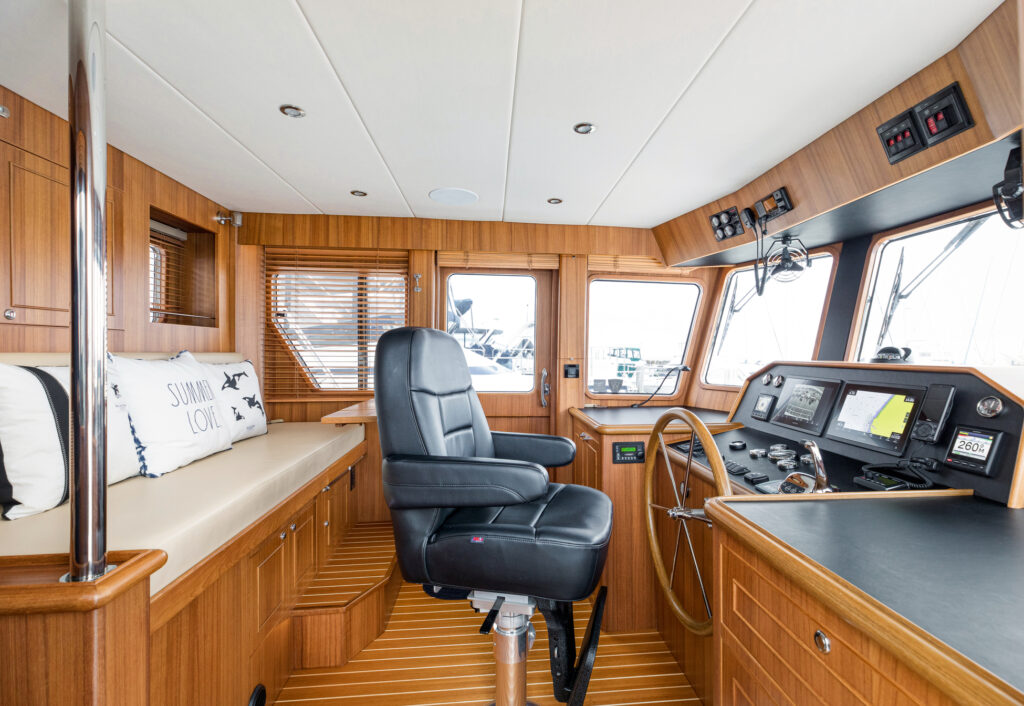
Large windows and a comfortable helm do not settle every visibility question. Rain and spray affect the outside glass, residue can remain after the water dries, and condensation can form inside. These are different problems to identify before judging the equipment meant to address them.
The useful inspection starts with the view the operator needs and ends with the actual installation, controls, and maintenance instructions.
Identify which side of the glass is affected
Exterior wipers address moisture on the outside. A washing system can help clear residue, while inside condensation needs attention to the conditions at the interior glass. One component cannot be assumed to solve every obstruction.
Look at the glass from the seated and standing positions you use. Note where residue, fogging, or streaking interrupts the relevant view. Our guide to night-running glare and reflections develop the additional light-control question; this article focuses on glass clarity.
Evaluate the swept area from the helm
As Imtra explains, marine wiper system selection depends on window dimensions, the area to clear, operating conditions, and available motor mounting. Compare the installed sweep with the actual operator positions rather than assuming a large blade clears every needed reference.
Ask staff or a technician to demonstrate permitted functions according to the equipment instructions. Notice the parked position, remaining unswept areas, and whether blades or arms approach a frame. Arm length, blade choice, and motor capacity are an installation decision to verify with the supplier.
Our guide to headroom and visibility provides the eye-position baseline. A clear patch of glass is useful only when it corresponds to the view you need.
Trace the washer supply and service access
Imtra offers washing-system components for pressurized water supplies or a separate remote reservoir. That establishes alternatives, rather than the plumbing fitted to a particular yacht.
On the actual boat, ask where the fluid comes from, how its level or supply is checked, what fluid is approved, and how the system is serviced or prepared for cold weather. Review nozzle delivery, controls, and access without assuming a universal valve or pump arrangement.
Keep component cleaning and fault diagnosis within the manual or a technician’s instructions. A failed washer deserves an appropriate response; an improvised substitute is not proof that the intended visibility system remains adequate.
Review inside-glass condensation control
Warm moist air against cooler glass can produce condensation. Ask how the selected boat manages heating, airflow, ventilation, and moisture near the windshield, and how the installed arrangement is controlled.
A feature label alone does not show effective clearance at every pane. A pleasant showing may not reproduce the temperatures and humidity you expect while cruising. Record what requires a more representative demonstration and avoid assuming every North Pacific model has a particular demister installation.
Make a practical equipment record
| Problem observed | Installation to examine | Follow-up question |
|---|---|---|
| Rain or spray on outside glass | Wiper sweep, blades and controls | Does the cleared area serve the actual helm positions? |
| Residue or smearing outside | Washer supply and delivery | What maintenance and fluid instructions apply? |
| Condensation inside | Actual airflow, heat and moisture control | How is the relevant glass kept usable? |
| Difficult servicing | Component access and documentation | Which parts and professional support are needed? |
Our guide to a boat-show walkthrough can identify access and controls, but may leave operating questions unresolved. Review the equipment before a passage and seek appropriate help for defects. If visibility becomes inadequate underway, the response must account for position, hazards, conditions, and vessel control; this checklist is not a maneuver procedure.
When you talk with us, bring the actual configuration and the clarity problem you want to understand.