

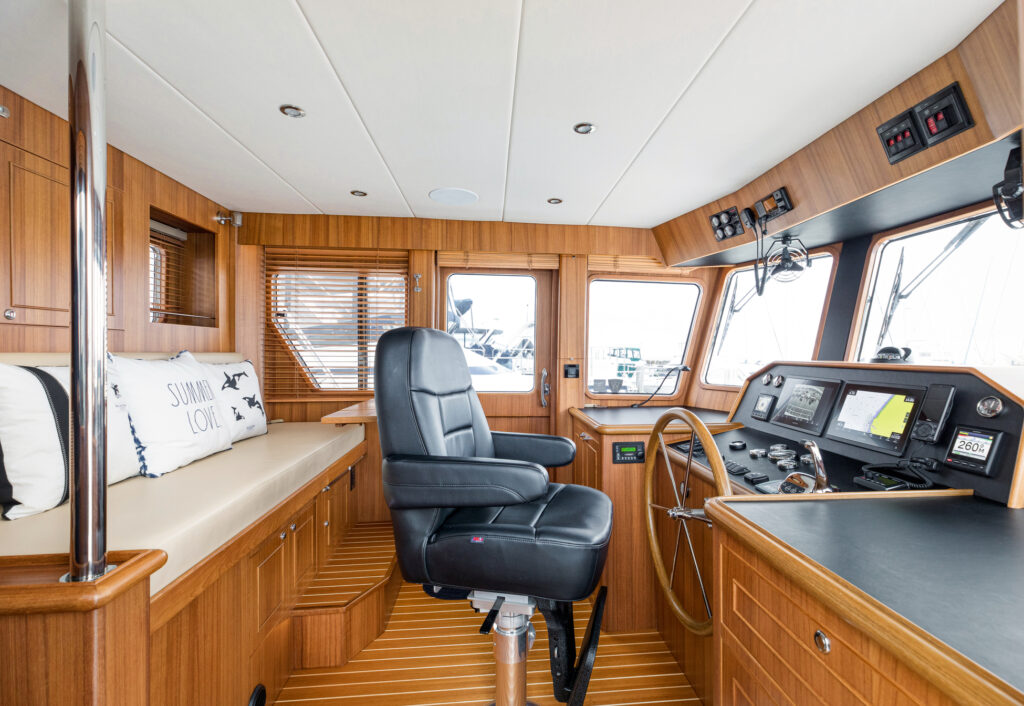
Boat shows reward quick impressions. A focused half hour can help you decide which yacht deserves a quieter return visit, provided you leave with specific observations. It cannot establish condition, running performance, or suitability by itself.
Use this time plan as an example and adapt it to boarding queues, staff availability, and permitted access.
| Time aboard | Focus | Useful result |
|---|---|---|
| First seven minutes | Helm | Notes on position, reach, view and nearby movement |
| Next seven minutes | Main deck | An occupied circulation or storage question |
| Next six minutes | Accommodations | A berth, head or gear-space observation |
| Next six minutes | Deck and permitted access | A transition or service-access question |
| Final four minutes | Follow-up notes | A reason to return and an unresolved question |
Before boarding, set two priorities
Confirm the model and displayed configuration with the representative. A show boat may carry options or an arrangement different from the one you studied. Choose one helm question and one daily-living question before joining the line.
Ask permission before adjusting seats, opening lockers or doors, lifting hatches, moving cushions, trying berths, or taking interior photographs. Staff can tell you what is appropriate on that boat and assist with access.
Begin at the helm
Sit in the operator’s position if permitted. With controls inactive, assess how the wheel and primary controls meet your hands, where your feet rest, and what changes when you stand. Each regular operator should have a turn when show traffic permits.
Look forward, toward the quarters, and through the side windows. Record the specific frame, display, or fitting that interrupts a view. Keep running visibility as a follow-up question: trim, weather, motion, and equipment performance require a different setting. Our headroom and visibility guide develops those measurements in greater depth.
Notice how someone reaches a companion seat or passes behind the helm. A permitted photo of the exact clearance question will often be more useful later than another photograph of the whole console.
Follow the main-deck traffic path
Walk from the helm toward the galley, seating, and aft entry at a normal pace. Observe how another person’s position changes the passage. With permission, open one frequently used drawer or locker and note whether its movement interrupts the route.
Sit briefly in the salon if allowed. Imagine where bags, jackets, or a grocery tote would go. Show crowds can reveal congestion, but they do not reproduce a normal cruise; record a question rather than a verdict.
Try accommodations as usable rooms
Look at berth access, standing room to change, and a place for a guest bag. Follow the path to the head and back. If staff permit, try the door and check the space to turn without moving equipment or disturbing personal items.
Notice stair landings, headers, and hand placement in both directions. Privacy and sound can be difficult to assess amid show noise. Save those for a quieter appointment and guest cabin and privacy planning.
Finish with deck transitions and permitted service access
Follow the exterior route staff permit while the boat remains secured. Note steps, fittings, door movement, and where a rail meets your hand. Visit an upper deck only if access is allowed and appropriate.
Ask staff to open one service hatch or access enclosure if available. Look at the opening, where a person would stand, and what furniture or stored gear might interfere. Leave systems, panels, valves, and switches alone.
For a specific example, our 49 Pilothouse equipment includes removable headliners, wiring chases and access panels, with engine-room access through gas-assisted salon-floor hatches. Their location is useful to review on that model; it does not establish the same installation on every yacht.
Write four notes before moving on
- The strongest reason to return.
- A helm detail to recheck without a crowd.
- One living-space or deck conflict.
- A question requiring a technical answer, sea trial, or professional survey.
Use physical descriptions rather than a general rating. Apply the same note headings to the other boats you visit. An appropriate sea trial can address running questions, while a qualified surveyor assesses condition within the agreed survey scope; neither is a guarantee that every question will be settled.
Our guide to a stationary pilothouse walkthrough gives you a more deliberate next visit. When you talk with us, bring the displayed model, configuration, and the observations that made you want to return.