

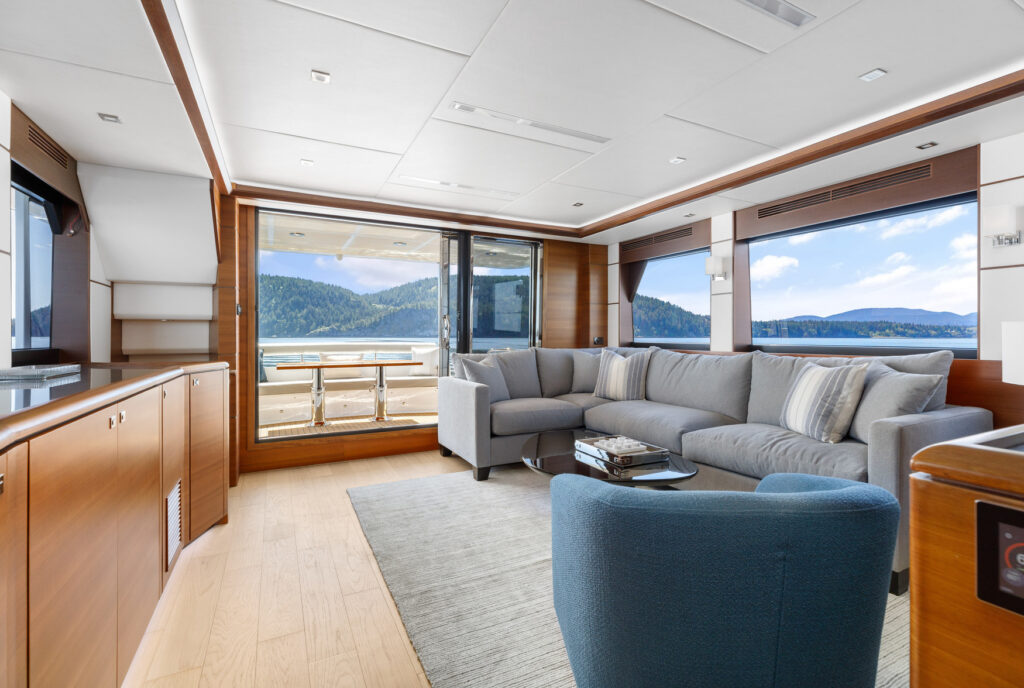
A berth count tells you how many sleeping places a plan contains. It does not show how comfortably guests can unpack, dress, reach a head, or share a morning with the owners. Those occupied routines deserve attention before choosing an accommodation arrangement.
Start with the visits you actually expect, then consider how the boat returns to ordinary owner use after the visitors leave.
Match the cabin to real visits
Another couple staying a week may value different things from grandchildren joining for a weekend. Ask about visit frequency, duration, sleeping arrangements, mobility, and belongings. Avoid designing around an assumed guest schedule.
If a cabin also serves as storage or an office, walk through the conversion. Where does owner gear go when guests arrive? How much rearranging is acceptable? A flexible room is useful when both functions work without blocking equipment access or displacing daily essentials.
Our guide to pantry, freezer, and laundry planning helps assess the household consequences of extra people. Give their food, towels, bedding, and used clothing homes along with their berth.
Trace the berth-to-head path
Follow the path from each sleeping place to the available head. Note door swings, shared entrances, sightlines from public areas, and where someone waits while the room is occupied. Repeat the thought exercise for an early riser and someone sleeping late.
An ensuite entrance can reduce public passage, while a shared head may serve a crew well if its access and privacy routine are understood. Neither a fixture count nor a label guarantees privacy. If there are multiple entrances, ask how locks and occupancy are managed on the actual boat.
Listen during a quieter visit for ordinary door, pump, and footstep sounds. Ask about the actual ventilation and partitions. Do not infer acoustic isolation or construction details from the plan alone.
Give guests room for their belongings
Identify a place for a bag, clothing, shoes, chargers, and towels. Check whether a guest can open the locker and change clothes without standing in the passage. Discuss suitable baggage before a visit when storage is limited.
Damp gear also needs a workable drying arrangement. Review the available ventilation and space without assuming that a hook or an enclosed locker solves every moisture problem. Our guide to storage and payload planning places guest belongings within the complete load aboard.
Compare configuration consequences
For example, our 49 Pilothouse interior offers two- or three-stateroom layouts, or two staterooms with an office. Most arrangements have stateroom and head access from the salon; selected full-beam midship master designs have access from the pilothouse. Trace the chosen plan rather than assuming the same privacy boundary across all layouts.
For example, our 590 Pilothouse interior has a day head forward on the starboard side of the salon. Its guest-room arrangement depends on the selected master-stateroom layout. The forward VIP room has a private entrance to the shared guest head and shower. Review all entrances on the actual plan to understand how occupants will share that room.
The 590 lazarette can also be configured for accommodation, with an optional head and separate shower, or for storage and utility uses. That is a choice about space and routines; it does not establish complete sound isolation or identical privacy in every build.
Rehearse an occupied morning
| Person or task | Route to follow | Detail to observe |
|---|---|---|
| Owner rising early | Berth to head and galley | Doors and light near sleeping guests |
| Guest using the head | Guest berth to available head | Shared entrance, privacy and waiting space |
| Guest dressing | Berth, locker and changing area | Open-door clearance and bag placement |
| Household cleanup | Towels, laundry and supplies | Drying and storage without blocked passage |
Imagine these tasks occurring together, then repeat the relevant paths during a permitted stationary visit. A show crowd can obscure privacy and sound, so keep unresolved questions for a quieter appointment.
After guests leave, does the arrangement return to a comfortable boat for the owners? Bring both the hosting routine and the ordinary week aboard when you talk with us about accommodation choices.