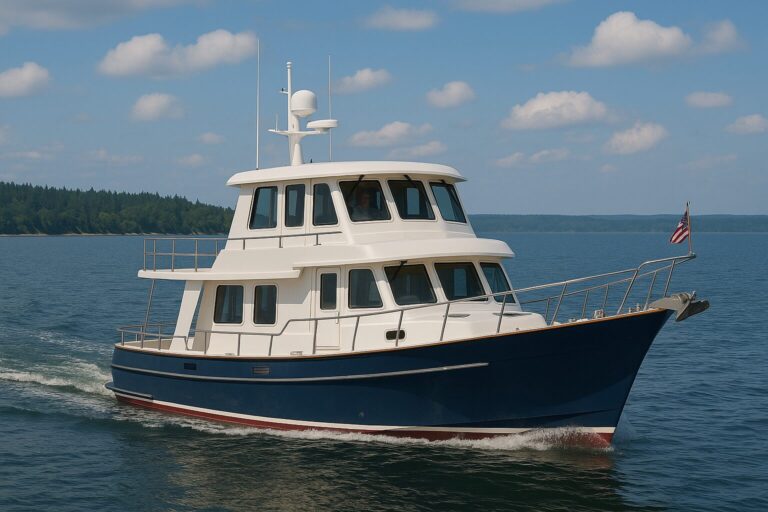
Choosing between a dedicated pilothouse and a sedan layout comes down to how you spend your days underway and where your crew gathers when the anchor drops. If your cruising grounds feature chilly morning fog, driving rain, or intense midday heat, an enclosed helm station protects you from the elements without forcing you onto an exposed bridge. However, the space allocated to an elevated wheelhouse reshapes the entire interior footprint of the boat.
To find out whether this layout matches your cruising style, you do not need to run an offshore trial. A securely docked walkthrough helps you identify layout questions; running visibility and other operating characteristics may need an appropriate sea trial.
By conducting a stationary walkthrough—testing sightlines, walking the pathways, and imagining daily life aboard—you can determine whether a pilothouse serves your routine or whether an alternate arrangement better matches your time on the water.
Step 1: Gauge Your Cruising Climate and Operating Hours
Before stepping aboard, consider how you actually cruise. An owner running two hundred hours a year along the protected waterways of the Intracoastal Waterway in fair weather has very different operational requirements than an owner cruising the Pacific Northwest up to Alaska over several months.
Ask yourself these baseline questions:
- How many hours do you run in a typical day? On a four-hour hop between marinas, stepping up to a separate helm is a minor detail. On a ten-hour run through unpredictable weather, having an enclosed, climate-controlled station with an adjacent settee alters your entire underway routine.
- Where will you spend the majority of your time? Consider your own balance of time underway and at rest, and whether you prefer an expansive shared living area for entertaining at rest, or if you value having separate zones dedicated to running the boat versus relaxing.
- Who is at the helm? If you cruise as a couple, isolation can feel like work. If one partner enjoys running the vessel while the other reads, cooks, or rests, the physical distance between the galley, the salon, and the helm becomes a central consideration.
Step 2: Test Sightlines and Movement While Secure in the Slip
Board the yacht, shut the engines off, and spend twenty minutes directly at the helm. Take your time assessing how your body interacts with the space in both working and resting postures.
Seated Versus Standing Visibility
Climb into the captain’s chair. Adjust the seat to your typical operating position and look forward, laterally, and down toward the bow.
- Can you see the water directly ahead, or does the foredeck obscure close-in floating debris?
- Now stand up. Does your line of sight clear the window mullions comfortably, or do you have to duck your head to see the horizon?
- Turn around and look aft. In some pilothouse designs, looking aft means staring into a bulkhead; in others, you can see straight through the salon windows to the stern. Note where your natural blind spots fall.
Deck Access and Lateral Movement
Step out from behind the wheel as if you need to step onto the deck immediately.
- Is there a weather-tight door directly beside the helm? Having an immediate exit to the side deck simplifies line handling and observation.
- Step outside through that door. Can you reach the side deck in three strides without negotiating awkward corners or steps?
- Notice how your voice carries from the helm to the side deck or foredeck. Effective crew communication relies on clear physical and verbal access between the person at the controls and the person handling lines or anchoring gear.
Step 3: Evaluate Shared Living, Light, and Privacy
A common misconception is that every pilothouse is an isolated acoustic and visual capsule. In reality, a pilothouse is not automatically sound- or light-isolated; the physical layout, joinery, and door selections dictate how well separated the helm actually is from the rest of the living space.
Light Bleed During Night Passages
Step into the wheelhouse and pull down the shades or imagine running in full darkness.
- If someone in the galley turns on an overhead task light or watches television in the salon, does that illumination reflect directly off the forward helm windows?
- Some layouts position the helm high enough, or tuck it behind partial bulkheads, to shield the operator’s night vision. Others leave a direct line of sight between the salon lighting and the forward glass, making light control a question to discuss for the specific boat.
Daytime Social Dynamics
Watchstanding can be lonely if the helm is entirely cut off from the galley and salon. Conversely, it can be distracting if social activities spill directly into the navigation area.
Take a seat on the pilothouse settee. Can an off-watch companion sit comfortably with a laptop, share a meal, or monitor navigation without crowding the helm chair? In an effective pilothouse arrangement, the watchstander and the off-watch partner can spend hours together in the same room without interfering with the vessel’s operation.
Step 4: Compare Practical Layout Variations
Because deck geometry dictates interior space, comparing specific configurations helps highlight functional trade-offs. At North Pacific Yachts, we construct several distinct approaches to the relationship between the helm, galley, and living quarters. Examining these variations helps clarify which balance of space serves your routine best.
| Model / Configuration | Helm Characteristics | Living Area & Galley Flow | Accommodations Access |
|---|---|---|---|
| 44 Sedan | Slightly raised helm separated by cabinetry; dedicated side door beside helm | Galley located near the salon on the main level | Ask to trace the route to the selected cabins |
| 49 Pilothouse | Fully dedicated pilothouse with L-shaped settee, table, and two opening side doors | Galley in the salon, keeping food preparation near the shared living area | Most accommodations accessed directly from the salon |
| 49 Euro Pilothouse | Two opening doors and an L-shaped settee with table | Aft door slides in either direction, connecting galley directly to cockpit | Lower deck options for 2–3 staterooms or dedicated office |
The Sedan Approach: Integrated Main-Deck Living
A traditional sedan configuration is often assumed to be entirely flat and open, but smart design introduces subtle functional zones.
On our 44 Sedan, the helm is slightly raised and separated by cabinetry rather than an enclosed wall. A dedicated door sits right beside the helm for quick side-deck access, while the galley sits near the salon. This arrangement keeps the captain close to the conversation and the galley without sacrificing the defined workspace needed to manage the boat. For cruisers who prefer a single, unified gathering area and fewer level changes between living spaces, this configuration maintains social connection throughout the day.
The Dedicated Pilothouse: Distinct Operational Zones
Stepping up to a larger footprint allows the wheelhouse to become a dedicated compartment.
Our 49 Pilothouse features a complete pilothouse fitted with an L-shaped settee, a dining table, and two opening side doors that provide cross-ventilation and immediate access to both port and starboard side decks. Unlike designs where stateroom stairs run directly out of the wheelhouse—creating foot traffic past the helm—most accommodations aboard the 49 are accessed directly from the salon. Ask how the selected arrangement affects traffic around the operating station.
For owners desiring a more contemporary line, the 49 Euro Pilothouse reconfigures movement on the main deck. Its aft door slides in either direction to connect the aft galley directly to the cockpit. This setup links outdoor entertaining with food prep, while retaining the dedicated wheelhouse above. Below deck, owners can configure the interior with two or three staterooms, or consider a two-stateroom layout with an office.
Deck Walkarounds and Upper Deck Options
Interior and exterior arrangements deserve a separate comparison on the exact boat. Our 44 Sedan offers either full walkaround decks or a wide-body salon with a walkaround on one side. Our 590 Pilothouse offers pilothouse and flybridge or skylounge configurations, with two-, three- and four-stateroom designs. These are configuration choices to examine against your routes around the boat and how you use shared space; they are not universal advantages of a pilothouse.
Step 5: Questions to Ask Before Making Your Decision
As you finish your dockside walkthrough, step back into the salon, sit down, and run through this final operational checklist:
- Where will guests sit while we are underway? If they are with you in the pilothouse, does the seating allow them to see out comfortably? If they prefer the salon, are you comfortable running the boat separated from them?
- How does traffic move through the boat? Follow the path from the master berth to the coffee maker, and from the galley to the cockpit table. Notice whether those paths cross the helm.
- What is your access to the dock during line handling? Where are the routes between the helm and deck, and how would the crew divide line-handling duties while someone remains in control of the boat?
- How do you spend your evenings at anchor? Do you prefer having multiple separate seating areas—a salon, a pilothouse settee, and an aft cockpit—so guests can find personal space, or do you prefer one large living room where everyone stays together?
A pilothouse is neither inherently superior nor inferior to a sedan; it is a specialized tool built for specific cruising styles. A good match can make daily routines more comfortable, while operating workload still depends on the boat, conditions and crew.
If you are weighing layout choices and want to walk through these sightlines, deck options, and interior arrangements on a specific boat, talk with us about your cruising plans. We can help you examine our current configurations and find the platform that best fits your time on the water.
Sources
- 49 Pilothouse interior
- 44 Sedan interior
- 49 Euro Pilothouse interior
- 590 Pilothouse overview
- 49 Euro Pilothouse
- 44 Sedan