

You do not need rolling seas to identify a reach gap or awkward transition. A securely docked walkthrough lets you inspect the route between the cockpit, side deck, pilothouse, and relevant stairs before deciding what deserves further review.
A passage that looks generous in a photograph may feel different when a fitting, open door, or carried bag occupies part of it. Evaluate movement with your actual crew rather than counting rails or relying on one width measurement.
Follow a complete route in both directions
Choose an ordinary route, such as cockpit to side deck and back. Identify where each foot lands, where you turn, and where a hand can find intended support before a transition. Notice places to pause without standing in a doorway or blocking another person.
Reverse direction. Descending a stair, returning through a threshold, or turning toward the cockpit can expose a question that was less obvious going forward. Do the assessment with the boat secured; it is not an invitation to test marginal footing in wet or moving conditions.
Look at usable passage
Examine clearance at foot, body, and overhead levels. Cleats, fills, rail bases, cabin sides, brackets, and door movement may affect different parts of the route. Record the obstruction and its position rather than inferring a safe passage from nominal width.
A hinged, sliding, or pantograph door behaves differently. Try the actual door with permission and see how its movement and latch relate to the passage. A door type alone does not guarantee clear access.
Our comparison of wide-body salons and full walkarounds addresses where main-deck width is allocated. Once that choice is understood, examine the quality of the available route here.
Give stairs and thresholds their own attention
Look at tread depth, riser consistency, the landing, and the turn at each end. Try only the normal permitted route and follow guidance for the particular stair or ladder. Do not infer an appropriate direction of descent from appearance alone.
At a threshold, notice both the sill and header. Where does the next intended handhold fall as you cross? Can you operate the door without losing a useful place to pause? These observations are more useful than applying a universal dimension to every crew member.
Check support for the people aboard
Each regular crew member should try the route. Reach height, mobility, footwear, gloves, and bulky clothing can change how a handhold feels. Keep the initial assessment manageable and avoid carrying a load that makes the test awkward.
Notice where an unfamiliar visitor naturally reaches. A window frame or loose fitting may look like a handhold without being intended for support. Ask which grab points are designed for the task and record gaps for discussion.
Examine a current route without inventing its geometry
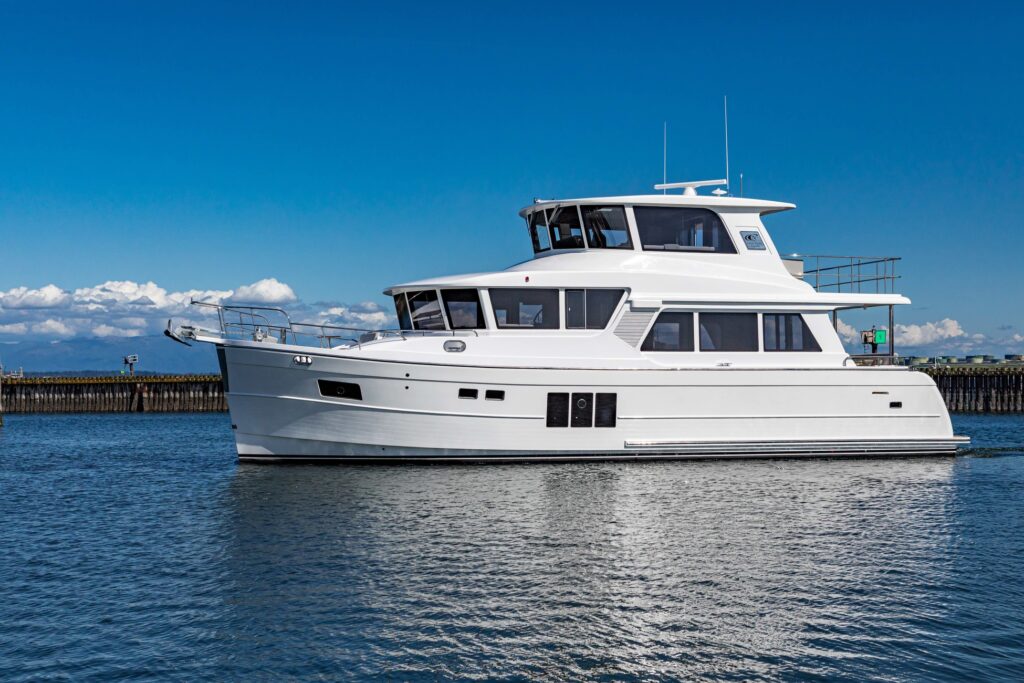
For example, our 590 Pilothouse exterior has a standard starboard walkaround, with full walkaround available. The passage can be reached from the cockpit or starboard pilothouse door and leads to the Portuguese bridge and foredeck. A sliding stainless steel and glass hatch provides access to the flybridge stairway toward the cockpit, and transom doors are positioned on each side of the cockpit seating.
Those features identify routes to examine on the selected boat. They do not establish flush soles, continuous rails, gate dimensions, or a particular stair geometry. Trace and measure the actual arrangement.
| Transition | Observation to record | Question to discuss |
|---|---|---|
| Cockpit to side deck | Fittings, foot room and door movement | Where can someone pause? |
| Side deck to pilothouse | Threshold, header and intended support | How does the actual door operate? |
| Stair and landing | Tread, turn and reach | Which route and support should the crew use? |
| Return direction | Changed hand placement or clearance | What was less obvious going forward? |
Control location is a separate question developed in wing stations and aft controls. Our guide to solo docking workload also deserves its own assessment; a convenient walkway does not authorize leaving an active helm unattended.
Bring your observations when you talk with us about deck arrangements and the way your crew moves aboard.