

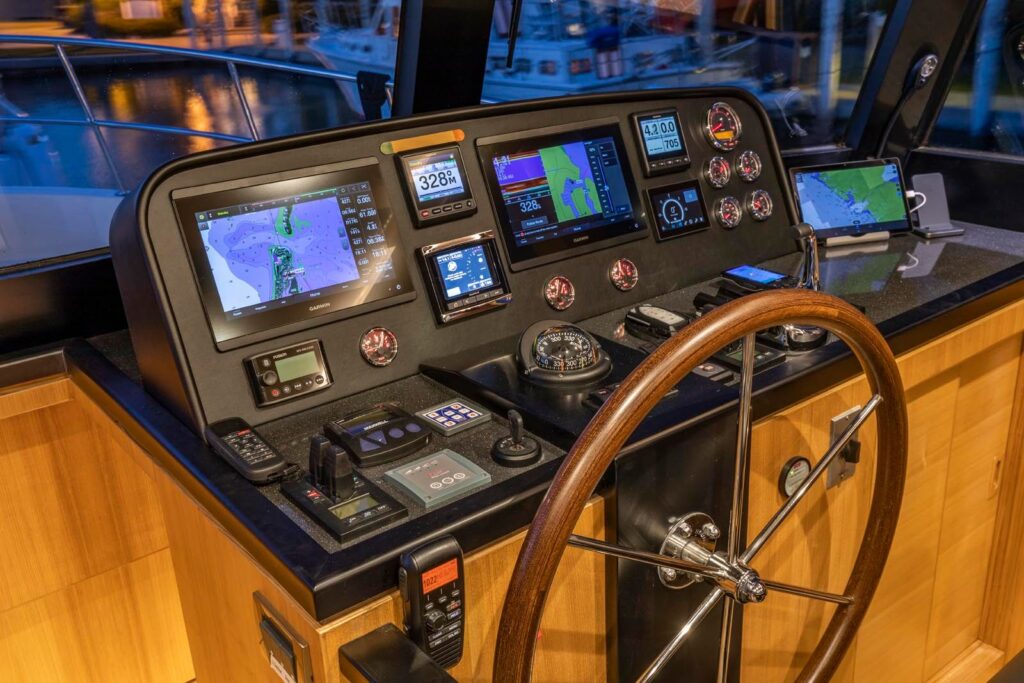
Docking confidence on a pilothouse yacht comes from more than hull design and operator experience. It also comes from being able to see the right parts of the boat at the right time and having controls positioned where those sight lines actually help. That is why wing stations, aft controls, and docking visibility matter so much to serious buyers and operators, especially when the boat is being handled short-handed.
The question is not simply whether a yacht has more than one helm position. The better question is whether the control layout truly reduces blind spots, improves slow-speed awareness, and makes close-quarters maneuvering feel calmer instead of more complicated. On the right pilothouse boat, thoughtful alternate controls can turn docking from a stressful guesswork exercise into a more deliberate and repeatable process.
Why Control Layout Matters So Much During Docking
Docking confidence on a pilothouse yacht is not only about experience or boat size. It is also about what the operator can actually see and control in the moment. Slow-speed maneuvering is where layout decisions become very real. A helm that feels excellent underway can still create uncertainty around pilings, finger piers, fairways, and stern movement if sight lines are compromised or the controls do not match the operator’s view of the boat.
That is why control layout matters so much. Wing stations, aft controls, and well-considered visibility from different helm positions can make docking feel calmer, more deliberate, and more manageable, especially when conditions are tight or the crew is short-handed. These features do not replace skill, but they can reduce the amount of guesswork and physical repositioning needed when the boat is moving slowly in close quarters.
For buyers comparing pilothouse yachts, this is an important distinction. The question is not simply whether a boat “has good visibility.” The better question is whether the control and sight-line combination actually supports confident docking in the kinds of situations the owner expects to face. That makes this topic more specific than a general docking article and more useful for buyers thinking seriously about real-world helm control.
What Wing Stations and Aft Controls Actually Change
Why side visibility matters at slow speed
At slow speed, side visibility often matters more than forward visibility alone. The operator needs to judge distance to the dock, the angle of approach, how the hull is tracking relative to pilings, and how wind or current is affecting the boat’s side movement. From a central helm, some of that picture can be indirect or delayed. Moving control closer to the relevant sight line can make those judgments much easier and more immediate.
How alternate controls reduce blind spots
Wing stations and aft controls reduce blind spots by letting the operator run the boat from a position that better matches the docking problem. Instead of trying to infer stern position or side clearance from mirrors, camera views, or partial sight lines, the operator can often stand where the geometry is easier to read directly. That can reduce hesitation, overcorrection, and the feeling of docking “by guess” rather than by clear reference.
Why this is especially valuable for short-handed crews
These alternate control positions become even more valuable when the crew is limited. If one person is managing both boat position and much of the docking sequence, anything that improves visibility and reduces movement between stations becomes meaningful. For short-handed owners, better control placement often translates directly into less stress and more repeatable docking behavior.
Docking Visibility Is More Than Seeing Forward
Corner awareness and line-of-sight to the dock
Many docking problems begin at the corners of the boat rather than directly ahead. The operator needs a clear sense of how the bow and stern quarters are moving relative to the dock, not just whether the boat is pointing in the right direction. A pilothouse that offers strong corner awareness through windows, side access, or alternate controls gives the operator better information at the exact moment fine adjustments matter most.
Seeing the stern, swim platform, and boarding zones
Stern awareness matters just as much, especially on boats where boarding happens aft or where the swim platform plays a major role in docking use. A central helm may not give a clean read on the last few critical feet at the stern. That is where aft controls or improved side access can change the experience significantly by giving the operator a more trustworthy visual picture of what the boat is actually doing.
How superstructure and layout can help or hurt confidence
Superstructure shape, window placement, seating height, and overhangs all influence whether a pilothouse feels intuitive or visually compromised during close-quarters maneuvering. A yacht can be beautiful and comfortable underway yet still make docking feel more complicated if the layout hides important references. Buyers who already care about pilothouse visibility as a design strength should extend that thinking specifically to docking sight lines as well.
When Wing Stations Make the Biggest Difference
Wing stations tend to matter most when the operator needs strong side visibility and immediate awareness of how the hull is moving along a dock. They are especially helpful in crosswind situations, tight slips, and approaches where seeing the boat’s side relationship to pilings or finger piers is more useful than staying centered at the main helm. They can also be a major confidence boost when docking repeatedly in unfamiliar marinas.
For many owners, wing stations become a practical answer to the question of how to make a larger pilothouse yacht feel easier to place precisely. They reduce the need to lean, guess, or rely entirely on secondhand references when the operator really needs direct visual confirmation. On the right layout, that can make docking feel more controlled without changing the core handling characteristics of the boat itself.
When Aft Controls Make More Sense
Aft controls make more sense when stern visibility and transom placement are the real challenge. On some yachts, especially those where stern-first maneuvering, swim-platform awareness, or boarding-zone precision matter, an aft station can provide the clearest picture of the problem the operator is trying to solve. Instead of treating the stern as something being monitored indirectly, the operator can control the boat from a position that naturally prioritizes it.
This can be especially useful for owners who value boarding convenience, tight stern spacing, or cleaner awareness of what is happening behind the pilothouse. Like wing stations, aft controls are not automatically necessary on every boat. But on the right layout and in the right docking habits, they can reduce stress by giving the operator a much clearer relationship to the part of the yacht that matters most in that moment.
How to Think About Control Redundancy and Simplicity
Additional controls can improve docking, but only if they are intuitive and well integrated. More stations are not automatically better if they create confusion, inconsistent feel, or a more complicated decision tree at the worst possible moment. Good redundancy should expand useful options without making the helm logic harder to manage under pressure.
This is where the best layouts tend to feel purposeful rather than gadget-heavy. Buyers should think about whether alternate stations are clearly placed, easy to access, and aligned with the visibility problem they are meant to solve. The goal is not to add controls for the sake of having them. It is to give the operator a simpler path to the right view and the right level of command when docking gets tight.
What Short-Handed Owners Should Prioritize
Short-handed owners should prioritize visibility, predictability, and low-stress movement between decision points. A boat that demands too much repositioning, too much guesswork, or too much reliance on another person for visual confirmation can feel harder to dock than its size alone would suggest. Features that support calm solo or couple operation become much more valuable in that context.
That is why control placement and sight lines matter so much for owners already drawn to the logic of single-handed docking from a pilothouse layout or the broader appeal of pilothouse yachts for short-handed cruising. The best setup is usually the one that reduces the amount of interpretation required at the dock and lets the operator stay calm, observant, and in command.
Common Docking and Visibility Mistakes on Pilothouse Yachts
One of the most common mistakes is judging docking visibility only from the main helm at rest and assuming that is the full story. The real question is what the operator can see while the boat is moving slowly, turning, backing, and sliding toward a dock under real conditions. Another common mistake is adding controls without thinking through whether they genuinely improve the operator’s view of the problem or just add another place to stand.
Owners also sometimes underestimate how much confidence depends on simple sight-line quality. A layout may offer plenty of comfort and good underway visibility, yet still feel awkward at the dock because stern corners, side clearance, or boarding zones are difficult to read. Docking usually gets easier not from magic equipment, but from better alignment between controls, operator position, and the parts of the yacht that matter most in close quarters.
A Simple Docking-Visibility Checklist for Pilothouse Buyers and Owners
- Check how much of the dockside picture is visible from the main helm at slow speed.
- Assess bow-quarter and stern-quarter awareness, not just forward view.
- Decide whether wing stations or aft controls solve a real visibility problem on the boat.
- Think about how alternate controls help in crosswinds, tight slips, or stern-first docking.
- Make sure additional stations simplify operation rather than complicate it.
- Pay attention to boarding zones, swim-platform visibility, and stern clearance.
- Prioritize layouts that support calm short-handed maneuvering.
- Consider how the superstructure and window layout affect docking sight lines.
- Favor control positions that match the operator’s real decision point at the dock.
- Look for a setup that reduces guesswork, not just one that adds features.
The Best Docking Setup Is the One That Lets You Stay Calm and In Control
The best docking setup on a pilothouse yacht is not necessarily the one with the most stations or the most technology. It is the one that gives the operator the clearest view of the problem, the simplest path to the right controls, and the confidence to maneuver without unnecessary guesswork. For many owners, that comes down to thoughtful alignment between visibility and control rather than raw feature count.
When wing stations, aft controls, and sight lines are matched well to the boat, docking starts to feel calmer and more repeatable. That is exactly what serious pilothouse buyers should be looking for. A well-designed control layout turns close-quarters maneuvering from a source of tension into a manageable part of normal ownership.
Contact Us
If you are comparing pilothouse yachts, evaluating docking confidence, or trying to understand how control placement and visibility shape real-world maneuvering, North Pacific Yachts can help you think through the tradeoffs. We focus on pilothouse and trawler yachts built for practical comfort, safety, and real cruising use. Reach out to us at info@northpacificyachts.com or call 1-877-564-9989 to talk through your goals.