

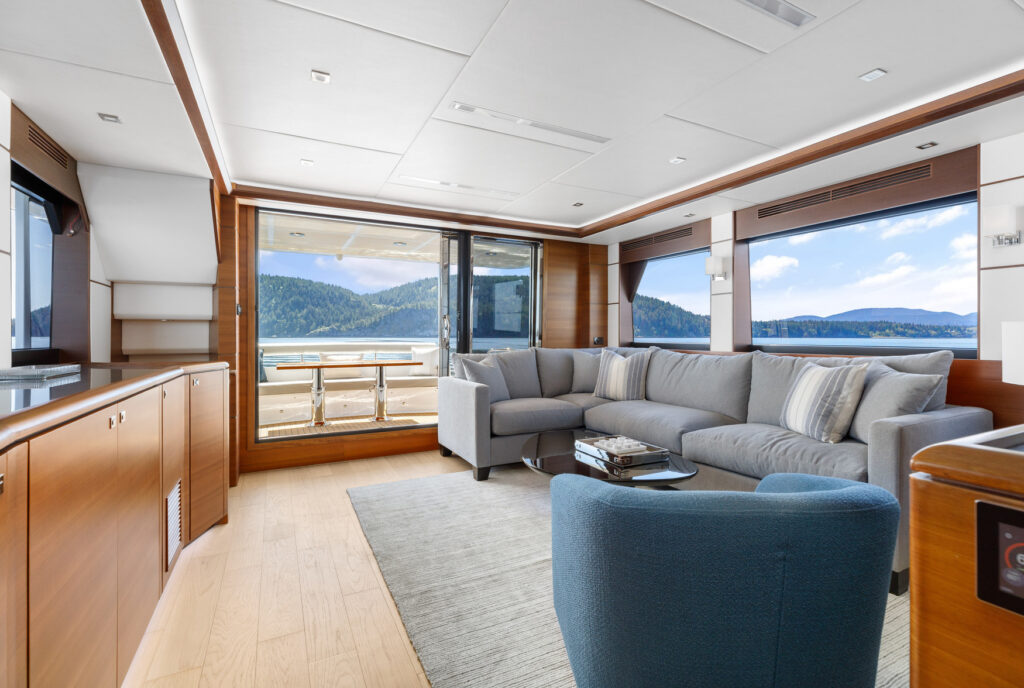
A wide-body salon and full walkaround decks allocate main-deck width differently. Extending the salon on one side can give more room inside; preserving an exterior passage on both sides retains another route for deck tasks. The useful choice depends on the actual arrangement and the routines your crew repeats.
Read the allocation on the selected plan
Follow the salon walls and exterior passages on the main-deck drawing. A one-side wide-body arrangement extends the interior into space that would otherwise serve an exterior passage. A full walkaround arrangement keeps a passage on both sides. The available width, furnishings, doors, and changes in deck level still need examination on that particular boat.
Raised walkarounds are a separate arrangement to inspect. Do not assume every full-beam salon uses the same route or that every boat described as a walkaround has a flush passage from cockpit to foredeck.
Give extra interior width a concrete job
Begin with the furniture you expect to use. Does the selected arrangement make a preferred settee, table, chair, or cabinet fit better? Trace the passage while someone remains seated. Then, with permission aboard, open a frequently used drawer or appliance door and observe what it changes.
Extra room can be valuable for meals, work, reading, and time inside during poor weather. Its benefit comes from the actual furniture and circulation, rather than an assumed number of inches or a guarantee that everyone can pass an open refrigerator.
Guests add bags, coats, and occupied seats. Think through where those items will live. If the wider layout does not change your intended use appreciably, ask what that allocation contributes before choosing it.
Give the second exterior passage a concrete job
An exterior passage on each side can offer more choices for reaching side-specific tasks. Consider where your crew prepares fenders, reaches fittings, and carries washdown tools. Review both the familiar home berth and less predictable arrangements at marinas you visit.
On a one-side walkaround, trace the actual available access to the opposite side. Do not assume there is a door, opening window, or safe cleaning position simply because a task needs doing. Discuss maintenance access and line-handling arrangements on the exact boat. An inconvenient task deserves a practical answer before purchase.
The quality of either route matters alongside its existence. Our guide to side decks, stairs, and handholds looks more closely at transitions, footing, and hand placement.
Compare current North Pacific arrangements
For example, our 44 Sedan exterior has full walkaround decks, with a wide-body salon and walkaround on one side also available. These are alternatives to compare against your preferred interior arrangement and exterior tasks.
For example, our 590 Pilothouse exterior has a starboard walkaround, with full walkaround available. The starboard passage is accessed from the cockpit or starboard pilothouse door and leads toward the Portuguese bridge and foredeck. For example, our 590 Pilothouse interior has a customizable salon, with the port walkaround eliminated in the standard arrangement and full walkaround available.
These examples establish available allocations. Exact furniture clearances, access dimensions, and the consequences of a selected configuration still deserve review on its drawing and aboard a representative boat.
Compare frequency and consequence
Salon use can last for hours while a deck task takes minutes. Time alone will not settle the choice: a brief task that is awkward for your crew may deserve substantial weight.
| Routine | Interior question | Exterior question |
|---|---|---|
| Meals with guests | How do occupied seats and open drawers affect passage? | Which route remains useful while the salon is occupied? |
| Arrival preparation | Where can gear be staged without blocking movement? | Which side-specific tasks require access? |
| Cleaning | How are furnishings and doors used? | How will each exterior surface be reached appropriately? |
| Extended time aboard | What furniture or daily use earns the extra width? | How often would a second passage change an actual task? |
Mark an interior routine and an exterior routine on each plan. When a representative boat is available, repeat them while securely docked, with permission and the actual crew. Bring the places where those routines conflict when you talk with us about the available arrangements.