

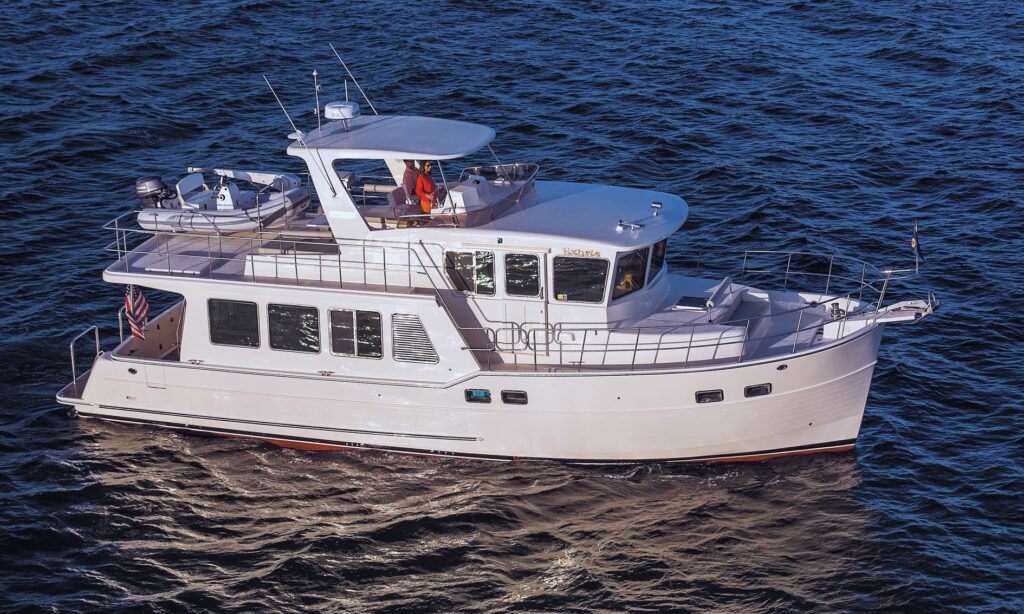
A slip that looks generous on paper can prove unworkable the day you tie up. Securing the right slip for a 45 to 60-foot cruising yacht requires matching the boat’s true physical footprint, operational draft, electrical appetite, and maintenance requirements to a marina’s physical layout and regulatory reality.
Finding the right berth means measuring beyond marketing badges, testing dockside access, and verifying local marina rules before signing a lease.
Measuring True Footprint: Length Overall, Beam, and Physical Appendages
Never reserve a slip based on the hull designation in a yacht’s model name. Model numbers denote a design series or nominal hull mold, not the true tip-to-tail length overall (LOA) that harbor masters use to calculate slip fit and fairway protrusion.
For example, our 49 Pilothouse carries a nominal 49-foot badge, but its actual LOA measures 51 feet 4 inches, paired with a 15-foot 4-inch beam and a 4-foot 10-inch draft. Moving up in size, our 590 Pilothouse runs 61 feet 4 inches LOA, with an 18-foot 4-inch beam and a 5-foot 10-inch draft.
| Yacht model | LOA | Beam | Draft |
|---|---|---|---|
| 49 Pilothouse | 51 feet 4 inches | 15 feet 4 inches | 4 feet 10 inches |
| 590 Pilothouse | 61 feet 4 inches | 18 feet 4 inches | 5 feet 10 inches |
Marinas manage slips based on total occupied space. A facility with a strict 50-foot limit that enforces a zero-overhang policy will reject a yacht with a 51-foot 4-inch LOA, or force you into a 55-foot or 60-foot slip class.
When presenting dimensions to a harbor master, provide:
-
True LOA: Including the anchor roller, pulpit, swim step, and any tender overhang.
-
Extreme Beam: Including rub rails and outboard-mounted hardware.
-
Full-Load Draft: Accounting for full fuel, fresh water, and cruising stores.
-
Depth through the tidal range: Ask the marina about the depth, applicable datum and expected low-water conditions; assess clearance for the actual loaded boat.
Fairway Geometry, Finger Piers, and Daily Access
A slip with adequate water depth can still present serious access issues if the surrounding fairways and dock hardware do not support a vessel of this displacement.
Observe the approach, turning room, neighboring boats and ordinary wind or current conditions with an experienced operator. The useful question is whether your crew can use the berth comfortably, rather than whether a generic fairway ratio is met. Ask whether an end-tie or another location offers a better fit.
Finger pier configuration directly affects everyday loading and boarding safety:
-
Finger pier length: Check whether your boarding gate and preferred loading point align with a usable part of the dock. A short finger may change where you can board.
-
Dock width and movement: Inspect footing, handholds, lighting and relative boat/dock movement. Construction material alone does not establish safe boarding.
-
Shoreside Transit: Evaluate the distance from the marina parking area and loading zone to the slip gate. Lugging routine provisions, engine fluids, and gear across hundreds of yards of exposed breakwater quickly becomes exhausting.
Aligning Pedestals, Pumpout Services, and Liveaboard Bylaws
Do not assume that an operational marina offers the utilities needed to run complex domestic yacht systems, or that full services automatically mean you can live aboard.
Verify the boat’s actual shore-power connection, voltage and expected loads with the marina and a qualified marine electrician. Our 590 Pilothouse has variable-speed direct-expansion air conditioning and heat, but that feature alone does not establish its shore-power requirement. Your shore power and battery routines belong in the operating plan alongside the pedestal specification.
| Utility or amenity | What to verify |
|---|---|
| Electrical service | Voltage, connection type, available capacity and condition for the actual boat |
| Fresh water | Location, access and seasonal interruptions |
| Pumpout | Location, availability and whether a visit requires moving the boat |
| Overnight use | Liveaboard and guest-stay rules for the intended pattern |
Look closely at municipal and private operating regulations. A clear real-world example is Fishermens Terminal in Seattle. The facility offers robust, heavy-duty commercial infrastructure: electrical hookups, potable water, a pumpout station, an on-site boatyard and parking.
Yet, despite this comprehensive service profile, Fishermens Terminal operates under strict Port of Seattle rules that do not permit recreational liveaboard moorage.
Before committing to a lease, ask the harbor master directly:
-
Does the pedestal deliver consistent voltage when adjacent slips run full heating or cooling loads?
-
Are dockside water supplies maintained year-round, or are shore bibs shut down during winter freezes?
-
What is the explicit policy regarding overnight stays per month for non-liveaboard slips?
Maintenance Logistics, Yard Access, and Tender Deployment
A home slip is your primary base of maintenance. When evaluating serviceability, evaluate how the marina handles technical work, vendor visits, and machinery staging.
Independent marine technicians need easy access. Ask management if outside mechanics, divers, and electronics installers can access the docks, or if the marina restricts access through hefty vendor insurance minimums or daily vendor gate fees. If you plan to handle basic fluid changes and preventive maintenance yourself, verify that parts deliveries can reach the marina office and that dock carts can carry heavy spares, tool kits, and oil drain tanks.
| Maintenance need | Marina capability to confirm |
|---|---|
| Outside contractors | Access rules, approvals and insurance requirements |
| Parts deliveries | Delivery and staging arrangements |
| Nearby yard | Haulout capacity and dimensions suited to the actual boat |
| Tender handling | Clearances for the approved launch arrangement |
Tender launch geometry is another factor often overlooked during initial slip selection. Our 49 Pilothouse has an electric/hydraulic power luffing davit, while our 590 Pilothouse has a full-function UMT hydraulic davit. Check the approved launch path for the exact boat, tender and davit configuration.
Pilings, covered-slip roofs and neighboring boats may limit that path. Confirm whether tender handling is permitted and practical at the berth.
Conducting an On-Site Marina Evaluation
Never sign a long-term moorage contract based solely on marketing materials, online listings, or an inspection completed on a calm, mid-week morning. Visit candidate marinas during peak tidal current, midday wind chop, or winter cold snaps to observe how the basin actually behaves.
| Evaluation factor | Observe during the visit |
|---|---|
| Approach and turning room | Available space and ordinary traffic |
| Finger pier | Boarding-point alignment, footing and handholds |
| Exposure | Wake, current and wind effects |
| Utilities | Access, condition and requirements needing professional confirmation |
| Security and loading | Gates, parking and cart routes |
Take note of unresolved questions during your visit:
-
Do vessels surge against their cleats when commuter ferries or commercial traffic pass outside the breakwater?
-
Are the dock pilings tall enough to retain the floating dock during an extreme spring high tide combined with a storm surge?
-
Is there adequate overhead clearance if considering a covered slip, accounting for radar arches, domes, and mast-mounted antennas?
A well-matched berth can make departures, returns, loading and maintenance easier throughout the time you use the boat.
If you are planning your next vessel and want to review real-world dimensions, electrical setups, or layout needs for your cruising grounds, talk with us.