

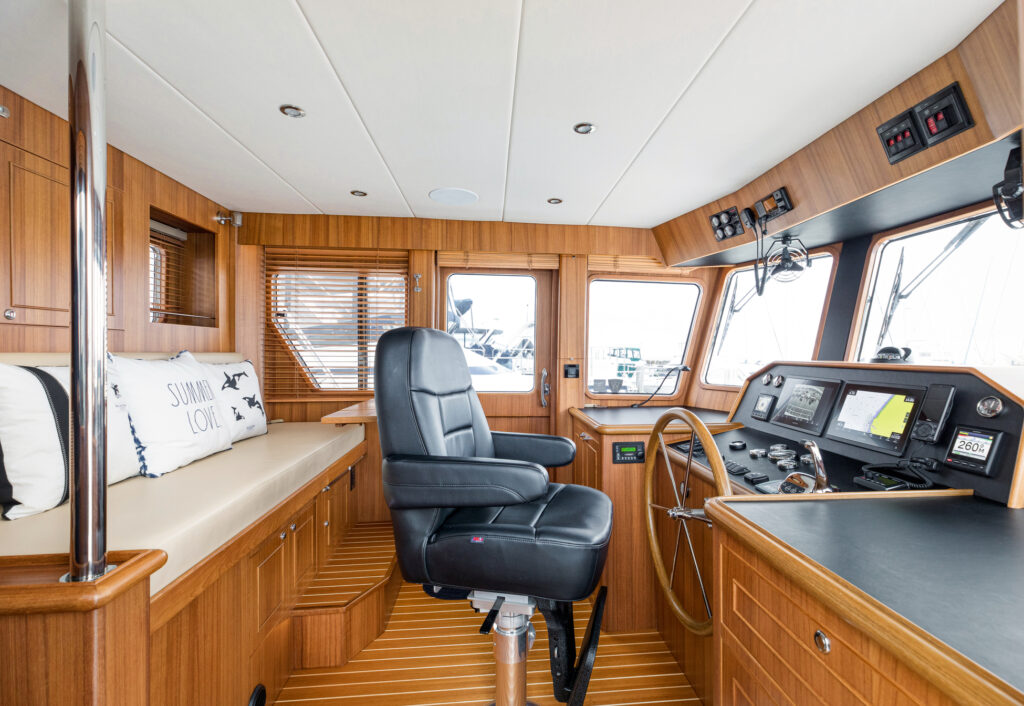
A nighttime helm needs readable information and a usable outside view. Screens, cabin spill, small indicators, and reflected light can compete with that view. Managing the visual environment means checking the actual boat and operator position, then establishing a routine the crew can maintain.
Find light sources from the helm
At a permitted stationary dusk assessment, sit and stand where the operator normally works. Look through the forward and side glass and identify reflections from displays, overhead lights, adjacent rooms, phones, and small indicators.
Change one controllable light source at a time and observe the effect. A reflection that seems minor from one seat may matter from another position. Record the source and the pane or reference it affects rather than inferring the result from window angle alone.
Keep required indicators, controls, ventilation and equipment intact. Ask a technician about appropriate shielding or modifications instead of covering a warning light or changing hardware without understanding its purpose.
Balance screen readability and outside visibility
Use the manufacturer’s available brightness and palette settings. Find a level at which the operator can read necessary information without unnecessary reflected light. Absolute minimum brightness is not automatically the useful setting.
Different people and displays may need different adjustments. If dimming groups are available on the installed equipment, learn their scope; check separate instruments too. Do not assume every screen or gauge follows one network setting.
The USCG Navigation Rules require a proper lookout by sight, hearing, and appropriate available means. Electronic information contributes to that assessment; dimming the helm must preserve readable information as well as the outside view.
Review cabin spill and glass condition together
Check what happens when someone uses a galley task light, opens a nearby door, or enters with a phone. Agree on lighting that supports appropriate movement without sending unnecessary light toward the helm.
Available shades or other separation may help, but their use must suit the actual boat and preserve needed views and access. Our guide to social gathering and helm operations develops how companions and the working helm share space.
Residue and condensation can also make lights harder to interpret through the glass. Use appropriate cleaning guidance and inspect the installed systems. Our guide to wipers, washers, and demisters addresses those glass-clearance questions separately.
Prepare a repeatable lighting routine
Before darkness makes the task more demanding, review the display settings, cabin lighting, small indicators, and crew’s personal devices. Agree that someone will warn the watch before introducing a bright light or changing the setup.
Keep cabin and instrument adjustment separate from prescribed navigation lights. Rule 20 governs their display and restricts additional lights that impair their visibility or distinctive character, or interfere with a proper lookout. Interior glare management is not an instruction to dim required navigation lights.
| Source to check | Stationary observation | Action to evaluate |
|---|---|---|
| Navigation display | Readability and reflection from actual position | Available brightness and palette settings |
| Separate instrument | Indicator light or unreadable data | Its own documented adjustment |
| Cabin task light | Spill through the passage or onto glass | Appropriate task lighting and crew routine |
| Personal device | Sudden light near the watch | Readable settings and considerate use |
| Glass | Residue, fogging or reflected image | Cleaning or equipment follow-up |
Recheck when the setup changes
A new display, chair position, light, or companion routine can change the visual environment. Repeat the relevant check instead of assuming an earlier adjustment still works.
Our guide to day and night pilothouse cruising covers the broader questions of voyage timing, route, weather, and crew workload. If the view becomes inadequate underway, assess the response against the actual position, hazards, conditions, and vessel control; a universal instruction to step outside, stop, or anchor would overlook those circumstances.
Bring the reflection you observed and the actual equipment arrangement when you talk with us about helm priorities and configuration questions.