A true weather window covers your entire passage, not just a calm stretch of water off the harbor breakwater. Too many departures are scheduled around a momentary lull in wind speed, only for the crew to run headlong into stacked seas at an exposed headland, an opposing tidal gate, or a difficult docking situation at dusk.
A reliable passage plan requires treating weather as an evolving system. You are matching the forecast against your vessel’s operating profile, your crew’s stamina, and the physical geometry of your route.
The Complete Anatomy of a Weather Window
A workable window spans four distinct operational phases: departure, open-water exposure, arrival maneuvers, and a protected fallback option. Consider all of these stages together before judging whether a departure period fits this trip.
Before casting off, look at the timeline across the entire route rather than the immediate forecast zone:
-
Departure conditions: Leaving a slip in a 20-knot cross-breeze or threading an unfamiliar inlet against an ebb current burns mental energy before the passage even begins.
-
The period of maximum exposure: Identify the stretch of open water where you have no lee and no quick escape routes. Calculate your transit time across this zone at real-world displacement speeds, factoring in adverse currents rather than clean-hull cruising speeds.
-
Arrival conditions: A safe passage that ends with an exhausted crew backing into an exposed slip during a gusting blow is a compromised plan. Your arrival harbor must offer protected water and sufficient depth across the full range of the tide.
-
Down-run alternatives: If conditions deteriorate mid-passage, you need an accessible port of refuge that can be entered safely in building seas, not an inlet bordered by a breaking bar.
For those planning stepped itineraries along complex coastlines, regional geography dictates unique timing. We explore route-specific pacing and tidal staging in our dedicated guide, Weather-Window Planning for Pacific Northwest Coastal Hops. Predeparture interpretation, however, begins with the core mechanics of the forecast data itself.
Reading Beyond Headline Wind and Wave Numbers
A marine forecast that reads “winds northwest 15 to 20 knots, seas 4 to 6 feet” does not give you enough information to make a departure decision. Those numbers describe selected conditions, but they do not describe shape, frequency, or timing.
Wave Components: Height, Period, and Direction
The sea state you experience is rarely a single clean wave train. It is usually a composite of long-period open-ocean swell overlaid with short-period wind chop.
| Wave Characteristic | What It Describes | Why It Matters |
|---|---|---|
| Wave height | Vertical distance from trough to crest | One part of the sea-state description |
| Wave period | Time between successive crests | Helps distinguish wave components and their likely motion |
| Wave direction | Direction from which waves travel | Relates the sea state to your intended course |
Evaluating wave height, period and direction together gives a fuller picture than height alone. Different wave components can coexist, and their practical effect depends on the route, water depth, vessel and crew. A particular height and period do not establish comfort or passage suitability.
Cross-seas demand particular caution. When an incoming swell from a distant low-pressure system collides with local wind-driven chop at an angle, the waves lose their predictable rhythm. The motion shifts from a rhythmic pitch or roll into an erratic, corkscrewing dynamic that challenges stabilization systems and fatigues the crew.
Forecast Timing, Geography, and Update Cycles
Forecasts are models, not schedules. Forecast timing can change between updates; treat it as information to reassess rather than a fixed appointment.
Pay close attention to forecast valid times and geographic zones. Marine weather zones cover large geographical areas. The sheltered head of a sound can sit in a light breeze while the open boundary five miles out experiences gale-force gusts funneling through an offshore gap.
Compare successive forecast updates for changes in timing, direction and strength. Persistent agreement can be useful context, but a simple count of model runs does not establish confidence. When the forecast is uncertain or does not describe the exposed part of your route well, seek more relevant information and leave room to wait.
Matching the Forecast to Hull, Route, and Crew
A forecast is neither safe nor unsafe until it is placed alongside a specific vessel, an exact route, and the people on board.
Wind Against Current
Wind opposing a tidal current can change the sea state. Assess the relevant local hydrographic information and conditions for the particular passage rather than using a universal numerical example or assuming slack water is always the right transit time.
Crew Stamina and Human Exposure
Fatigue and motion can reduce a crew’s ability to work effectively even when the boat is operating within its limits. Consider the crew’s experience, rest and workload when choosing a departure period.
Factor the human element into the window:
-
Night passages: Running in darkness removes visual cues on wave trains, obscures floating debris, and accelerates fatigue.
-
Watch schedules: Plan how a proper lookout and necessary operating tasks will be maintained throughout the passage, with adequate rest and suitable help for the workload.
-
Pre-departure rest: A crew that spent the previous afternoon provisioning and preparing the boat starts the passage with a partial energy deficit.
Routine safety protocols should be settled long before engine start. Integrating marine forecasts and float plans into your standard predeparture habit ensures that someone ashore understands your route, your scheduled check-ins, and your planned diversions should conditions change.
The Pilothouse Advantage in Proper Context
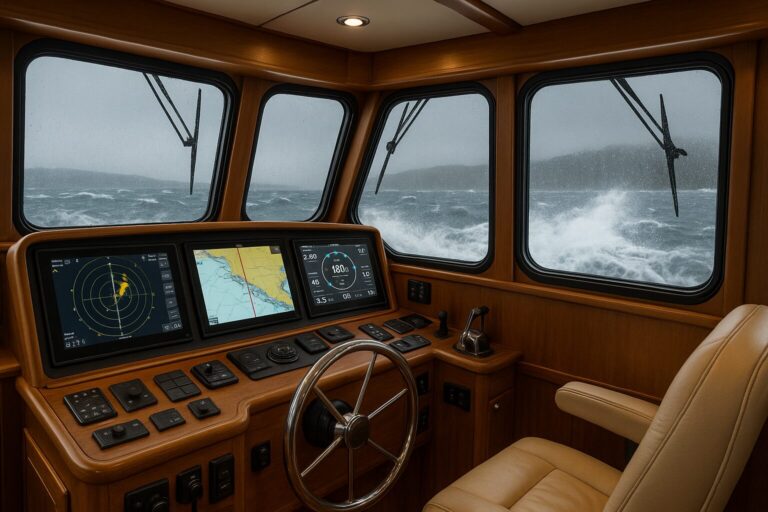
An enclosed pilothouse changes the physical experience of heavy weather, but it does not change the physical limits of the vessel or the ocean.
-
A sheltered helm can reduce direct exposure to wind, rain and spray.
-
Glass, reflections and weather can still affect visibility.
-
Comfort does not change wave conditions or replace proper lookout.
A sheltered helm can make chart work and monitoring more comfortable when the actual layout, ventilation and equipment suit the conditions. That benefit remains separate from the vessel’s limits and the crew’s ability to maintain a proper lookout.
This comfort brings its own operational risks:
-
Auditory isolation: An enclosed pilothouse filters out the sound of the ocean. You may not hear engine strain, shifting gear on deck, or the acoustic signature of breaking seas that an open bridge reveals instantly.
-
Visual distortion: Salt buildup, wiper patterns, and windshield rake can obscure floating logs, crab-pot buoys, and small targets, especially in driving rain or glare.
-
False confidence: Physical comfort can tempt an operator into pushing through sea states that place severe stresses on running gear, ground tackle, and deck fittings.
Comfort at the wheel is a tool for preserving your judgment, not an excuse to push past reasonable limits. To explore how to evaluate conditions once you are underway, see our companion article, Weather at the Pilothouse Helm: Connecting Forecasts with What You Observe.
Decision Triggers and Bailout Strategy
The final predeparture check requires establishing clear decision triggers: changes that prompt you to reassess whether to wait, alter the trip or seek a suitable alternative.
Commit to these criteria before you leave the slip, while your judgment is free from get-there-itis:
-
Before departure: Recheck current observations and relevant forecasts close enough to departure to evaluate whether the planning assumptions still hold. If conditions differ materially, reassess before leaving.
-
Before greater commitment: Identify where the route becomes harder to change, and assess conditions, systems and crew before committing to that stage. Choose a response appropriate to the actual circumstances rather than an automatic turn-back rule.
-
Alternative options: Identify realistic places to wait or change the trip, and verify their access and suitability for the conditions you might encounter.
Planning Your Platform Around Real-World Cruising
Understanding weather windows is ultimately an exercise in matching your cruising ambitions with the right platform. Hull balance, tankage placement, visibility from the helm, and heavy-weather ergonomics all shape how a vessel behaves when the sea conditions build.
If you are exploring layouts, displacement characteristics, and bridge designs across our current models, we can discuss the layouts and configuration choices relevant to your plans. We invite you to talk with us about your regional cruising goals, crew requirements and priorities for life aboard.