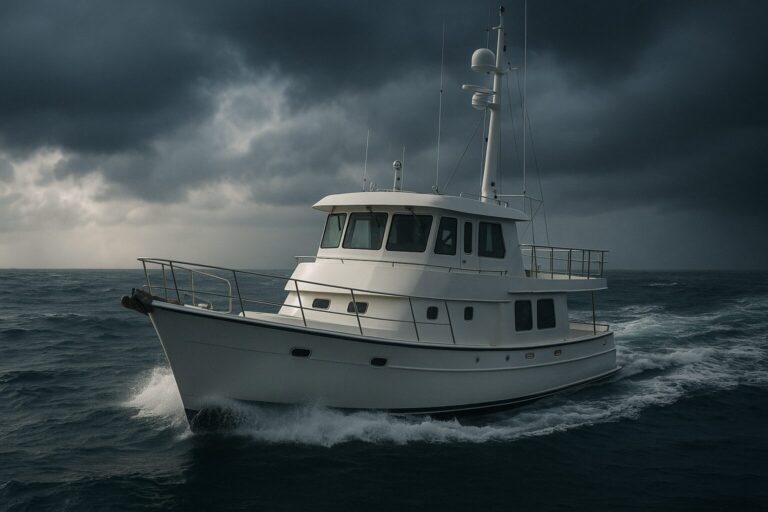
A forecast helps establish a plan; observations help test whether that plan still fits. From an enclosed helm, an operator may remain sheltered while wind, waves or visibility change outside. Keeping those changes connected to route timing and crew workload is a central part of a useful weather routine.
The purpose is not to find one instrument reading that settles every decision. It is to recognize when the assumptions behind a trip need another look.
Read the Forecast in Context
Check the issue date, valid period and geographic coverage of the products you use. The National Weather Service advises reviewing broader-area forecasts alongside point forecasts. A prediction at one location does not describe every exposed stretch, approach or stage of a longer journey.
Read relevant forecast text and warnings alongside graphics. Note when changes are expected relative to your departure, exposed legs and arrival. Successive updates may show a different timing or trend; compare them without assuming that a change in one number explains the whole weather system.
Use weather windows as a separate planning topic when choosing a departure period. At the helm, the immediate question is whether actual conditions continue to support the chosen plan.
Compare the Forecast with Conditions Underway
Record useful changes rather than relying on the impression that the weather is “better” or “worse.” A clearer description might identify a change in wind direction, more frequent spray, reduced visibility or growing difficulty moving around inside the boat.
Wind and Waves
NWS wave guidance describes wave height, period and direction. Different wave systems can coexist, so one height figure does not fully describe the water a boat will encounter. Significant wave height is an average of the highest one-third of waves, rather than a maximum.
Observe how conditions affect this vessel and crew. Is motion interfering with lookout, making a normal task difficult or changing the time expected to reach the destination? The same forecast can have different practical consequences for different boats, loading conditions and crews.
Keep local context in view. Exposed points, shallow approaches and tidal waters may require more specific information than a broad forecast provides. Appropriate regional forecasts, hydrographic information and competent local guidance help clarify those questions.
Rain and Reduced Visibility
Notice whether familiar reference points become harder to identify and whether the view through the glass remains usable. Rain, spray, salt residue and condensation can each affect it differently.
Electronics add information but have limitations in weather and sea clutter. Familiarity with the equipment and its instructions matters more than an assumption that a clear-looking screen means clear water. Reduced-visibility navigation requires suitable training and an assessment of the actual circumstances.
Manage Visibility and Workload
Review how the particular boat clears and demists its windows, how interior lighting reflects on glass and whether the watch can hear relevant outside sounds. Equipment checks can identify a problem before departure, but a checklist cannot guarantee clear visibility throughout a trip.
| Observation | Planning question it raises |
|---|---|
| Spray or condensation repeatedly interrupts the view | Can the watch maintain an effective lookout with the current arrangement? |
| Several tasks compete for attention | Is additional assistance available, and are responsibilities clear? |
| Motion makes routine tasks difficult | Does the route still fit the boat and crew’s present condition? |
| Arrival time changes substantially | Will the intended approach remain suitable when reached? |
USCG Rule 5 requires lookout by sight and hearing with appropriate available means. Rule 6 requires safe speed suited to circumstances. These obligations continue from an enclosed helm; no universal setting or simple maneuver follows from the fact that visibility has changed.
Reviewing rough-weather preparation is useful when securing the boat and briefing the crew. Keeping those tasks ahead of exposure can reduce the number of competing jobs later.
Decide When the Plan Needs to Change
Review alternatives while there is still time to assess them. Delay, a revised destination or another route may each offer advantages, but each must be considered against local conditions and access. A refuge that is sheltered inside may have an unsuitable approach.
Questions for reassessment include whether the observations match the forecast, whether the crew can sustain the required watch and whether the intended arrival still fits the conditions. Avoid allowing a promised arrival time to settle those questions by itself.
After the trip, compare what was forecast with what you observed and which tasks became difficult. That record can make a future conversation with an instructor or experienced local mariner more specific and useful.
Sources
- weather windows
- rough-weather preparation
- NWS Marine Forecasts FAQ
- NWS Wave Detail
- USCG Navigation Rules