

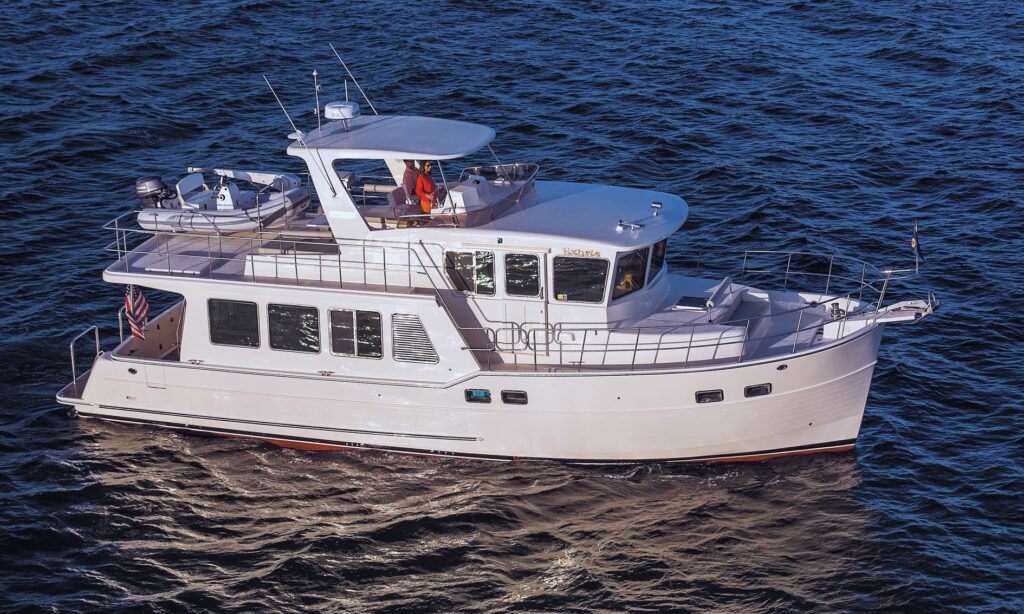
Large fuel tanks give a cruising yacht more flexibility between refueling stops. They can support a remote itinerary or a longer stay at anchor when diesel-powered auxiliary equipment is fitted. How much flexibility they provide depends on consumption and the supply that can actually be used.
Tank size alone does not tell you how far you can travel. A useful reading of the specification separates total capacity, usable fuel, planned reserves and the equipment drawing from that supply.
Fuel Storage as Cruising Independence
Refueling opportunities can shape a cruising itinerary. Carrying more usable fuel can offer more choices about where to stop, provided the boat’s measured demand and passage plan support those choices. Confirm current fuel availability with the destination rather than assuming that a listed facility will be operating when you arrive.
The main engine may not be the only diesel consumer. A generator, heater or other fitted appliance can continue drawing fuel while the yacht is at anchor. Identify the equipment on the exact boat, its fuel source and its documented or measured demand.
Consumption and storage answer different questions. Our article what makes trawlers fuel-efficient for long-distance cruising? explains why distance traveled per gallon matters alongside hourly fuel flow.
Nameplate Capacity Versus Usable Fuel
A stated tank capacity is not a passage allowance. The installed system determines how much fuel is reachable under operating conditions; the passage plan determines what reserve remains outside normal planned consumption.
Keep these quantities separate:
- Total stated capacity.
- Usable supply established for the exact installation.
- Planned reserve for the intended voyage.
- Fuel available for planned propulsion and auxiliary demand.
Tank geometry, pickup arrangement and operating trim belong in the discussion with the builder or service professional. Do not estimate unreachable fuel from a generic percentage or try to find it by running a tank dry.
Our guide calculating trawler endurance: usable fuel, measured demand, and planning reserves develops the calculation once those inputs are established.
The Structural and Dynamic Reality of Heavy Tanks
Fuel is part of the yacht’s changing load. Its amount and distribution affect displacement and trim, so tankage must be considered within the whole design. A tank’s location or size alone does not establish improved stability or roll comfort.
Owners also need to understand inspection and service access. Ask which fittings, level indicators, valves and inspection points can be reached, and which tasks require a technician. Follow the exact system’s documentation when fuel must be transferred or a tank serviced.
These questions matter over an ownership season. A capacity figure is easy to compare; the ability to understand and maintain the installed system takes a closer look.
Evaluating an Installed Specification
For example, our 49 Pilothouse has 700 gallons of fuel capacity in two tanks, with 920 gallons optional. Those are the capacity choices in the 49 Pilothouse specifications. Confirm the arrangement on the yacht you are considering rather than assuming that an optional figure describes every boat.
| Specification question | What to establish |
|---|---|
| What capacity is installed? | The exact yacht’s documented tank arrangement |
| What fuel is usable? | Commissioning information and qualified system guidance |
| Which equipment shares the supply? | Propulsion and fitted auxiliary fuel connections |
| How are levels monitored? | Installed indicators, their limitations and verification method |
| What access is available? | Documented inspection and service points |
A larger capacity offers potential endurance; it does not independently establish a route, operating range or serviceability advantage.
Turning Capacity into a Passage Plan
Bring the capacity information together with measured consumption, auxiliary use, expected conditions and refueling alternatives. Record uncertainties explicitly so that a tank figure does not quietly become a promise about the next leg.
For passage budgeting and reserve decisions, continue with fuel planning for long-range trawler cruising: range, reserve, and real-world margins.
If you are comparing models or optional tank arrangements, talk with us about the exact configuration and how it relates to your cruising plans.