

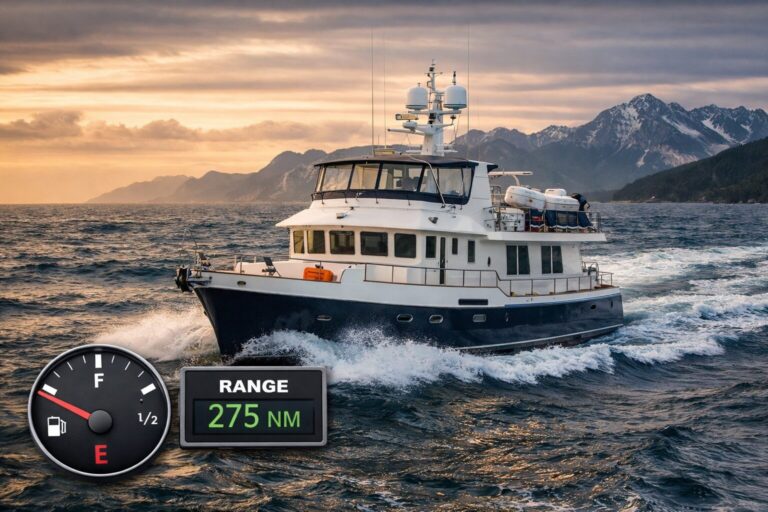
A trawler’s true cruising endurance is not determined by the volume stamped on its fuel tanks or the theoretical range printed in a brochure. Endurance is a mathematical budget balancing actual usable fuel against every engine and appliance consuming diesel on board.
Sea-trial curves are reference measurements taken under stated conditions. Our North Pacific 49 specifications describe calm water and a boat loaded for cruising; different configurations use different tank capacities. Your own loading, hull condition, weather, speed and auxiliary use still need to be included in the budget.
Determining how far and how long your yacht can run requires calculating your vessel’s specific fuel burn, isolating your dead fuel, and ring-fencing an inviolable reserve.
Separating Nameplate Capacity, Reachable Fuel, and Reserve
A 500-gallon tank does not give you 500 gallons of burnable diesel. Tank capacity breaks down into three distinct volumes: total nameplate capacity, physically reachable fuel, and planned operational reserve.
- Total Tank Capacity (Nameplate)
- Unusable Fuel (Below pickup tubes, trapped by baffles)
- Usable Fuel
- Operational Contingency Reserve (Untouchable margin)
- Planned Burnable Fuel (Available for propulsion & auxiliary)
Nameplate vs. Reachable Fuel
Nameplate capacity is the internal volume of the tank. Reachable fuel is the fraction of that volume your pickup tubes can draw without sucking air.
Reachable fuel depends on tank and pickup geometry and the boat’s operating conditions. Establish it from commissioning information, drawings and qualified assessment. Do not assume a fixed pickup height or deliberately run the system toward fuel starvation to find the limit.
Exclude unreachable fuel from the available supply. Keep that exclusion separate from the contingency reserve you choose to retain.
Establishing an Operational Reserve
Reserve fuel is not fuel you plan to burn; it is a margin for delays and changed consumption. There is no universal percentage that fits every passage. The curves in the North Pacific 49 specifications include a 10% reserve; an operating reserve still needs to reflect your own route and uncertainty.
Choose reserve with the full route in view: alternate fuel stops, likely delays, forecast uncertainty, crew decisions and consumption confidence. The 10% retained in a published performance plot is its calculation convention, not a route-specific operating recommendation.
Reserve fuel protects against:
- Dodging unexpected weather systems or running at higher RPM to beat an inlet tide gate.
- Fighting an unpredicted countercurrent that degrades your speed over ground (SOG).
- Arriving at a planned remote fuel dock to find it out of service, contaminated, or dry.
Subtract your unusable fuel and your chosen contingency reserve from your total tank volume before planning a single nautical mile.
Building an All-Source Fuel-Demand Budget
Propulsion engines are the largest consumers on board, but they are rarely the only equipment drawing from your tanks. A sound endurance calculation accounts for all concurrent diesel consumers across the entire journey, underway and at anchor.
Total Voyage Fuel Demand = Underway Propulsion + Underway Generator + Anchored Generator + Auxiliaries
1. Measured Propulsion Burn
Engine curves and vessel trials answer different measurement questions. Check the stated conditions before applying either to your actual load, hull condition and speed.
Use owner-measured burn figures established over multiple fill cycles. Track engine hours against metered fuel dock receipts to calculate genuine gallons-per-hour (GPH) or liters-per-hour (LPH) figures across typical operating RPM bands.
Generator demand depends on the installed model and electrical load. Use its manufacturer data and measured fuel use under your expected loads, keeping underway and anchored operating hours distinct.
- Underway generator use: If your stabilizers, navigation electronics, or climate control require AC power underway, add generator burn directly to your hourly underway consumption.
- Anchored generator use: Time at rest still draws down fuel reserves. For a purely hypothetical example, two daily two-hour recharge cycles at an assumed 0.75 GPH consume three gallons per day. Across a five-day anchorage, that represents fifteen gallons drawn from your total supply before you get underway again.
Diesel-fired heating or cooking equipment may draw from the same fuel supply. Include the installed appliance’s measured or manufacturer-supported demand and expected run time when managing tank capacity on extended stays.
Step-by-Step Endurance Calculation Worksheet
This calculation determines how long you can cruise and how far you can travel before dipping into your emergency reserve.
Use this worksheet alongside fuel planning for the route, weather windows, alternate stops and operating margins.
The Math: Fuel, Hours, and Range
-
Net Usable Fuel:
Net Usable Fuel = Total Usable Fuel Onboard – Contingency Reserve -
Total Underway Hourly Burn:
Total Underway GPH = Main Engine GPH + Underway Generator GPH -
Underway Fuel Consumption:
Underway Fuel = Planned Running Hours × Total Underway GPH -
Stationary Fuel Consumption:
Stationary Fuel = Planned Generator Hours at Rest × Generator GPH -
All-Source Fuel Demand:
Total Demand = Underway Fuel + Stationary Generator Fuel + Auxiliary Fuel
Add each diesel heater, stove or other auxiliary’s expected fuel use across its own operating hours. Keep overlapping generator hours counted only once.
- Remaining Operating Margin:
Margin = Net Usable Fuel – Total Demand
Hypothetical Cruising Scenario
The following worked example illustrates the arithmetic. These numbers are purely fictional inputs to show how the variables interact, not an official North Pacific Yachts performance claim, recommended reserve, or engine prescription. The example assumes no other diesel loads; add them separately if they exist on your boat.
The Vessel Inputs
- Total fuel aboard at departure: 600 gallons (already adjusted for unusable fuel)
- Operational reserve target: 120 gallons (20% retained reserve)
- Planned underway time: 20 hours at cruising RPM
- Planned stationary layover: 24 hours at anchor
- Propulsion burn rate: 8.0 GPH
- Generator burn rate: 1.0 GPH (consistent average under load)
Step 1: Calculate Planned Burnable Fuel Budget
Subtract your untouchable reserve from your starting fuel:
- 600 gallons available – 120 gallons reserve = 480 gallons planned burnable fuel
Step 2: Calculate Underway Consumption
Determine fuel burned during the 20-hour transit, running both the main engine and generator:
- Main propulsion: 20 hours × 8.0 GPH = 160 gallons
- Underway generator: 20 hours × 1.0 GPH = 20 gallons
- Total underway burn: 160 + 20 = 180 gallons
Step 3: Calculate Stationary Layover Consumption
Calculate fuel burned during the 24-hour anchorage:
- Anchored generator: 24 hours × 1.0 GPH = 24 gallons
Step 4: Calculate Total Leg Consumption
Sum underway and stationary draws:
- 180 gallons underway + 24 gallons stationary = 204 gallons total consumption
Step 5: Assess Remaining Fuel and Endurance
Evaluate your position at the end of this leg:
- Remaining burnable fuel: 480 gallons – 204 gallons = 276 gallons
-
At an underway consumption of 9.0 GPH combined (8.0 main + 1.0 gen), that remaining 276 gallons yields:
276 gallons ÷ 9.0 GPH = 30.6 additional underway hours -
If cruising at a steady 8 knots speed over ground (SOG), that equates to roughly 245 nautical miles of remaining range before you touch your 120-gallon reserve.
-
Total Fuel Onboard: 600 Gal
- Operational Reserve (Protected): 120 Gal
- Planned Usable Fuel: 480 Gal
- Total Consumed (Underway + Anchor): 204 Gal
- Remaining Usable Fuel: 276 Gal (~30.6 Hours Run Time Remaining)
If you alter your profile—say, you decide to anchor for an extra four days running the generator four hours per day—you simply deduct those 16 gallons from your remaining 276 gallons. The reserve remains untouched.
Stress-Testing Your Calculations
A calculation completed on a calm morning in a slip must be tested against real-world degradation. Before casting off, run sensitivity checks against your baseline numbers.
| Scenario | What changes | Budget response |
|---|---|---|
| Head seas or wind | Speed and propulsion demand may differ from the baseline | Use vessel-specific observations and conservative scenario inputs |
| Unfavorable current | Time needed to cover ground increases | Recalculate hours for the leg using speed over ground |
| More electrical demand | Generator load or hours change | Recalculate from the installed unit’s expected demand |
| Higher speed | The measured speed/burn relationship changes | Compare your boat’s data at the intended operating speed |
Speed vs. Burn: The Non-Linear Curve
The single biggest variable an operator controls is the throttle. Displacement hull resistance rises steeply as hull speed is approached.
Speed can materially change the budget. Compare your own boat’s consumption at candidate speeds and include speed over ground in the distance calculation. For example, our 49 Pilothouse range/consumption information is a starting resource, with the stated configuration and test conditions kept visible; it does not establish a universal one-knot saving.
Grounding Calculations in Your Vessel’s Reality
Accurate endurance planning comes down to disciplined measurement. Keep an ongoing engineering log aboard your vessel:
- Record hour meters, operating profiles and fuel added at fills. If multiple consumers share the supply, allocate their use before treating the total as propulsion burn.
- Check fuel-flow readings against reliable refill records and the equipment’s calibration procedure, with other consumers accounted for.
- Establish pickup limitations from commissioning records, tank geometry and qualified assessment; keep uncertainty in the available-fuel figure.
Every trawler build varies by tank configuration, engine selection, generator sizing, and cruising payload. If you are configuring a new vessel, planning long passages, or want to discuss tankage setups and options for our hull designs, talk with us about your exact yacht configuration and cruising plans.