

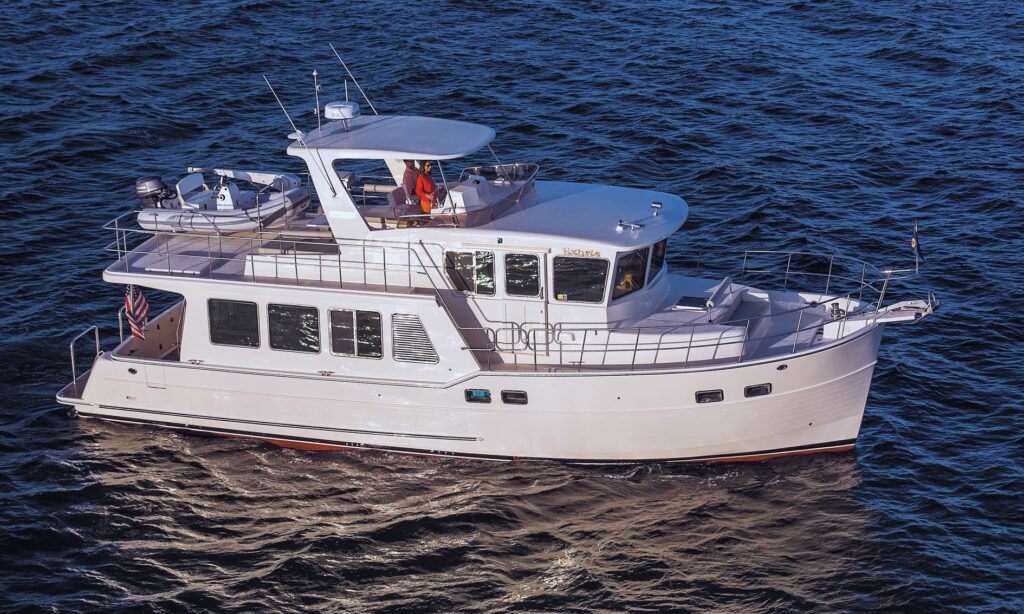
Nameplate fuel capacity will betray you if you treat it as a passage budget. A long run across open water—whether down the Pacific Coast, across the Gulf of Maine, or through the Exumas—demands an arithmetic budget built on running time, auxiliary burn, and environmental drag rather than a simple division of tank gallons by engine cruising speed.
Planning a passage comes down to controlling known variables and budgeting for the unknown ones. By treating your fuel capacity as a working operating budget with dedicated line items for the main engine, generator, and operational reserves, you eliminate the guesswork before slipping lines.
Usable Fuel vs. Nameplate Tankage
Usable fuel can differ from nominal tank capacity because of tank and pickup arrangements, trim and operating conditions. Establish the figure for the actual installation instead of subtracting a universal percentage.
Usable fuel is still not the planned passage allowance: a deliberate reserve remains separate.
On our 49 Pilothouse, standard fuel capacity is 700 gallons, with an optional configuration expanding capacity up to 920 gallons. That 700- or 920-gallon figure is an engineering specification, not a range promise.
Review our 49 Pilothouse equipment when considering the available tank configuration. Actual consumption depends on the boat, loading, speed and conditions; tankage alone cannot establish a passage range.
Calculating the Leg Budget: Time and Total Consumers
Marine diesel engines consume fuel as a function of horsepower delivered over time, not distance over the seabed. To build an accurate passage budget, calculate the run in hours, determine the burn for those hours based on your own observed logs, and budget for every diesel consumer on board.
The baseline calculation follows two primary steps:
Estimated running hours = leg distance in nautical miles ÷ anticipated speed over ground in knots.
Estimated fuel consumed = running hours × observed engine consumption in gallons per hour, plus separately calculated fuel for other consumers.
Auxiliary Generation Is Not Free
A common oversight on long offshore runs is ignoring auxiliary diesel consumption. If you run a generator continuously underway to power reverse-cycle air conditioning, high-output watermakers, or galley appliances, include its fuel consumption in the total budget, checking which tanks supply it.
Even intermittent daily cycling to top off house batteries accounts for a measurable volume over a multi-day run.
While the nuances of load balancing are covered when sizing a cruising generator or planning a trawler battery bank, your passage budget must account for this burn directly:
| Consumer | Operating Metric | Baseline Rate (Hypothetical) | Total Run Time | Subtotal |
|---|---|---|---|---|
| Main Engine | Hypothetical passage at 8.0 knots SOG | 5.0 GPH | 30 hours (240 nm leg) | 150.0 gal |
| Generator | Morning/Evening Battery Cycles | 0.6 GPH | 6 hours total | 3.6 gal |
| Alternative generator scenario | Continuous use instead of the cycling example | 0.8 GPH | 30 hours total | 24.0 gal |
Note: The burn figures above are purely hypothetical examples for demonstration purposes. They do not reflect verified performance figures for any specific hull or propulsion combination.
Current, Weather, and Detour Scenarios
A static fuel plan falls apart the moment environmental resistance changes your speed over ground (SOG). Running into a headcurrent or heavy sea state forces a choice: advance the throttle to maintain scheduled speed (sharply increasing hourly burn), or hold steady engine load and absorb the loss of speed over ground (extending run time and total passage burn).
At an unchanged hourly consumption rate, slower progress over the same distance increases running time and fuel use. If engine load or speed changes too, update the consumption assumption as well.
Environmental Impacts on the Passage Budget
-
NOAA Current Observations: As a simplified arithmetic example, a sustained 1.5-knot headcurrent against an 8-knot through-water speed reduces speed over ground to 6.5 knots. On a 200-nautical-mile passage, that velocity drop extends run time from 25 hours to nearly 31 hours. That means six extra hours of continuous engine and auxiliary fuel burn over the same geographic distance.
-
National Weather Service (NWS) Marine Warnings and Watches: Marine forecasts cover coastal and offshore zones with distinct boundary lines. NWS marine watches mean hazardous conditions are favorable but not assured; warnings mean dangerous winds, seas, or squalls are occurring or imminent.
-
Detours and Evasive Routing: Heading off-track to avoid a worsening offshore zone, jogging into an inlet to wait out a squall line, or diverting around a reef system adds physical distance.
A static “10% rule” or blanket reserve percentage fails because it ignores the geometry of the route. If your escape route to an alternate port requires running 45 nautical miles beam-to-seas against a tidal sweep, your contingency fuel must reflect that exact distance and speed—not an arbitrary percentage left in the tank.
Establishing an Actionable Reserve
Choose a reserve fuel allowance before departure and retain it for a changed plan. It is a chosen volume of usable fuel, separate from expected consumption, that preserves options if a harbor is closed, weather changes or progress slows.
Compare usable fuel with the estimated consumption, contingency allowance and reserve before committing to the leg. Allow for a viable alternate stop, time lost to conditions and any additional generator or heating use.
Do not double-count unusable fuel as reserve. The reserve is fuel available for a changed plan, while fuel the installation cannot reliably deliver is unavailable in the first place.
Before departure, plot explicit go/no-go waypoints along the route. These are geographical checkpoints where you reconcile burned fuel against remaining distance.
If you reach a go/no-go waypoint and find that headcurrents or detours have eaten into your contingency volume, the plan dictates that you divert to a pre-identified secondary fuel stop while you still have the supply to do so comfortably.
Logging and Reconciling Underway
A fuel plan is a living calculation. Use the yacht’s actual monitoring equipment and keep a consistent log of engine and generator hours, consumption estimates and progress. Understand how each gauge or monitoring system should be read and its limitations.
-
Compare actual progress and consumption with the departure assumptions.
-
Update expected arrival time and remaining fuel needs when conditions change.
-
Reconcile readings with refueling records and other available evidence.
-
Reassess alternate stops before dwindling margin limits the choices.
A slower speed may improve fuel economy in some circumstances, but use boat-specific evidence and the route conditions rather than assuming every speed reduction fixes a shortfall.
Long-range trawler cruising is about managing margins with discipline. If you are preparing an offshore route, reviewing fuel capacities, or setting up a vessel for serious distance, talk with us about configuring your boat for extended, self-sufficient travel.