

A yacht specification sheet provides a standardized summary of a boat’s dimensions, capacities, and mechanical layout. It does not, however, tell you how that boat behaves in a chop, whether you can comfortably reach the primary fuel filters, or what your actual monthly marina bill will look like.
When you line up specification sheets from different builders, you are rarely comparing identical baselines. One builder publishes dry weights with empty tanks and bare hulls; another publishes half-load displacement with standard joinery and auxiliary gear included. Learning to dissect these documents allows you to filter out marketing fluff, spot missing operational variables, and determine whether a yacht matches your crew and cruising grounds.
Standard Configurations, Options, and Matching Baselines
Confirm the publication date, model and configuration before comparing numbers. Ask which equipment and loading condition the displacement describes, and whether an optional package changes any of the figures.
Cross-reference the specification with the new yacht equipment list. Dimensions and capacities help describe the boat; the equipment list explains the package under discussion. A listed system may still need its exact model, inclusion and installation state clarified.
Keep units consistent. US gallons, Imperial gallons and liters are different measures, as are short tons, long tons and metric tonnes. If a sheet uses an ambiguous unit or weight description, ask what it means before calculating or comparing.
Do not assume “light ship,” “half-load” or “loaded for cruising” means exactly the same thing across builders. Retain the stated condition beside the number, and ask what the boat carries in that condition.
Hull Dimensions: Translating LOA, LWL, Beam, and Draft to Marina Reality
LOA is overall length; LWL is length at the waterline. They describe different parts of the boat. Ask what is included in the published LOA and what a marina or yard requires for moorage and handling. Beam informs physical fit, but does not show the usable width of every passageway or berth.
Draft and air draft are route questions. Confirm the actual boat’s loaded draft and height, then evaluate local depths, tides, bridge clearances and suitable margins through current route information. A model-page height to the hardtop may not describe every antenna or accessory aboard.
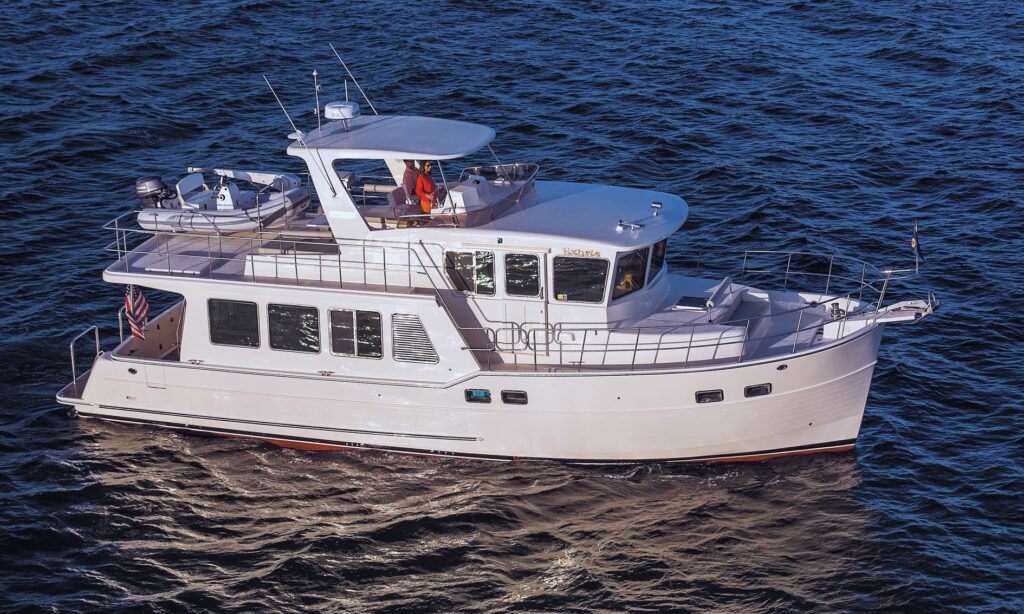
Our 49 Pilothouse specifications provide a concrete example:
- LOA: 51 ft 4 in.
- LWL: 46 ft 10 in.
- Beam: 15 ft 4 in.
- Draft: 4 ft 10 in.
- Air draft: 17 ft 4 in to the top of the hardtop, with 15 ft listed for the optional folding radar arch.
Keep the height reference and optional configuration attached to those numbers. They help you ask which arrangement fits your route; they do not establish clearance under an individual bridge or describe every fitting on a delivered yacht.
Tankage Numbers vs. Usable Trip Range
Fuel capacity is not the same as trip range. Published range data needs its engine, fuel quantity, loading, conditions and reserve kept together. Usable fuel and a prudent trip reserve need to be established for the actual boat and voyage.
Our 49 Pilothouse has 700 gallons of standard fuel capacity, with 920 gallons optional. Its published range data uses particular engine and tankage configurations. The notes identify calm conditions, a boat loaded for cruising and a 10% reserve; the tankage shown with a performance chart must not be silently replaced by the standard capacity.
Use those notes to compare the conditions behind two sets of numbers. Ask whether a range estimate includes a reserve and which installed configuration it describes. Weather, loading, speed and other operating conditions can change the result; a chart does not guarantee a passage distance.
Freshwater and holding capacity also need the crew’s routine and refill or pumpout opportunities. At the shopping stage, identify which capacities could shape stops. Detailed voyage planning belongs with the actual itinerary and consumption observations.
Interpreting Engine Options and Speed Ratings as a System
Read engine, cruise-speed and top-speed lines together. Ask which configuration produced the published figures and which conditions accompanied the test. Horsepower alone cannot establish speed, fuel consumption or suitability for your intended pace.
For engine duty and operating limits, use the manufacturer’s information for the exact model and rating. Do not substitute a universal throttle percentage or daily maximum-output allowance for the equipment instructions.
Single and twin packages can change the machinery arrangement and service requirements. Ask about the actual installation, access, maintenance and available performance data. A useful comparison evaluates the package you would buy at the pace you expect to use, rather than extrapolating from another engine option.
The Critical Layout Details No Spec Sheet Can Show
A spec sheet is a flat, two-dimensional summary. It tells you what equipment is installed, but it reveals nothing about how that equipment fits into daily life aboard.
When you step aboard a yacht, look beyond the numbers to inspect:
- Engine Room Access and Working Clearances: A spec sheet lists the generator output and primary propulsion, but you must step aboard to evaluate serviceability and verify whether changing an impeller, swapping an alternator belt, or draining a fuel-water separator requires contortions. Look for clear walkway space, direct overhead clearance, and easy sightlines to sea strainers.
- Traffic Flow and Handholds: Dimensions do not show whether two people can pass each other in the galley, whether steps are too steep for pets or aging knees, or whether you can transit safely from the pilothouse to the foredeck in heavy seas.
- Liveaboard Stowage Volume: A boat can claim three staterooms on a brochure, but offer no hanging lockers deep enough for foul-weather gear, no dry storage for extra provisions, and no designated locker space for fenders, shore power cables, and secondary ground tackle.
- Helm Sightlines: A spec sheet will not tell you if the pilothouse mullions block your view of the starboard quarter from the helm chair, or whether you can see the swim step while backing into a slip.
A Structured Framework for Side-by-Side Model Evaluation
Build the comparison around your route, crew and ownership habits. Record the number, its qualifier and the question it raises.
| Specification | Practical question | Confirmation needed |
|---|---|---|
| LOA and beam | Will the boat fit suitable moorage and yard facilities? | Measurement reference and facility requirements |
| Draft | Which waters and entrances need closer planning? | Actual loaded draft and current local depth information |
| Air draft | What overhead limits affect the intended route? | Height reference, configuration and all relevant fittings |
| Fuel capacity and range | How might fuel stops shape the trip? | Engine, tankage, test conditions, usable fuel and reserve |
| Water and holding capacity | How will crew habits and services affect stops? | Actual use pattern and refill or pumpout opportunities |
| Displacement | Which loading condition does the number describe? | Equipment and liquids included in the stated figure |
| Engine and speed | Does the package fit your cruising pace? | Configuration-specific data and manufacturer limits |
The figures help you shortlist boats and ask better questions. To evaluate serviceability, movement, storage and sightlines, follow the sheet with drawings and an aboard visit.
If you would like to discuss our models and the configuration behind their published numbers, contact our team.