

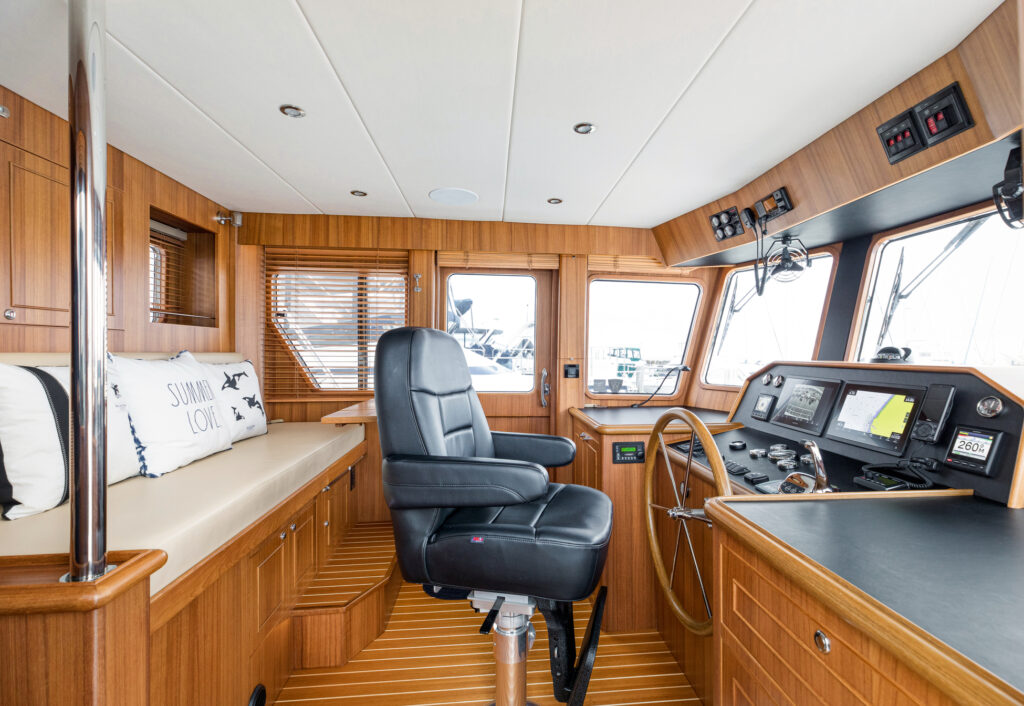
Choosing between our North Pacific 45 Pilothouse and the Helmsman 43E begins with the way your crew wants to live and work aboard. Their published overall lengths are only two inches apart, but their helm, accommodation and equipment arrangements give you different details to examine.
A close-size comparison is useful when it leads to a better walkthrough and a clearer quotation. Start with the dimensions, follow a normal day through each interior, then compare the exact equipment and options you would purchase.
Dimensional Baseline and Specifications
| Specification | North Pacific 45 Pilothouse | Helmsman 43E |
|---|---|---|
| Published LOA | 45 ft 8 in | 45 ft 6 in |
| Beam | 13 ft 8 in | 14 ft 2 in |
| Draft | 4 ft 6 in | 4 ft 6 in |
| Fuel capacity | 400 gal; 700 optional | 600 gal |
| Freshwater capacity | 240 gal | 200 gal |
| Listed engine | Single Cummins QSB 355 hp; larger singles and twins available | Cummins QSB 6.7, 380 hp; engine options available |
These figures establish a comparison point, not a shared slip classification or an interior-volume ratio. Confirm overall dimensions and projections on the boat you are considering, then check your berth, yard and waterway requirements.
Helm Design and Daily Traffic Flow
The North Pacific 45 Dedicated Pilothouse
Our 45’s pilothouse has a central helm seat and a raised bench seat and table aft. The bench can extend into an L-shaped arrangement or convert into a bed. Two opening side doors connect the space with the exterior.
The galley, staterooms and heads can be reached without passing through the pilothouse. If one person expects to rest while another takes the helm, that arrangement gives you a specific route to evaluate. Test conversation, sound, lighting and reflections aboard rather than assuming separation will eliminate every disturbance.
The Helmsman 43E Low-Rise Pilothouse
The 43E has a low-rise pilothouse communicating with a full-beam salon. Its current specification includes port and starboard pilothouse doors, two staterooms and two heads, including a day head adjacent to the salon. Helmsman also describes a convertible salon settee that can be enclosed with the day-head area for additional guest use.
Consider whether you want people to gather close to the operating station and how that works during meals or watch changes. Inspect both doors and the actual deck routes. Neither an open connection nor a more distinct pilothouse is automatically better for every crew.
Accommodations and Interior Living Space
Our 45 also has a full-beam salon, with exterior access arranged through a raised walkaround. Its salon furniture can be configured with different settee, dinette and recliner arrangements. The galley sits in the salon, while the accommodations are accessed directly from it.
The guest room can have a bed, bunks or an office/bunk arrangement, depending on the selected plan. Compare the sleeping and flexible-use spaces with the people who regularly cruise with you.
The 43E’s two-stateroom and day-head arrangement offers another way to divide private accommodation and guest use. Walk the route from each berth to the heads and shared spaces, and check what storage remains when a convertible space is in use.
If the decision is still about overall model size, compare the 45, 49 and 590 before concentrating on this close-size pair.
Machinery, Performance, and Standard Equipment
Engine Power and Dynamics
The 45’s listed 355 hp engine and the 43E’s listed 380 hp engine do not establish a speed, fuel-consumption or handling winner. Compare current performance information for the installed package, including loading, propeller configuration, speed and conditions. Engine options also need to be identified in the proposed quotation.
Fuel Capacities and Range Assumptions
Our 45 has 400 gallons of fuel capacity as standard, with a 700-gallon option. The 43E lists 600 gallons. Those capacities cannot determine the suitability of a particular voyage.
Our 45’s published 355 hp range chart uses the 700-gallon configuration, almost-full fuel and water, cruising load, calm conditions and a 10% reserve. Keep that configuration with the chart. Do not apply its result to a standard-capacity boat or a different engine package, and ask for equivalent detail when reviewing the Helmsman.
For an actual trip, use boat-specific consumption, usable fuel and an appropriate reserve plan. Auxiliary consumption, loading and conditions also belong in that discussion.
Construction, Finishes, and Systems Access
Joinery and Living Materials
Our 45 interior uses handcrafted teak paneling, bookmatched flush cabinetry, dovetailed drawers and real teak-and-holly floors. Selected lighter materials, large windows and layered lighting contribute to its interior direction.
Helmsman’s 43E specification includes teak solids and veneers, teak-and-holly floor planks and multilayer satin polyurethane finishing. Compare the actual surfaces, cabinet operation and available finish choices; neither material list proves that one yacht will last longer or cost less to maintain.
Laminates and Structural Systems
Our 45 has a solid hand-laid fiberglass hull, vinylester resin in the outer two layers and a fiberglass stringer grid. The superstructure uses primarily closed-cell foam coring, with rigid PVC in selected higher-strength areas.
The 43E has a solid FRP laminate hull with vinylester in external layers, an internal FRP grid and PVC-foam-cored decks. Its removable ceiling panels and wireways are specific service-access details to inspect. Review the applicable construction documentation with qualified help where appropriate, without turning these choices into a blanket quality ranking.
Serviceability Checks
Locate the routine inspection and service points on each boat. Check working clearance around filters, pumps, batteries, strainers and plumbing, and see how hatches or panels open with the selected furniture in place. Ask a marine technician about the actual machinery’s maintenance requirements if you expect to do some work yourself.
Defining Value: Spec Sheets and Quote Comparisons
The useful price comparison is between two defined purchase scopes. Mark each item as included, optional, an allowance or excluded:
- Engine package, controls and thrusters.
- Generator, inverter/charger, batteries and shore-power equipment.
- Heating, cooling and intended electrical loads.
- Navigation displays, radar, autopilot and communication equipment.
- Ground tackle, tender provisions, davit and exterior covers.
- Cabin plan, appliances, furniture and finishes.
- Transport, offloading, commissioning, handover and warranty responsibilities.
Both builders offer options and customization choices. Confirm what is available for the model under discussion and what is actually included in the quote. The comparison does not need unsupported resale forecasts or a claim that one brand cuts corners.
Choosing the Right Yacht for Your Routine
Bring the same crew to each walkthrough. Sit at the helm, prepare an imaginary meal, follow the accommodation routes and inspect door operation while secured. Then compare the spaces you would use during an ordinary trip, not just the biggest room or longest equipment list.
Our 45’s dedicated pilothouse, salon-level accommodation access and flexible guest room are concrete choices to explore. The 43E’s low-rise pilothouse, two staterooms and salon-adjacent day head provide a different combination. When you talk with our team, bring the features you prefer and the questions that remain about your proposed 45 configuration.