

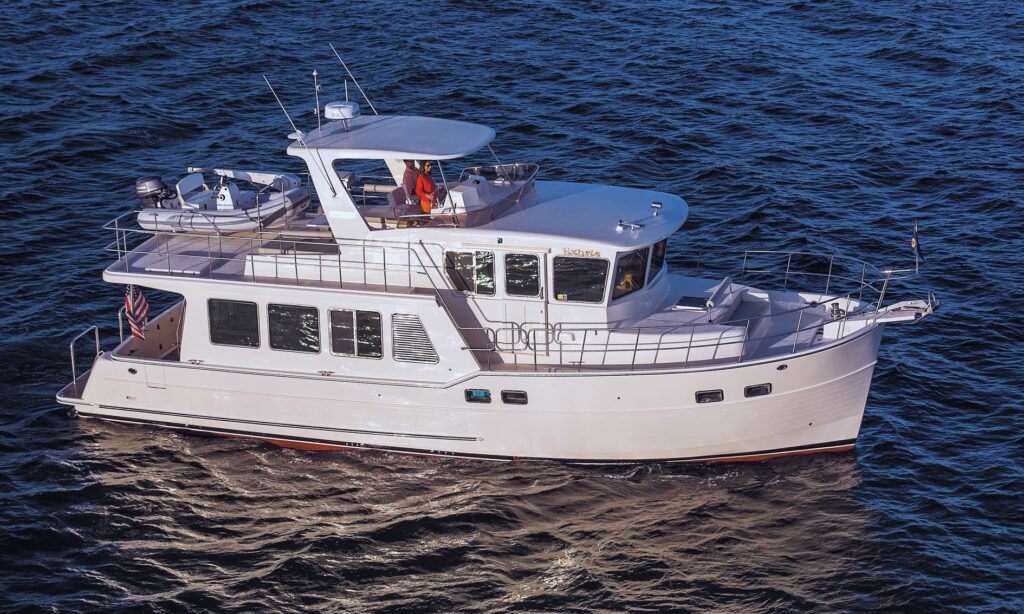
Choosing the size of a pilothouse yacht starts with the trips and people you expect to repeat. Extra space is useful when it solves a real accommodation, storage or living need. The smaller model deserves equal consideration when its arrangement already supports your plans.
Our North Pacific 45 Pilothouse, North Pacific 49 Pilothouse and North Pacific 590 Pilothouse offer different dimensions and configuration choices. Compare those particulars with your crew, berth, equipment and daily workload before deciding how much boat you need.
Start with the Trips and Crew You Actually Cruise With
Build a simple cruising brief:
- Who regularly sleeps aboard, and how often do other people join?
- How long are the trips you expect to repeat?
- Which rooms need privacy, and which should also support work or storage?
- What gear, spares and provisions need a permanent place?
- Which marinas and yards do you expect to use?
- Who performs the operating, dockside and maintenance tasks?
Include occasional guests without allowing a rare trip to decide every room. At the same time, do not dismiss a recurring need simply because it takes more space. The right size is the one that supports the life you intend to have aboard.
Dimensions, Capacities, and Propulsion Configurations
| Specification | North Pacific 45 Pilothouse | North Pacific 49 Pilothouse | North Pacific 590 Pilothouse |
|---|---|---|---|
| Published LOA | 45 ft 8 in | 51 ft 4 in | 61 ft 4 in |
| Beam | 13 ft 8 in | 15 ft 4 in | 18 ft 4 in |
| Draft | 4 ft 6 in | 4 ft 10 in | 5 ft 10 in |
| Fuel capacity | 400 gal; 700 optional | 700 gal; 920 optional | 1,800 gal |
| Listed power | Single Cummins QSB 355 hp | Single Cummins QSB 355 hp | Twin Cummins QSL9, 405 hp each |
| Other engine choices | Larger single or twin options | Larger single or twin options | Larger twin and single options |
These figures frame the comparison; they do not establish a universal moorage fit, handling category or equal interior-volume relationship. Confirm the actual overall dimensions, projections and loading of your proposed yacht, then check your berth and yard requirements.
Tank capacity also does not decide cruising range. Our 45 and 49 performance charts describe particular engines, capacities, loading, calm conditions and a reserve. Use the applicable curve and boat-specific information when evaluating performance, rather than transferring the same assumptions to every model.
Living Space and Cabin Configurations
North Pacific 45: Traditional Flow
Our 45 has a full-beam salon with customizable seating and a galley in the salon. The staterooms and heads can be reached directly from the salon without passing through the pilothouse. The guest room can have different sleeping or office/bunk uses depending on the selected plan.
In the pilothouse, a central helm seat sits ahead of a raised bench and table. The bench can extend into an L-shaped arrangement or convert into a bed, and two opening side doors connect with the exterior. Compare these details with your actual crew and the way you prefer to move through the day.
North Pacific 49: Salon and Accommodation Choices
Our 49 also has a full-beam salon with customizable furniture and a galley in the salon. Its accommodation choices include two or three staterooms, or two staterooms and an office.
Most accommodation arrangements are reached from the salon. Full-beam midship master designs with access from the pilothouse are also available. The pilothouse has room for two helm seats and an L-shaped settee and table aft.
Study the plan that addresses your needs rather than assuming the additional length automatically solves every storage or guest-space problem. Check where your own gear and supplies will go and which access arrangement you prefer.
North Pacific 590: Master and Helm Options
Our 590 has a full-beam master with a nearly-king bed and flexible guest-room arrangements. The interior offers two or three staterooms forward and optional lazarette quarters. Review our 590 stateroom choices to connect your crew’s requirements with a particular accommodation proposal.
The standard pilothouse helm is forward of the galley. Selecting the optional Skylounge removes the lower helm and encloses the upper helm and gathering area, with a sliding door to the aft flybridge. That is a separate choice from cabin count and one worth examining after the overall model size is settled.
Shoreside Limits and Daily Maintenance Demands
Check the infrastructure you expect to use before assuming a model will fit. Ask marinas for their actual length, beam, depth and access requirements. Ask yards about the proposed boat’s dimensions, displacement and lifting requirements. Avoid relying on a generic “45-foot slip” or equipment label.
Consider the daily work as well as the largest room. Inspect the installed engines and systems, routine checks, washdown areas, storage and access panels. More equipment or exterior area may add work, but the actual installation and your division of tasks matter more than a model-size assumption.
Do not assume any particular yacht can be handled safely by a crew of two simply because it has thrusters or a convenient door. Discuss operation and crew suitability for the individual boat, conditions and experience involved.
Evaluating the Shortlist During an Onboard Walkthrough
Bring your regular cruising partner and the same requirements list to each model:
- Sit at the helm and companion position. Check the views and space each person expects to use.
- Follow the actual exterior and interior routes while the boat is secured. Inspect stairs, thresholds and handholds.
- Open galley and storage spaces with your provisioning list in mind.
- Examine machinery and routine service access, with qualified help where appropriate.
- Trace the routes between berths, heads, shared spaces and the helm, especially when someone is resting.
If two smaller models meet your needs, our 44 Sedan and 45 Pilothouse comparison addresses a different helm/living-space choice. Once the 590 is selected, its helm and accommodation guides can help with those more specific decisions.
Defining Your Cruising Brief
Use the model comparison to decide what deserves a closer look. The 45, 49 and 590 differ in physical dimensions and the arrangements available, but the most useful next step is to connect those choices to your own recurring needs.
When you talk with our team, bring your usual crew, gear list, preferred cabin functions and known berth constraints. We can discuss the current models and the details to confirm for your proposed configuration.