
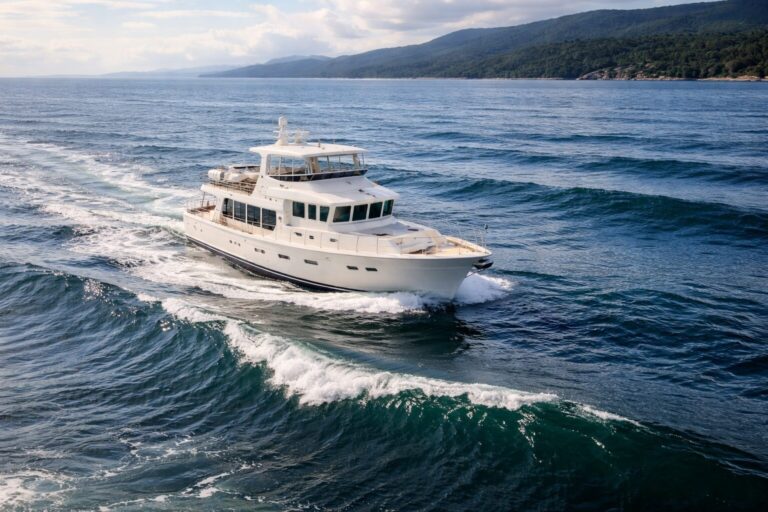
If you have ever stepped from a fast planing yacht onto a trawler, the first thing you may notice is the mood. The trawler feels settled. Conversations feel easier. Coffee stays in the mug longer. Even when the sea has a bit of texture, the boat often feels like it is working with the water instead of fighting it. This does not mean faster yachts are “bad” boats. Many are excellent at what they are designed to do. But speed changes how a hull meets the ocean, and it changes how we feel on board. In the North Pacific, where conditions can shift quickly and the distances can be long, the calm character of a trawler is one of the biggest reasons people fall in love with the style. Below are the main reasons trawlers often feel calmer at sea, explained in a general, practical way.
1) Speed Changes the Whole Relationship With Waves
A faster yacht usually aims to get on plane. Planing means the hull climbs up and rides more on top of the water. At the right speed and in the right conditions, that can feel exciting and efficient. But in mixed seas, it can also feel more active because the boat is constantly meeting the next wave at higher relative speed. A trawler, by design, runs at displacement or semi displacement speeds. Instead of skipping across the surface, it moves through the water with a steadier rhythm. That slower pace is not only about comfort, it is about physics. When you reduce speed, you reduce the impact energy when the hull meets a wave. That can mean less pounding, fewer sharp motions, and a more predictable ride.
There is also timing. At lower speeds, a boat is less likely to “launch” off wave tops. It tends to follow the shape of the sea. The motion is still there, but it often feels rounder and less sudden. This is one reason trawler owners talk about arriving less tired after a long passage. The boat may take longer, but it can ask less of the crew. In the North Pacific, you also deal with swell and wind waves at the same time. A longer swell from a distant system may roll under you while a shorter chop hits from a different angle. High speed can make these patterns feel harsher because you meet them more frequently. A trawler’s moderate speed can make the sea feel more “spaced out,” which many people experience as calmer.
2) Hull Form and Weight Work in Your Favor
Trawlers are typically built with comfort, range, and sea keeping as priorities. That often leads to hull shapes and construction choices that naturally soften motion. Many trawlers have fuller displacement hulls with a deeper forefoot and more volume forward. That shape can help the bow slice and lift smoothly instead of slapping. The boat is not trying to climb onto plane, so the hull can be optimized for steady movement through a wide range of conditions.
Weight is another big factor. Trawlers are often heavier than comparable length fast yachts because they carry larger fuel capacity, robust systems, and structures intended for long range use. In boating, weight is not always a negative. More mass can reduce quick accelerations. In simple terms, a heavier boat resists being tossed around. The sea still moves it, but it often takes more energy to make it react sharply. Balance matters too. Designers aim for a comfortable center of gravity and a layout that keeps weight low and centered. Tanks, machinery, and systems are often placed with passage making in mind. A lower center of gravity generally improves stability and reduces the snappy feel that can happen when weight is high. A common misconception is that a boat should be light to feel smooth. In flat water, light can feel lively and fun. In rougher water, a certain amount of mass and a hull made for displacement travel can feel more composed.
3) Stability, Roll Behavior, and the “Softness” of Motion
When people say a trawler feels calmer, they are often talking about roll. Roll is the side to side motion, and it is one of the main triggers for discomfort and fatigue. Two boats can be equally safe yet feel very different because of roll timing and roll amplitude. Trawlers are usually designed with steadying at sea in mind. Many include stabilizers, either fin stabilizers, gyro systems, or other solutions depending on the design and owner priorities. Stabilizers can reduce roll significantly, especially during longer passages when the sea state is not perfectly aligned with your heading. Even without stabilizers, many trawlers have hull proportions and weight distribution that create a slower, more predictable roll period.
That roll period is important. A quick, snappy roll can feel unsettling, like the boat is constantly flicking side to side. A slower roll can feel more gentle, even if the angle is similar. The goal is not to remove motion entirely. The goal is to shape motion into something the body can tolerate, and even ignore after a while. Faster yachts can also have stabilizers, and many do. But when a boat is running at high speed, additional factors come in, such as dynamic lift and how the hull transitions from wave to wave. Those effects can add complexity to the motion. Trawlers tend to feel calmer because the motion is less complicated. The boat is not changing “modes” between displacement and planing. It is staying in its comfort zone. It is also worth mentioning beam and hull shape. Some trawlers have generous beam for interior volume, but good designs balance that with underwater shape that behaves well in a seaway. Comfort is never just one number. It is the combination of hull form, weight, and how the boat is intended to be used.
4) Range, Systems, and the Passage Making Mindset
Calm is not only a physical sensation. It is also a feeling of confidence. Trawlers are often built for long range cruising, which means systems are designed to support extended time on the water. That mindset changes how owners plan trips, and it changes the stress level on board. For example, a long range trawler usually carries more fuel relative to its speed and consumption. It may have redundancy in key systems, strong ground tackle for anchoring, and storage for supplies. These features support the idea that you can choose your weather windows, slow down when needed, and still reach your destination comfortably.
Fast yachts often focus on getting there quickly, which can be a real advantage. But speed can tempt people to push marginal conditions because the trip is “only a few hours.” In areas like the North Pacific, conditions can change quickly. The ability to slow down, adjust course, or wait it out without feeling like you are losing the whole plan is a kind of calm that matters. There is also the sound and vibration factor. Trawlers typically run at lower engine rpm for cruising. This can reduce noise, vibration, and the sense of strain. On many boats, a quieter machinery space and a steady engine note can make the whole interior feel more peaceful, even before you look outside. A trawler’s comfort is often tied to its purpose. It is a boat that expects to be at sea, not just to cross it quickly.
5) Comfort On Board: Layout, Sightlines, and Everyday Living
A calm ride is partly about what the sea does to the hull, and partly about what the boat does for the people inside it. Trawlers often have pilothouses with excellent visibility and protected watch standing. Being able to see the horizon and read the water helps with motion comfort. It also helps with decision making. When you can see clearly from a stable helm position, you feel more in control.
Interior layouts on trawlers are also typically designed for life underway. Handholds are placed where you need them. Walkways feel secure. Galleys are often arranged so you can cook safely while the boat moves. These details matter more than people think. When you can move around without bracing every second, the whole day feels calmer. The motion you feel inside the boat can also be softened by how the space is built. Solid joinery, thoughtful seating, and practical storage reduce rattles and reduce clutter. On longer trips, this makes a real difference. A boat that feels organized and quiet supports a calmer crew. Finally, the social pace is different. On a trawler, the journey is part of the point. People read, cook, talk, and watch the coastline slide by. On a high speed run, the focus can be more on the destination and the act of driving. Neither approach is wrong, but the trawler style naturally encourages a slower rhythm, which many people associate with comfort and calm.
The Calm That Lets You Go Farther
Trawlers feel calmer at sea because they are built to move with the ocean at a sensible pace, with hull forms and weight that soften motion, and with systems and layouts that support long days on the water. Faster yachts can be thrilling and capable, but speed brings higher impacts and more dynamic motion, especially in mixed conditions. In the North Pacific, where passages can be long and the sea has its own personality, that trawler calm can be more than a comfort feature. It can shape the entire cruising experience. It lets you slow down, watch the weather, enjoy the ride, and arrive feeling ready for what comes next.
We turn your cruising dreams into reality by developing bespoke trawler and pilothouse yachts built for comfort, safety, and performance. From the initial hull design to the final varnish, our experienced naval architects and craftsmen collaborate with you every step of the way, integrating fuel-efficient engines, ergonomic deck layouts, and beautifully appointed living spaces. With industry-leading warranties and personalized support, we make sure your new yacht feels like home the moment you step on deck. Reach out to us by email at info@northpacificyachts.com for personalized responses to all your inquiries. If you’d prefer a conversation, we invite you to give us a call at 1-877-564-9989.
Frequently Asked Questions
1) Why do trawlers feel more stable than faster yachts in rough water?
Trawlers usually run at displacement or semi displacement speeds, so they meet waves with less impact energy and a steadier rhythm. Many also have heavier builds and long range cruising hull designs that reduce quick, jerky motion, which can feel calmer in choppy or mixed seas.
2) Are trawlers safer than faster yachts in the North Pacific?
Safety depends on design quality, maintenance, crew skill, and good decision making. That said, trawlers are often built for extended offshore cruising with strong structures, long range systems, and stable operating speeds, which can be well suited to North Pacific conditions when used properly.
3) Do trawlers have stabilizers, and do they really help?
Many trawlers offer fin stabilizers or gyro stabilizers. These systems can significantly reduce side to side rolling, especially at cruising speed and when seas hit from angles. Less roll usually means better comfort, less fatigue, and fewer seasickness issues for passengers.
4) What is the best cruising speed for comfort on a trawler?
Most owners find the most comfortable speed is the boat’s normal displacement cruising speed, often where the hull moves efficiently without pushing hard. The exact number depends on hull design, load, and sea state, so comfort is usually found by adjusting speed to match the wave pattern and conditions.
5) What should I look for in a trawler yacht for long range cruising?
Look for a proven hull design, good stability features, efficient fuel burn, protected pilothouse visibility, safe deck walkarounds, and reliable mechanical and electrical systems. For North Pacific cruising, practical details like strong anchoring gear, heating, ventilation, and weather protection also matter a lot.