

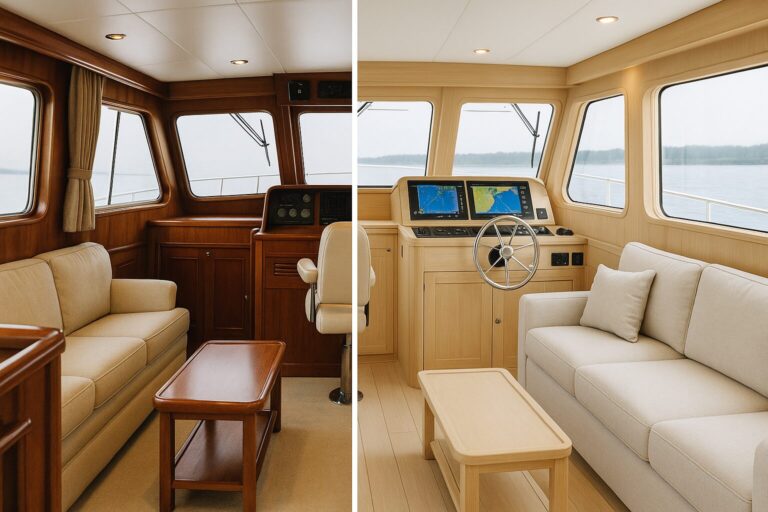
Every successful refit begins with physical reality rather than a wish list. Trawlers are complex industrial ecosystems enclosed in fiberglass, where a single deferred maintenance issue can compromise an entire suite of expensive cosmetic or electronic additions. Approaching a major overhaul requires a disciplined sequence: establish the vessel’s baseline condition, map system dependencies so work is not duplicated, and design improvements around how your crew actually lives at anchor and underway.
Establishing the Baseline: Surveys, Service History, and Mission Scope
A comprehensive refit plan starts with an unvarnished audit of the hull, machinery, and electrical backbone. Too many projects stall because an owner buys new navigational displays while seawater is weeping through rudder stock packings or freshwater plumbing is degrading behind joinery.
The most reliable baseline combines an out-of-water inspection, a sea trial under load, and a forensic review of past service logs. If you recently acquired the vessel, your prepurchase marine survey provides an essential starting catalog of safety deficiencies, structural concerns, and inventory conditions. Remember, however, that a survey identifies visible defects and evaluates valuation; it does not troubleshoot intermittent electrical faults, run extended load tests on heat exchangers, or guarantee machinery longevity.
Before committing yard funds, draft a clear mission statement for the boat:
- Are you prepping for coastal hops with nightly marina slips, or self-sufficient multi-week anchoring along remote coastlines?
- What specific discomforts or operational bottlenecks have you personally measured during extended passages?
- Does the existing hull and mechanical layout support this scope, or does the required investment push the project into the territory of a refit versus new build evaluation?
Answering these questions prevents “scope creep”—the slow accumulation of unrelated jobs that balloons yard bills and keeps boats trapped on the hard for seasons.
The Hierarchy of Dependencies: What Needs to Happen First
Plan the sequence around dependencies: condition and leak repairs, machinery access, infrastructure, power capacity, interior work and electronics installation. The actual order depends on what the survey and yard find; coordinate jobs so new work does not obstruct later repairs.
1. Watertight Integrity and Structural Repairs
Address all moisture intrusion before touching the interior. Deck core rot beneath leaking stanchions, crazed deck hatches, failing portlight gaskets, and questionable thru-hull assemblies must be repaired first. Installing new cabinetry or acoustic headliners under a deck that leaks during heavy spray is wasted capital.
2. Machinery and Running Gear
Have the appropriate specialists assess engines, generators, steering and running gear while access is available. Coordinate disruptive repair work before finishes that could be damaged or obstruct access.
3. Service Access and Infrastructure Chases
Before building out new bulkheads or sealing overheads, protect your future maintenance pathways. Long-range cruisers require swift access to pumps, manifolds, and cable runs. Our North Pacific 49′ Pilothouse equipment is accessible through hatches, removable headliners and wiring chases. When planning structural adjustments or custom furniture, never box in a valve, junction box, or steering component to save a few inches of locker space.
4. Primary Electrical Architecture
Calculate your total electrical budget before selecting appliances or climate gear. Modern high-draw conveniences demand substantial house banks and clean inverted power. Adding high-output alternators, an expanded AGM bank, or a Victron inverter/charger requires reviewing conductor sizes, fuse locations, and battery compartment ventilation.
If you are shifting toward lithium iron phosphate (LiFePO4) storage to reduce generator runtimes, verify charging profiles, BMS shutoff integration, and alternator protection devices before buying domestic appliances.
5. Navigational Suites and Helm Ergonomics
When modernizing an existing pilothouse, mount displays, radar scanners, and transducer cabling only after primary power distribution is stable and clean. For electronics, establish compatibility, power and network requirements with the installer. Our NP49 Garmin suite includes chartplotters, autopilot, radar, fish finder and VHF radios; exact components change, so it does not establish the hardware required for your refit.
6. Weight Distribution and Stability Reviews
Every substantial system added to a trawler impacts its displacement, center of gravity, and trim. Heavy machinery, oversized battery arrays, larger tenders on the boat deck, or added fuel bladders alter transverse and longitudinal stability.
Consult Transport Canada’s vessel stability guidance or an independent naval architect whenever moving heavy equipment, altering watertight bulkheads, or adding overhead loads. A refit that compromises righting energy or causes a persistent list undermines safety long before you reach open water.
Prioritizing Daily Routines Over Feature Lists
Refit marketing often pushes standalone technologies as cure-alls for onboard comfort. In practice, long-term crew happiness depends on mundane daily workflows: sleep quality, meal preparation, personal hygiene, and quiet living spaces.
| Daily Routine Area | High-Impact Refit Target | System Dependencies | Common Pitfall to Avoid |
|---|---|---|---|
| Galley & Dining | Residential refrigeration, functional prep counters | DC house bank, inverter continuous rating, dedicated AC breakers | Installing induction without verifying real-world amp-hour consumption at anchor |
| Rest & Sleeping | Mattress sizing, sound dampening, active ventilation | Hull insulation, bulkhead baffling, low-amp DC cabin fans | Upgrading berth upholstery while leaving uninsulated hull surfaces that sweat condensation |
| Sanitation & Heads | Freshwater-flush heads, dedicated dry shower stalls | Freshwater tank capacity, blackwater hose permeability, pump discharge wiring | Retaining old, odor-permeated sanitation hoses when replacing toilet fixtures |
| Interior Climate | Multi-zone reverse-cycle AC, hydronic heat | Raw-water manifolds, ducting clearance, shore power/generator capacity | Undersizing duct runs, which creates loud air velocity noise and chokes airflow |
Cooking and Refrigeration
Galley modernizations must balance convenience against electrical overhead. Our North Pacific 49′ Pilothouse includes residential galley appliances. On an older boat, compare a proposed appliance’s space, mounting, ventilation and electrical requirements with the installation it replaces.
For an induction cooktop or different refrigeration, measure or estimate actual daily demand and ask the installer about the complete power arrangement. Replacing one energy source introduces different dependencies; it does not eliminate all risks.
Berths, Sound, and Temperature
Sleeping comfort is rarely fixed by a new mattress alone. Consider heat, noise, airflow and access together before changing cabin liners or bulkheads. A marine specialist can assess which thermal or acoustic measures suit the boat. In the heads, investigate odors and drainage before choosing a replacement fixture or flushing arrangement.
Structuring the Yard Brief: Allowances, Discovered Work, and Weight
Yard refits fail financially when the scope of work is vague. A yard cannot accurately bid on “upgrade electrical system” or “service plumbing.” Ask instead for a defined component and a vessel-specific installation scope from the appropriate specialist, including required supporting work, testing and documentation.
The Three-Bucket Budget
Divide your refit budget into three clear categories:
- Defined scope: Written quotes for identified work, with parts, labor assumptions and exclusions.
- Discovered work: A contingency discussed with the yard for defects uncovered during access or dismantling; its size should reflect the actual uncertainty.
- Optional improvements: Items that can be deferred if essential repairs take priority.
Managing Timeline, Trades, and Access
Coordinate trades sequentially to avoid having your shipwright, marine electrician, and mechanic working on top of each other. General fiberglass and structural modifications must be executed by professionals versed in marine composite repairs.
Similarly, critical steering, stabilizer hydraulics, and running-gear alignments demand dedicated marine specialists rather than general service hands. Clearly state that no work outside the written work order is to begin without written owner approval of costs and schedule impacts.
Commissioning, Acceptance, and the Reality of Resale
The physical refit ends when every system is proven under operating conditions, not when the final invoice is paid.
Acceptance Criteria Checklist
Before signing off on yard departure, complete a rigorous dockside and underway commissioning process:
- Documentation and Labeling: Demand updated, legible schematics for all modified AC/DC circuits and plumbing lines. Every new breaker, terminal strip, shutoff valve, and wire run must be permanently labeled at both ends.
- Functional and Load Checks: Agree appropriate tests with qualified specialists and follow equipment instructions; verify the changes under the conditions for which they were designed.
- Component Service Access: Verify that routine service parts remain accessible. You should be able to reach raw-water impellers, primary fuel filters, sea strainers, and bilge pumps without dismantling custom joinery or using mirrors.
Setting Capital Expectations
A refit budget is not a promise of the same amount back at resale. Condition, workmanship, documentation and market context influence what a buyer will pay. Do not treat an upgrade invoice as evidence of its resale contribution or assume it will shorten selling time.
Assess refit spending by the repairs and practical improvements it is intended to provide for the cruising routes you plan to undertake.
Every trawler project carries unique structural conditions, operational goals, and design trade-offs. We welcome the opportunity to discuss your cruising plans, examine vessel layouts, and explore how our direct-to-owner approach to hull design, equipment access, and long-range systems can guide your next step on the water.