
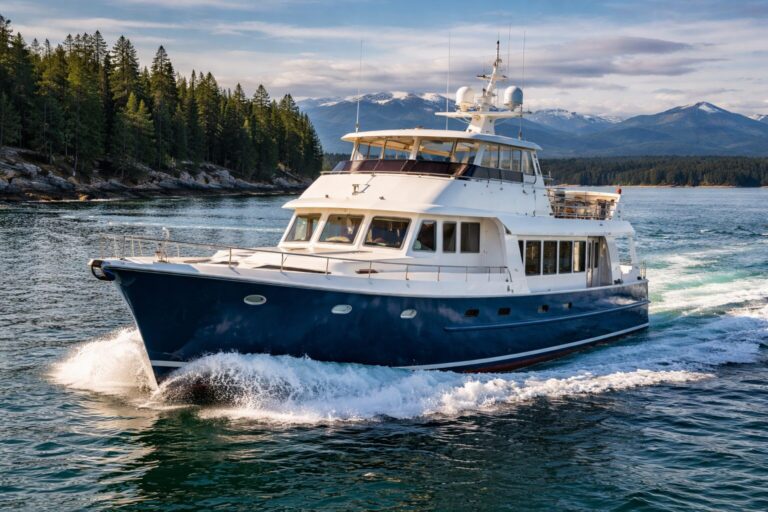
When people begin researching trawler or pilothouse yachts, one of the first technical terms they encounter is draft. Draft is often misunderstood, and many buyers assume that a deeper draft automatically means a worse boat, especially for coastal cruising or exploring remote areas. In reality, draft is far more nuanced. A deeper draft can offer important advantages in stability, comfort, and offshore performance, particularly in the demanding waters of the North Pacific.Understanding draft correctly helps buyers make smarter decisions, avoid common myths, and choose a vessel that truly fits their cruising plans. This article breaks down what draft really means, why deeper is not always a drawback, and how thoughtful design plays a bigger role than numbers alone.
What Draft Really Means on a Trawler Yacht
Draft is the vertical distance between the waterline and the lowest point of the hull, usually the keel or propeller. In simple terms, it tells you how much water a boat needs beneath it to float safely without touching the bottom. For trawler and pilothouse yachts, draft is influenced by several factors, including hull shape, displacement, keel design, fuel capacity, and propulsion setup. A fully loaded trawler with fuel, water, and cruising gear will often sit deeper in the water than the same boat at rest in a marina with empty tanks. Many buyers focus only on the draft number listed in specifications, but that number alone does not explain how the yacht behaves underway, how it handles rough seas, or how protected its running gear is. Draft should always be viewed as part of the overall design rather than an isolated measurement.
Why Deeper Draft Often Improves Stability and Comfort
One of the biggest advantages of a deeper draft is improved stability. A hull that extends deeper into the water lowers the vessel’s center of gravity. This makes the boat feel more planted and predictable, especially in open water or confused seas. In the North Pacific, where conditions can change quickly and long ocean swells are common, stability directly affects comfort and safety. A slightly deeper trawler tends to roll more slowly and gently than a shallow draft boat. This slower motion reduces fatigue, seasickness, and stress on both crew and equipment.
Deeper draft also allows designers to incorporate a more effective keel. A well designed keel improves tracking, meaning the boat holds a straight course more easily. This reduces the need for constant helm corrections and improves fuel efficiency over long distances. For passagemaking trawlers and pilothouse yachts, this is a significant benefit. Another often overlooked advantage is propeller protection. Deeper draft typically means the propeller and rudder sit higher relative to the keel. This reduces the risk of damage from floating debris, logs, or submerged objects, which are common in northern waters.
Shallow Draft Myths and Real World Tradeoffs
Shallow draft boats are often marketed as more versatile because they can access thin water, anchor closer to shore, and navigate shallow bays or rivers. While this is true in specific environments, it does not automatically make shallow draft better for all cruising styles. To achieve shallow draft, designers may reduce keel depth, flatten hull sections, or raise running gear closer to the hull bottom. These compromises can lead to increased rolling, less directional stability, and greater exposure of propellers and rudders.
In choppy or offshore conditions, shallow draft trawlers may feel more lively or twitchy. They can react faster to wave action, which some operators find uncomfortable during long passages. This does not mean shallow draft is bad, but it does mean there is a tradeoff. Another consideration is load carrying ability. Trawlers are often used for extended cruising with significant fuel, water, and supplies onboard. A design that already sits shallow may lose performance or efficiency when heavily loaded. A deeper hull generally handles weight changes more gracefully.
Matching Draft to North Pacific Cruising Conditions
The North Pacific presents a unique set of challenges that make draft selection especially important. Coastal routes often involve long stretches of open water, strong tidal currents, and unpredictable weather systems. In these conditions, stability, tracking, and seakeeping matter more than the ability to skim over shallow flats. A moderate to deeper draft trawler performs well in following seas, head seas, and quartering waves. The hull stays engaged with the water, reducing pounding and improving control. This is particularly valuable when traveling between remote harbors or crossing exposed areas where shelter may be limited.
That said, thoughtful design can balance draft with access. Many custom trawlers use full length or modified keels that provide depth where it matters while still allowing reasonable access to anchorages and marinas. The goal is not maximum depth, but purposeful depth. Understanding your typical cruising grounds is key. If most of your time will be spent in deep coastal waters, island hopping, or extended passages, a deeper draft can enhance safety and enjoyment. If shallow rivers or inland waterways are a priority, draft should be carefully evaluated, but not at the expense of offshore capability.
How Hull Design Matters More Than the Number
Focusing solely on draft measurements can be misleading. Two trawlers with the same draft can behave very differently depending on hull shape, beam, displacement, and keel profile. A well designed hull distributes buoyancy efficiently and maintains stability across a range of speeds and sea states. The keel shape influences how water flows beneath the boat, affecting both handling and fuel consumption. Weight placement also plays a major role, especially in pilothouse yachts where superstructure height must be balanced carefully.
Custom built trawlers offer the advantage of tailoring these elements to the owner’s needs. Draft can be optimized alongside hull form, propulsion, and interior layout to create a yacht that performs confidently without unnecessary compromises. Rather than asking whether deeper draft is good or bad, the better question is whether the draft supports the yacht’s intended purpose. In many cases, a slightly deeper draft is not a disadvantage at all, but a sign of a serious cruising vessel designed for real world conditions.
Choosing the Right Draft for Your Trawler
When selecting or designing a trawler or pilothouse yacht, draft should be considered alongside your cruising plans, comfort expectations, and safety priorities. There is no universal ideal number, only the right balance for how and where you plan to travel. A deeper draft often delivers better stability, smoother motion, improved tracking, and greater protection for vital components. These qualities become especially valuable in demanding environments like the North Pacific, where performance and reliability matter more than shallow water bragging rights. Understanding draft beyond the surface level helps buyers move past common misconceptions and focus on what truly makes a yacht capable. With the right design approach, deeper does not mean worse. In many cases, it means stronger, steadier, and better suited for the journey ahead.
We turn your cruising dreams into reality by developing bespoke trawler and pilothouse yachts built for comfort, safety, and performance. From the initial hull design to the final varnish, our experienced naval architects and craftsmen collaborate with you every step of the way, integrating fuel-efficient engines, ergonomic deck layouts, and beautifully appointed living spaces. With industry-leading warranties and personalized support, we make sure your new yacht feels like home the moment you step on deck. Reach out to us by email at info@northpacificyachts.com for personalized responses to all your inquiries. If you’d prefer a conversation, we invite you to give us a call at 1-877-564-9989.