

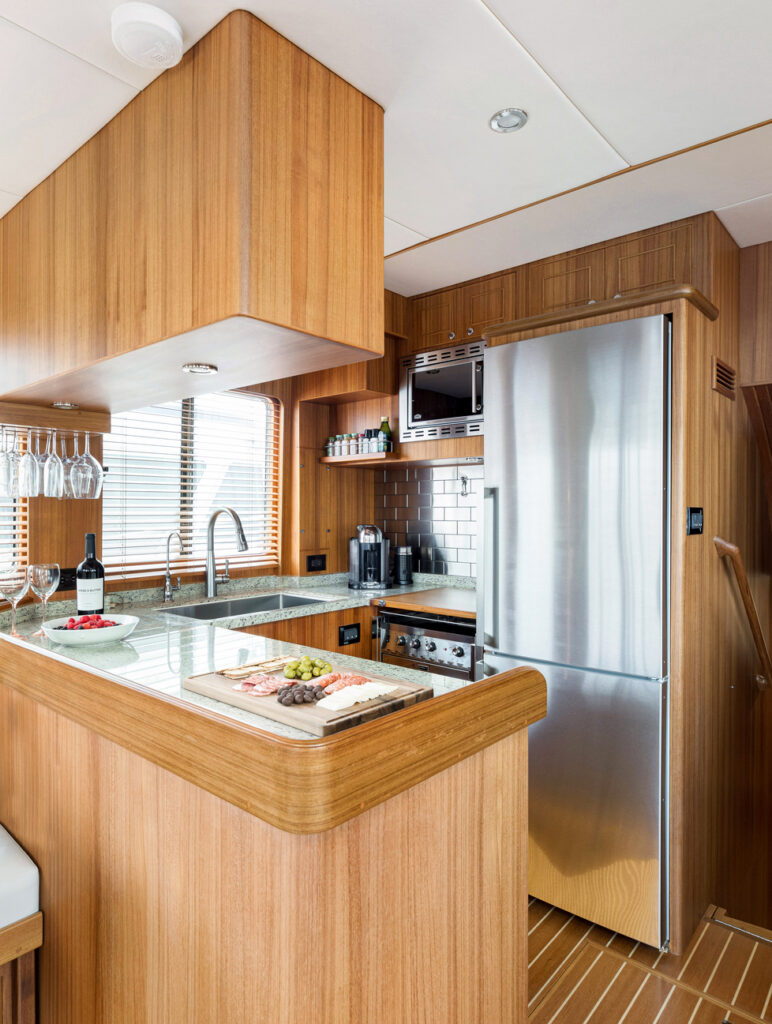
The neat departure-day boat does not show how household routines will work after a week aboard. Open provisions, used towels, rubbish, and guest gear all need places to go while the galley and living spaces remain usable.
Plan around the middle of the trip. The useful question is whether people can find food, manage textiles, and stage shore chores without unloading one space into another.
Keep working provisions within reach
Separate frequently used food from reserve inventory. Group items in a way your crew understands, label containers, and keep a record of where backups live. Deep storage can work well when retrieving a meal does not require emptying it onto the galley counter.
Open lockers and cold storage with the boat secure and permission given. Where can a removed container rest? Does the lid or door interrupt the cook’s workspace? Can someone find lunch without moving another person’s belongings?
For example, our 45 Pilothouse interior has its galley in the salon, with a dual stainless steel sink, a Force 10 three-burner cooktop and oven, drawers and cabinets, and a Summit fridge/freezer. Staterooms and heads are reached from the salon. These features make occupied circulation useful to assess on that model; they do not establish provisioning endurance.
Our guide to long-term provisioning covers quantities, food storage and inventory in more depth. Our guide to galley workflow underway addresses the meal task itself. Here, focus on where the household’s supplies go after loading and how they remain accessible. Follow appropriate food-storage guidance rather than applying a fixed thawing schedule to every ingredient.
Separate clean, used, and damp textiles
Give each stage a home. Clean linens need dry storage. Used clothing needs a place to wait. Damp towels and wet gear need an appropriate drying arrangement that does not obstruct passage or equipment.
| Household item | Storage or access question | Follow-up |
|---|---|---|
| Clean bedding | Is the assigned space dry and reachable? | Keep enough accessible for actual visits |
| Used clothing | Where can it wait without occupying a berth? | Plan onboard washing or shore laundry |
| Damp towels and gear | Where can they dry appropriately? | Check ventilation and actual drying arrangement |
| Guest belongings | Can visitors unpack without using shared counters? | Discuss bags and gear before boarding |
Our 45 Pilothouse has a linen closet that can accommodate an optional vented washer/dryer or stacked units. For example, our 590 Pilothouse interior offers a lazarette that can be configured for storage, a workbench and laundry, or other accommodation uses. These choices use space differently; confirm the selected arrangement, appliance installation, ventilation, water and electrical requirements before planning cycles.
A utility location does not guarantee silence or complete separation from the living area. Consider noise, access and the route used for carrying laundry as well as the appliance itself.
Give rubbish and shore chores their own space
Remove unnecessary packaging before loading where practical, retaining labels and instructions needed for food or other products. Arrange secure containment appropriate to the waste and separate waste handling from food preparation.
Decide how rubbish will leave the boat without spreading leaks or obstructing a route. Check shore disposal availability and local requirements before relying on a stop. Do the same for laundry, groceries, water and other household needs; a marked destination does not prove every service will be available.
Our guide to storage and payload planning helps place these household items within the complete cruising load. Avoid filling convenient spaces that are needed for service or emergency access.
Walk through day twelve
Imagine the actual crew after several days of use: some meals consumed, reserve containers opened, towels damp, and a shore visit due.
- Can you identify the next meal without unpacking the galley?
- Where do open packages and backup ingredients live?
- Can used textiles wait without taking over the guest cabin?
- Is damp gear drying without blocking movement?
- Can rubbish and shore-laundry bags be removed cleanly?
- Are needed equipment access points still clear?
Adjust the plan to the boat and habits aboard. When you talk with us, bring the household routines and storage questions that matter on your longer trips.