

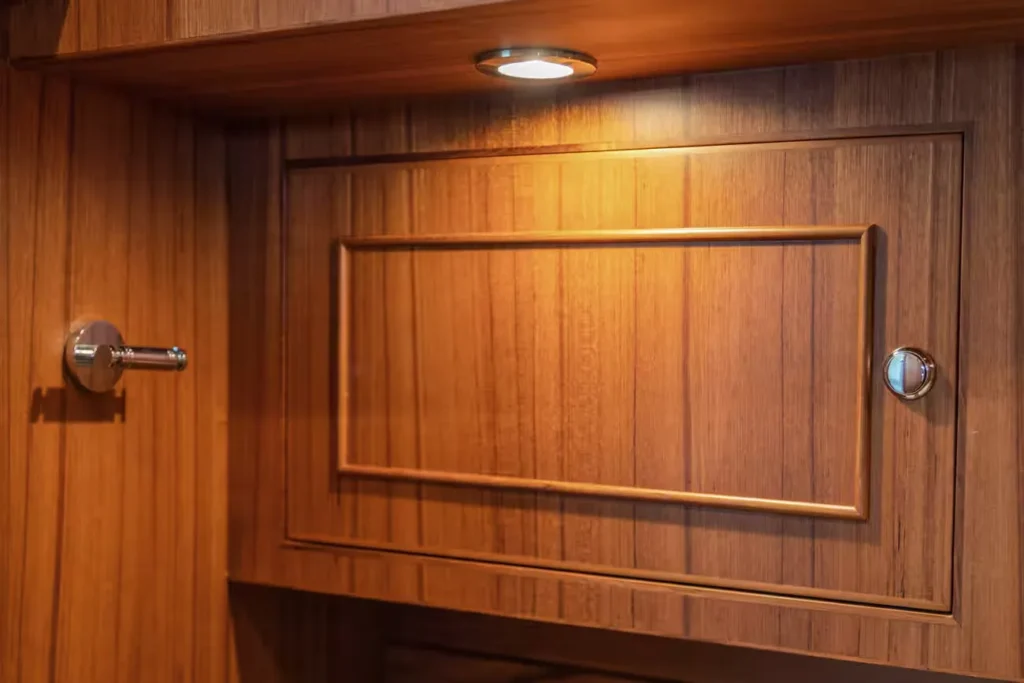
Locker volume tells you where items may fit. It does not establish whether the boat should carry their combined weight in those locations. Treat storage access and loading suitability as connected questions when evaluating a cruising yacht.
An inventory gives the discussion substance: what you carry, where it lives, how it is secured, and which access must remain clear.
Separate volume from carrying capacity
Published displacement alone does not provide an allowance for discretionary gear. Ask what condition the stated figure represents and obtain loading guidance for the actual boat and configuration. Do not subtract guessed weights to create a payload limit.
The equipment already installed, people aboard, tank levels, tender, and cruising gear belong in that discussion. A compartment that accommodates an item physically may still have loading, securing, environmental, or access constraints.
Build a realistic cruise inventory
Start with the longest trip you realistically expect to repeat and the actual crew. Account for installed and variable loads without double-counting equipment already included in the boat’s weight record.
- Fuel, water, and other tank contents under the conditions to be assessed.
- Tools, filters, fluids, and mechanical spares.
- Lines, fenders, anchors, and other deck equipment.
- Tender, motor, launching equipment, and accessories.
- Food, drinks, household consumables, and linens.
- Crew belongings and guest luggage.
- Recreation equipment you intend to bring.
Use actual item weights where practical and mark estimates that need confirmation. Our guide to pantry, freezer, and laundry planning develops household access; guest cabin and privacy planning helps identify what visitors will bring.
Assign access along with a location
Separate daily-use items from reserves, and keep emergency equipment, valves, machinery, and needed service points accessible. Inspect whether a proposed container blocks a hatch or requires lifting heavy gear before an ordinary check.
For example, our 49 Pilothouse equipment includes removable headliners, wiring chases and access panels, with engine-room access through gas-assisted salon-floor hatches. On that model, furniture and stowage should be considered alongside those actual access points. Do not infer the same hatch arrangement across every boat.
Ask whether a proposed storage area is dry, suitable for the item, and equipped for the intended securing method. A low compartment is not automatically appropriate if it blocks systems or exposes supplies to unsuitable conditions.
Review distribution against boat-specific guidance
Bring the inventory to the builder, surveyor, or other qualified professional appropriate to the loading question. Discuss heavier loads high aboard, aft, or concentrated on one side, including structural limits and the boat’s loading condition.
Do not design ballast changes or use fuel transfer as an improvised correction. The proper response depends on the actual vessel and systems. The inventory is a way to ask better questions, rather than a substitute for an engineering assessment.
Conduct the loaded-layout buying test
Assign each category a proposed home during a permitted stationary visit. Check dimensions and access, then identify what remains unresolved.
| Load category | Proposed location | Access needed | Confirmation required |
|---|---|---|---|
| Tools and spares | Record actual compartment | Service or reserve | Suitability, securing and loading |
| Household supplies | Record lockers and cold storage | Daily and reserve | Clear passages and service access |
| Tender and accessories | Record selected installation | Launching and service | Installed equipment and structural limits |
| Guest gear | Record cabin storage | During visits | Storage without displaced essential access |
| Emergency equipment | Record designated location | As required | Appropriate accessible stowage |
Revisit the list with the boat imagined fully provisioned. Are daily spaces still usable, access points clear, and loading questions answered? Bring that inventory when you talk with us about storage and equipment choices for your cruising plans.