

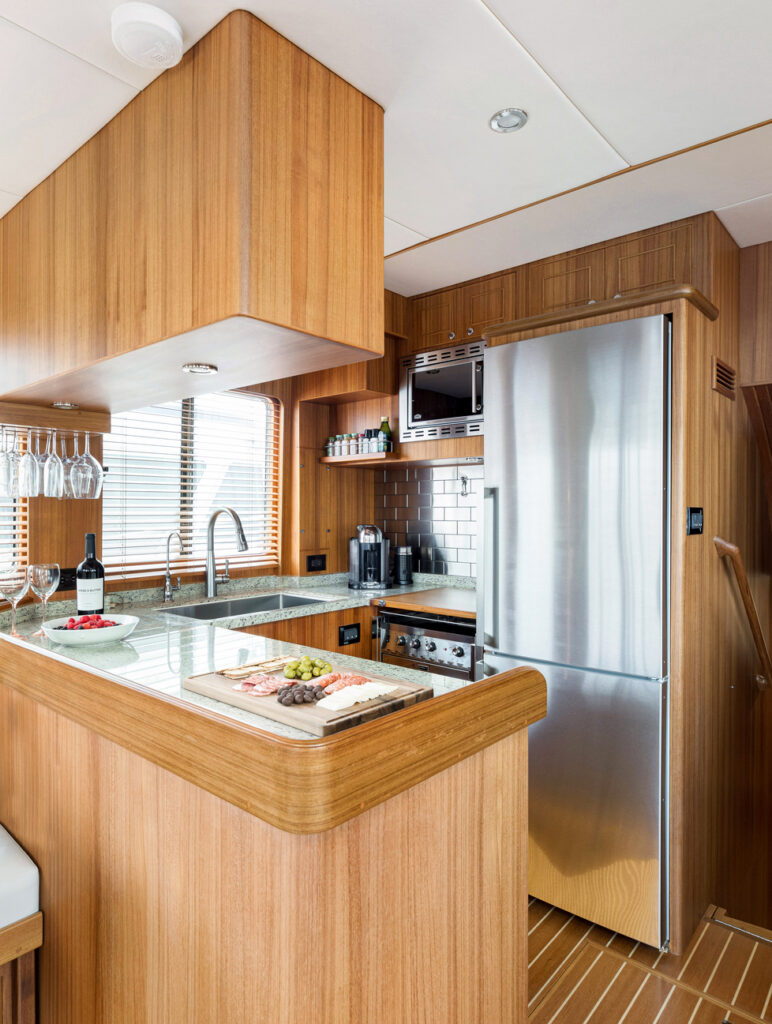
The easiest time to identify a frustrating galley layout is before committing to it. Counter finish and refrigerator size deserve attention, but they do not show how a cook retrieves food, prepares a meal, moves cookware, and cleans up while other people use the boat.
A stationary visit can reveal those relationships without operating appliances or deliberately exposing anyone to motion. Use a simple meal as the organizing task and record the movements that need discussion.
Walk through the complete meal
With the boat securely docked, appliances off, and permission given, follow the sequence from storage to cleanup. Use empty cookware if staff allow, rather than heat, liquids, or sharp tools.
- Retrieve imagined ingredients from cold and dry storage. Notice where doors travel and where a removed container can rest.
- Stand at the prep surface. Check reach and whether an intended support is available without leaning on controls or fragile fittings.
- Follow the transfer from prep surface to cooking area. Notice steps, turns, and through traffic.
- Find a place for plating or serving without crowding the working area.
- Follow the path to the sink and waste container, then consider where washed items can dry and be secured.
The sequence reveals more than a count of cabinets. Record each awkward turn or interrupted passage and how often it would appear in your normal cooking routine.
Review reach, support, and hot-item paths
On a moving boat, a working arrangement needs attention to footing, support, secured items, and appliance instructions. Ask which fittings are intended for bracing, how cookware is retained on the actual appliance, and what use is appropriate under the conditions you expect.
Short, uncomplicated transfers can reduce the amount of movement involved, but no step count establishes safe cooking. Plan manageable meals and discuss the limitations of the actual installation. A stationary visit identifies questions; it cannot prove how a galley will feel underway.
Add another person to the assessment
Have a companion use the normal passage while you stand in the prep position. With permission, repeat with a frequently used drawer or refrigerator door open. Observe where someone waits and whether the task interrupts access elsewhere.
A contained galley may suit one crew while an open arrangement suits another. Shape alone does not establish bracing, clear traffic, or capacity for two cooks. Compare the exact counter, furnishings, doors, and people involved.
Complete the task with storage and cleanup
Frequently used tools need accessible, secure homes. Review the actual storage and loading guidance for heavier cookware rather than treating every convenient locker as suitable. Our guide to storage and payload planning develops the complete loading question.
Waste access, washing, drying, and ventilation deserve equal attention. Can cleanup happen without occupying the main passage? What ventilation is installed, and how should it be used with the selected appliance? Our guide to pantry, freezer, and laundry planning extends this assessment to household routines over a longer trip.
Try the questions on a verified example
For example, our 45 Pilothouse interior has a galley in the salon with a dual stainless steel sink, a Force 10 three-burner cooktop and oven available with electric or gas burners, seven drawers and other cabinets, and a Summit fridge/freezer. Stateroom and head access is from the salon.
Use that arrangement as a place to examine meal tasks and occupied circulation. Do not infer exact counter orientation, latch hardware, or a guaranteed passing clearance from the equipment list.
| Meal stage | Observation to record | Question for the selected layout |
|---|---|---|
| Retrieval | Door movement and staging space | Can needed items be reached conveniently? |
| Preparation | Reach and intended support | What changes with another person passing? |
| Cooking and serving | Turns and transfers | How is the actual equipment used and secured? |
| Cleanup | Sink, waste and drying access | Can cleanup finish without blocked passage? |
Bring the task and the specific places where it becomes awkward when you talk with us about galley arrangements.