

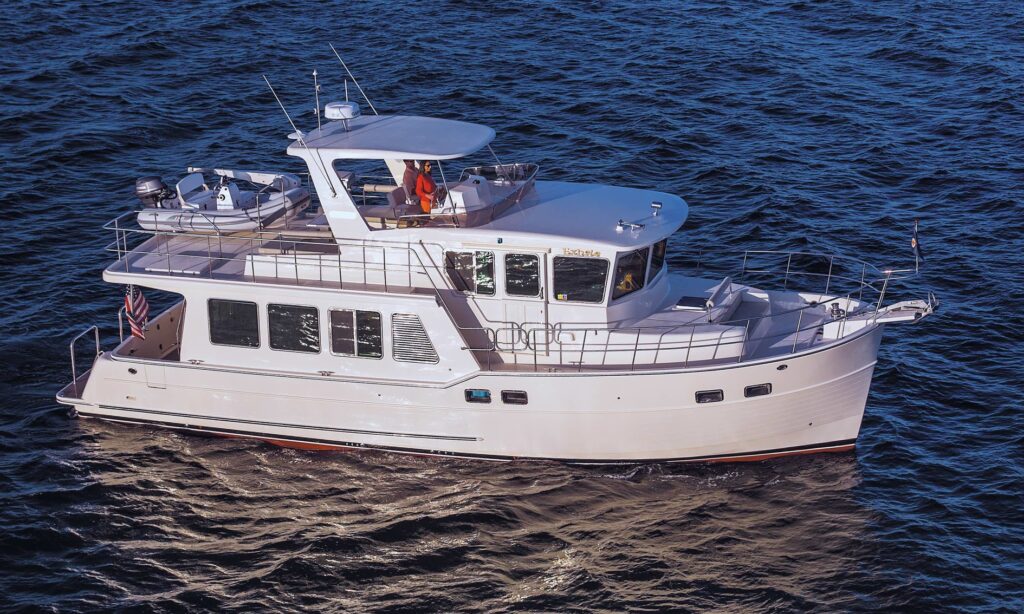
The space around the wheel shapes an ordinary cruising day. Where will a companion sit? How far is the galley from the helm? Which door or stair connects the operating station to the deck? Those questions are more useful than choosing a yacht by the word “pilothouse” alone.
We compare our North Pacific 49 Pilothouse and North Pacific 590 Pilothouse with the Grand Banks 60 Skylounge, Fleming 55 and Nordic Tug 44. These are five examples to investigate, with different dimensions and arrangements. They are not a ranking, and the details available for each model differ.
Main-Deck Pilothouses Versus Upper Skylounges
A dedicated pilothouse gives navigation its own space while keeping other parts of the interior nearby. An upper skylounge places the enclosed operating station on another deck and adds an interior gathering area there. The useful distinction is where you and your companions expect to spend time underway.
Think through a meal, a watch change and an arrival. A companion may want a forward-facing seat beside the operator, a settee nearby or a quieter space elsewhere. Doors, stairways and seating determine the routes to inspect. Check the actual seated view, glazing, reflections, ventilation and communication aboard; an arrangement name cannot answer those questions.
An upper helm also deserves a careful look at the connection to the main deck. Walk the stairs with your regular crew while the boat is secured, and consider how meals, drinks and equipment will move between levels. Evaluate the arrangement against your own reach and mobility rather than assuming an upper or lower helm is easier to operate.
Five Shortlisted Arrangements to Tour
1. North Pacific 49 Pilothouse
Our 49 has a full-beam salon with customizable furniture arrangements and a galley in the salon. In the pilothouse, there is room for two Stidd or Llebroc helm seats. An L-shaped settee and table sit aft, and the settee converts to a single bed. Two opening doors and sliding windows provide ways to connect with the exterior and ventilate the space.
The accommodation choices include two or three staterooms, or two staterooms and an office. Most arrangements have accommodation access from the salon; full-beam midship master designs with access from the pilothouse are also available. Compare the particular plan you prefer with the routes your crew will use, especially when someone is resting.
2. North Pacific 590 Pilothouse and Skylounge
Our 590 makes the enclosed-helm choice especially clear. In the standard configuration, the pilothouse helm is forward of the galley. It has a central helm seat, an L-shaped settee and table, and a starboard watertight door to the exterior deck.
Choosing the optional Skylounge eliminates that lower helm. The upper helm area becomes an enclosed steering and gathering space with dual helm seats and an L-shaped settee. A sliding stainless-steel and glass door opens to the aft flybridge area. If you prefer enclosed steering upstairs, this is the arrangement to explore; if you value the lower pilothouse helm, include its removal in your decision.
The interior offers two or three staterooms forward and optional quarters in the lazarette. A full-beam master with a nearly-king bed and flexible guest-room arrangements give you specific accommodation choices to discuss alongside the helm configuration.
3. Grand Banks 60 Skylounge
Grand Banks offers the GB60 in Flybridge and Skylounge versions. The Skylounge encloses the upper deck to create an additional climate-controlled interior room. The model range offers upper- or lower-galley options and three- or four-stateroom arrangements.
Explore the exact Skylounge plan you are considering, including the location of its galley, companion seating and stairs. Those choices matter when deciding whether the upper level will be the natural center of your cruising day. Grand Banks’ standard-vessel figures come from half-load testing; they should not be assumed to describe every customized Skylounge.
4. Fleming 55
The current Fleming 55 is a raised-pilothouse yacht with a dedicated helm seat and raised L-shaped companion settee. An internal stair connects the pilothouse to the flybridge, making the relationship between the two stations a useful part of a walkthrough.
Its master stateroom is forward, with guest arrangements that include twin- or double-bed choices and an optional office use in the starboard cabin. Compare those spaces with your own sleeping and work routines. This example is specifically the Fleming 55, not a combination of features from Fleming’s larger models.
5. Nordic Tug 44
The Nordic Tug 44 offers a smaller overall footprint than the larger yachts in this group. Its current manufacturer specifications identify a single Volvo D11 510 hp engine, 640 gallons of fuel and sleeping capacity for seven, including the settee and barrel chair.
That sleeping figure should not be read as seven private cabin berths. The manufacturer’s current vessels page also does not describe the helm’s relationship to the salon or its companion seating. Request the applicable arrangement and inspect those spaces aboard before deciding how the 44 fits your helm shortlist.
Technical Scale and Machinery Comparison
Knowing how to read a yacht specification sheet helps keep these figures in perspective. Model names are not overall-length measurements, and builders may include different projections. Fleming explicitly includes the swim step and anchor platform in the 55’s total LOA.
| Model | Published LOA | Beam | Draft | Fuel capacity | Engine configuration |
|---|---|---|---|---|---|
| North Pacific 49 Pilothouse | 51 ft 4 in | 15 ft 4 in | 4 ft 10 in | 700 gal; 920 optional | Single Cummins QSB 355 hp; alternatives available |
| North Pacific 590 Pilothouse | 61 ft 4 in | 18 ft 4 in | 5 ft 10 in | 1,800 gal | Twin Cummins QSL9, 405 hp each; alternatives available |
| Grand Banks 60 | 66 ft 10 in | 19 ft 2 in | 4 ft 3 in with standard shaft package | 1,532 gal | Twin Volvo D13 shaft engines, 900 hp each |
| Fleming 55 | 60 ft 9 in including swim step and anchor platform | 16 ft | 5 ft | 1,000 gal | Twin Cummins QSC, 500 hp each |
| Nordic Tug 44 | 45 ft 6 in | 14 ft | 4 ft 7 in | 640 gal | Single Volvo D11, 510 hp |
The GB60 technical specification gives a 19-foot-2-inch beam, while some descriptive text gives 19 feet 1 inch. Confirm the exact dimensions for the proposed yacht before making a berth decision. Treat every published LOA and draft as a starting point for confirming actual overall dimensions, loading and marina requirements.
Fuel capacity does not establish cruising range. Our 49’s published range charts describe particular engine and tank configurations, cruising load, calm conditions and a 10% reserve. The 590 specification supplies tankage and cruising speed without equivalent range-test conditions. Collect the applicable performance evidence for each proposed boat rather than filling those gaps by calculation.
Walkthrough Checklist: Inspecting the Space Around the Wheel
Use the same questions on every shortlisted yacht:
- Sit in the operator’s and companion’s positions. Check the forward and aft views, seating support and access to the controls you expect to use.
- Trace the route between the galley and helm. Inspect stairs, landings, handholds and places where people will pass.
- Open the actual deck doors and follow the intended dockside route while secured. Check door travel, clearances and line-staging locations.
- Examine lighting and reflections at the helm. Ask how interior lights, displays, wipers and ventilation work on that configuration.
- Follow the sleeping-space access routes. Consider whether watch changes, meal preparation and conversation will disturb resting crew.
A plan helps you choose what to inspect; the actual boat determines whether the arrangement suits you.
Evaluating Your North Pacific Options
Our 49 is worth exploring if you want a dedicated pilothouse with companion seating and flexible accommodation access. Our 590 offers a different scale and the choice of retaining the lower helm or moving enclosed steering to the Skylounge.
Describe the day you expect to repeat: who runs the boat, where companions sit, how meals reach the helm and which spaces need privacy. Then talk with our team about the current plans, equipment choices and walkthrough options for the model you want to examine. Those details turn a five-yacht shortlist into a practical next step.