

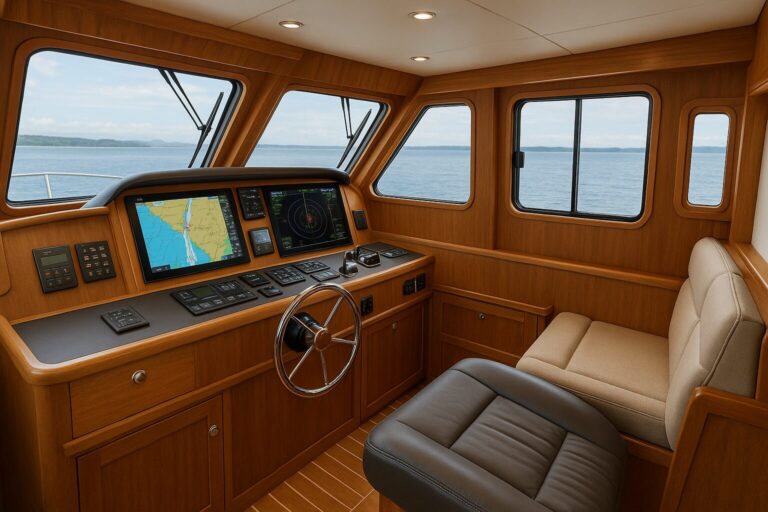
Pilothouse ergonomics need to fit how you and your crew use the space. On long coastal passages or overnight runs, an operator shifts constantly between seated monitoring, leaning back to evaluate radar, and standing to verify close-quarters traffic. The space must accommodate both the active watchstander and an off-watch partner who needs a place to review a chart or take a rest without entering the helmsman’s working arc.
Autopilot maintains a heading, but it never relieves the crew of maintaining an uninterrupted, vigilant lookout. If binoculars, handheld radios, or logbooks end up abandoned on dash cowls because there is no designated pocket nearby, forward night sightlines suffer immediately.
Integrating Seat Placement, Sightlines, and Control Reach
Adjusting a helm seat should never break your physical connection to primary engine controls or thrusters. When planning console depth and seat base placement, check your reach across the entire travel range of the seat pedestal. If reaching controls requires an awkward posture, note the mismatch before choosing the seat and console arrangement.
In Common Design Mistakes in Poorly Executed Pilothouses, poor coordination between seat height, dash cowl depth, and horizon visibility is a recurring flaw. You need an unobstructed view over the bow whether idling through a mooring field or running at displacement speed with the bow trimmed up.
Our 49 Pilothouse has room for two Stidd or Llebroc helm seats. That choice directly shapes the remaining footprint. Try the actual seats for both operators, including walking clearance behind and between them.
Restrained Storage That Protects Traffic and Sightlines
Working storage at the helm needs to be deliberate rather than voluminous. Adding oversized cabinetry to capture every spare inch risks blocking sightlines, pinching door swings, or obscuring lower corner visibility when docking.
In our 49 Pilothouse interior, the arrangement balances open crew movement with dedicated functional resting spots. The space incorporates an L-shaped settee and table positioned behind the helm seats, flanked by two opening doors to the side decks and three sliding windows. This configuration provides rapid deck access and cross-ventilation, but it also dictates where gear can live.
Choose storage positions that leave needed sightlines and access clear. Guidebooks, spotlight remotes, and safety gear need shallow fiddled shelves or dedicated drop-in lockers near the companionway. Assess proposed storage against each needed view and walking route.
Equipment Clearances and Behind-the-Dash Service Access
Selecting chartplotters and communication gear is only half the job; the console must physically support their heat dissipation, wiring bundles, and future maintenance. Every display, black box, and VHF radio generates heat that must escape the helm enclosure. Cramming electronics into unvented consoles shortens component life and invites intermittent network faults.
For a concrete equipment example, our 49 Pilothouse equipment includes Garmin chartplotters, autopilot, radar, fish finder, and VHF radios. While exact standard equipment configurations evolve across model years, the engineering requirement remains constant: serviceability.
Our 49 Pilothouse has removable headliners, wiring chases and access panels that support equipment and wiring access. Check the access needed for the actual installation before selecting additional equipment. Verified manufacturer clearances behind the dash must always take precedence over crowding the console face with extra instruments.
Finalizing an Achievable Pilothouse Specification
Every helm adjustment involves physical trade-offs. Choosing twin full-sized helm seats over a single chair and companion bench alters the usable floor area around the settee table. Adding oversized secondary displays can limit where you locate your primary compass, engine diagnostic panels, or horn switches.
Before locking your build specification, map your equipment list and storage needs against verified structural boundaries and factory offerings. Discuss available changes and their implications with us before treating a preference as an agreed build feature.
When you are ready to evaluate your helm layout, sightlines, and equipment preferences, talk with us to review build availability and work through the details of your pilothouse arrangement.