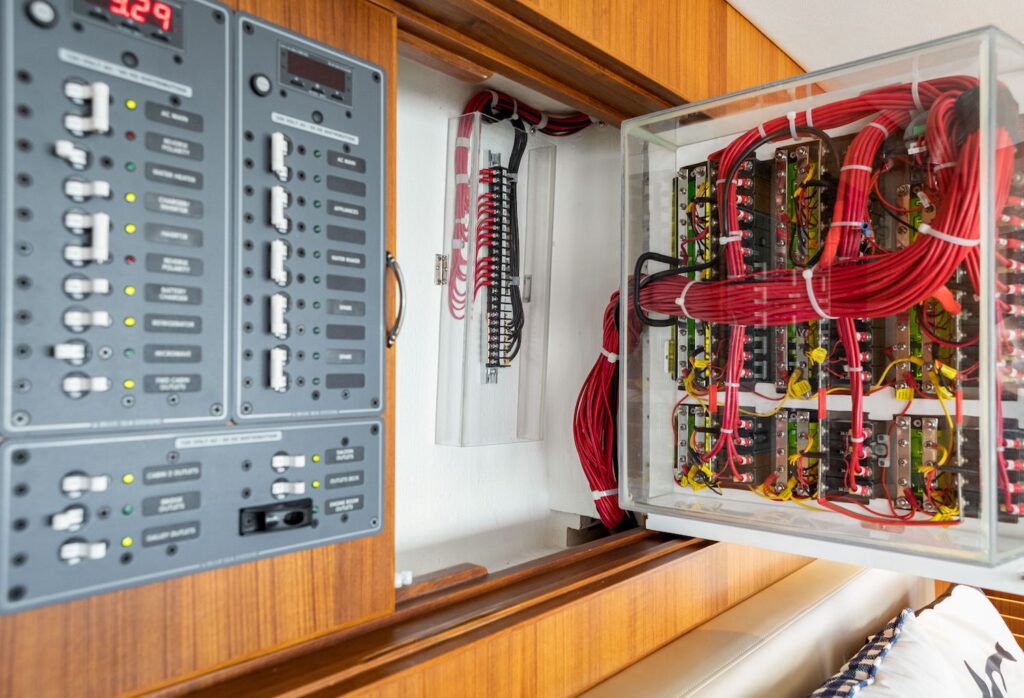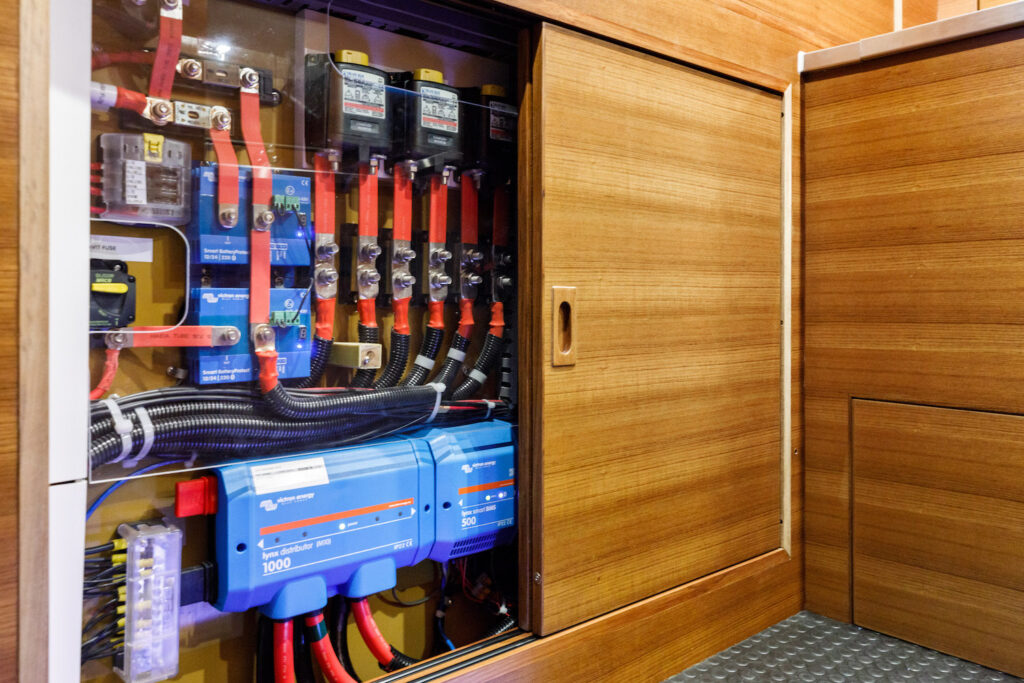
We encourage owners to approach electrical care through the boat’s documentation and safe observation. Reliable electrical power on a cruising yacht comes down to consistent observation, clean connections, and knowing where owner maintenance ends and qualified service begins.
Electrical problems can develop gradually or appear suddenly. Observations help identify concerns, but they do not establish that an installation is safe. Keep electrical diagnostics and repairs within the appropriate competence and service instructions.
Understanding Onboard Power Systems
Trawler electrical architecture separates into two distinct networks: alternating current (AC) for domestic appliances, water heaters, and heavy equipment, and direct current (DC) for engine starting, navigation electronics, communication gear, and house loads.
Keeping these networks conceptually distinct prevents mistakes when monitoring equipment or explaining an issue to a service yard.
AC Shore Power and Distribution
AC shore power brings high-voltage utility power onto the boat to run domestic gear and feed the battery chargers. Because shore power carries serious shock and fire hazards, your responsibility as an owner centers on the physical health of the connection point.
Shore cords and boat inlets operate in damp, salt-laden environments that accelerate contact oxidation. A compromised connection builds electrical resistance, which creates heat under load. Every time you connect or disconnect, look closely at the plug faces and the inlet pins. Browning, melting, burns, or damaged contacts require assessment before reuse. BoatUS identifies burns at shore-power connections as a reason to replace affected components.
Learn the normal operation of your yacht’s source selector, protection devices, and warning indicators from its electrical documentation. A reverse-polarity warning needs qualified investigation; do not dismiss it or keep reconnecting to reproduce the fault.
DC Batteries and Charging
Direct current runs the boat’s primary operational systems. DC networks generally divide into distinct battery banks: dedicated engine start banks, a generator start bank, house banks, and occasionally dedicated banks forward for windlasses or thrusters. Learn how your installation separates or combines these loads and what power must remain available for starting and essential equipment.
Managing battery banks on long-range trawlers requires understanding the charging sources installed on the boat. These may include inverter/chargers, alternators, and solar controllers. Observe the system displays and compare their normal behavior with the equipment documentation; charging stages and settings vary by product and chemistry.
Safe Visual Inspection and Record-Keeping
A useful owner inspection focuses on visible condition from the boat’s safe access points. It may reveal chafing, corrosion, or heat damage, but it is not a substitute for electrical testing by a qualified specialist.
Have the appropriate safe inspection and isolation procedure explained for your installation. A shore cord disconnected or an inverter switched off does not by itself establish that every conductor is de-energized. Never reach behind distribution panels or handle exposed conductors to investigate a concern.
Use your senses methodically during weekly engine-room checks:
- Look for discoloration: Check cable boots, busbar insulators, and terminal lugs for brown heat staining or cracked heat-shrink tubing.
- Inspect mechanical support: Marine wiring must be secured at regular intervals to prevent movement. Look for drooping harnesses or spots where cables vibrate against fiberglass bulkheads, fuel tanks, or engine mounts.
- Check safety components: Follow standard spring commissioning guidance by verifying that bilge pumps and automatic float switches move freely, have clear intake screens, and sit free of standing oil or debris. Ensure DC supply wires leading to bilge pumps remain elevated above normal bilge water levels.
- Smell for insulation breakdown: An unusual burning or chemical smell may indicate a serious problem. If you open a locker or hatch and detect acrid smells, keep people away from the suspected hazard and obtain appropriate help; do not investigate energized equipment yourself.
Maintain a dedicated paper or digital ship log for your electrical observations. Record resting DC bank voltages after the boat has sat without a charge source for a few hours, record any equipment warnings displayed at the helm, and log the date of every terminal inspection. When a charging anomaly or intermittent draw appears later, this running log provides the marine electrician with the baseline data they need to troubleshoot efficiently.
| Observation | Owner’s record | Next step |
|---|---|---|
| Shore-power damage | Photograph disconnected cord ends or visible inlet damage without handling suspect live equipment. | Arrange qualified assessment before reuse. |
| Battery corrosion or loose hardware | Record the location and battery type. | Follow the installed system’s service and isolation instructions; arrange help if unclear. |
| Chafed or unsupported wiring | Note the location without moving live conductors. | Ask a marine electrical specialist to assess the installation. |
| Repeated warning or trip | Record the displayed warning and equipment in use. | Stop repeated resets and arrange diagnosis. |
Care for Batteries and Connections
Battery maintenance varies dramatically depending on whether your boat uses traditional flooded lead-acid, sealed AGM, or lithium iron phosphate (LiFePO4) chemistries. Treating one battery chemistry like another degrades performance and can destroy a bank.
Some flooded lead-acid batteries require electrolyte checks and additions of distilled water; follow that battery’s instructions, precautions, and timing. Sealed batteries should not be opened or treated as flooded batteries.
AGM charging and storage requirements must come from the battery manufacturer and be coordinated with the installed charger. Do not change charging settings by applying a rule intended for another battery chemistry.
Lithium batteries have battery-specific operating limits for charging, discharge, temperature, and protection systems. Victron’s Lithium NG manual illustrates that these limits are specified for the battery model. Use the actual battery and BMS documentation to confirm your installation’s requirements rather than treating “lithium” as one universal setting.
Keep battery spaces and connections under observation, and report loose hardware, corrosion, damage, or unusual heat. Connection servicing requires the installed system’s isolation procedure, including all relevant charging sources. An indiscriminate “turn every battery switch off” rule can interrupt essential circuits such as bilge pumps; have the isolation and restoration plan confirmed before undertaking work.
Recognizing Fault Signs and Calling a Professional
Knowing when to close a locker and contact a professional is the cornerstone of safe yacht ownership. The distinction between owner maintenance and specialist intervention comes down to whether a task involves visual, unpowered care or energized diagnostic work.
Understanding DIY versus professional maintenance helps you define task-specific limits. A visual check differs from removing terminal hardware, repairing wiring, or changing circuit protection. Match each task to the actual manual, your training, and the consequences of a mistake.
Arrange prompt qualified assessment for repeated breaker trips, unusual heat or smell, unexplained battery depletion, persistent inverter/charger warnings, or any shock or tingling sensation. Keep people clear of a suspected electrical hazard. Use the boat’s emergency instructions and appropriate emergency assistance where needed rather than approaching or handling equipment to diagnose the cause.
When scheduling a technician, prepare clear documentation to streamline their diagnostic time. Hand them your log showing when the symptom first occurred, which breakers were active, what the battery monitor displayed, and what recent changes were made to the boat’s equipment. Clear operational notes give the technician a clearer starting point for investigation.
During your next visit, review the electrical documentation, note visible condition from safe access points, and record readings from the installed monitors. Arrange any uncertain inspection or service with the appropriate specialist.
Sources