

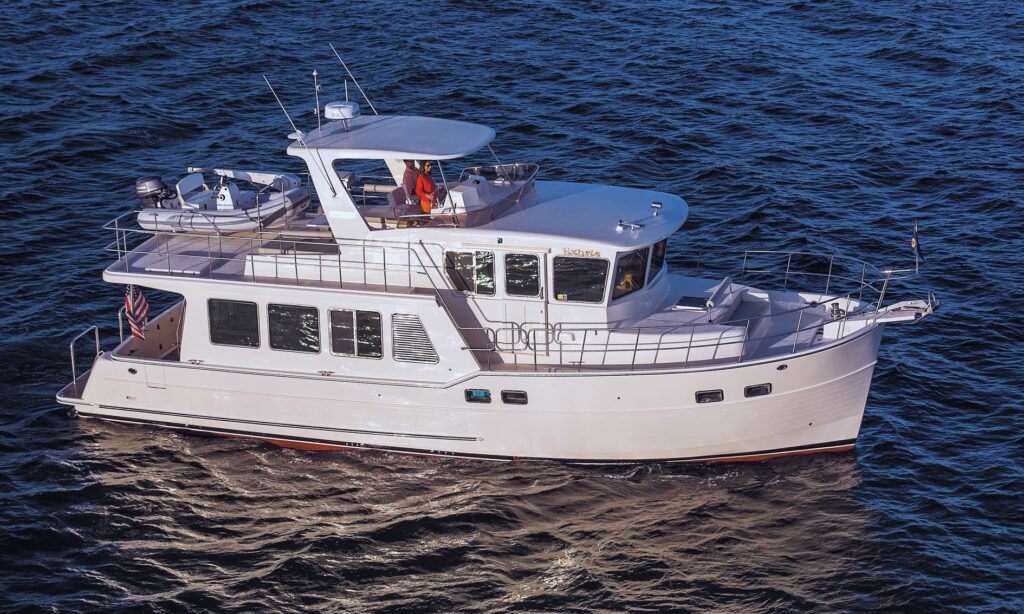
A comparison between our North Pacific 45 Pilothouse, North Pacific 49 Pilothouse and the Krogen 44 AE should help you choose what to examine next. Published dimensions, accommodation choices and engine packages give you concrete differences; hull categories alone cannot decide which yacht fits your crew or route.
Begin with your normal cruising speed, time aboard, guests and maintenance expectations. Then use the comparison to build a focused walkthrough and collect the information needed for a particular boat.
Dimensional Standards and Measurement Conventions
| Specification | North Pacific 45 Pilothouse | Krogen 44 AE | North Pacific 49 Pilothouse |
|---|---|---|---|
| Published LOA | 45 ft 8 in | 49 ft | 51 ft 4 in |
| Published beam | 13 ft 8 in | 16 ft 4 in over rubrail; 15 ft 6 in molded | 15 ft 4 in |
| Draft | 4 ft 6 in | 4 ft 6 in | 4 ft 10 in |
| Fuel capacity | 400 gal; 700 optional | 850 gal | 700 gal; 920 optional |
| Listed propulsion | Single Cummins QSB 355 hp; alternatives available | John Deere power | Single Cummins QSB 355 hp; alternatives available |
The Krogen’s molded and over-rubrail beam measurements answer different questions. Preserve that distinction when comparing space and confirming a berth. Our published beam figures should not be relabeled as both molded and over-rubrail measurements without confirming the measurement basis.
Overall length and draft also require boat-specific context. Check projections, loading and the requirements of your intended marina or yard. These numbers do not establish moorage costs, equal interior volume or a handling advantage.
What Hull Classifications Do—and Do Not—Decide
Kadey-Krogen identifies the 44 AE as a full-displacement yacht. Our 45 and 49 use hard-chine hull designs, with published engine and speed alternatives that should be reviewed for the package you are considering.
Our guide to full-displacement and semi-displacement hulls provides broader context. In this comparison, the useful step is to look at actual performance evidence. Ask what speed you expect to use, what fuel consumption supports it and how the boat behaves with its intended loading and equipment.
A hull label does not establish a superior ride, stability, safety or passage suitability. Those questions involve the individual yacht, conditions, loading, operating limits and crew. Extra speed should not be treated as a plan for outrunning weather or making a hazardous inlet approach.
Living Aboard: Layouts, Helm Routines, and Traffic Flow
The 45-Foot Platform Routines
Our 45 has a galley in the salon and accommodation access directly from the salon. The pilothouse contains a central helm seat, an aft bench and table, and two opening side doors. The bench can extend into an L-shaped arrangement or convert to a bed.
Compare those spaces with your daily routine. Can someone prepare food, rest or reach a head without passing through the operating area? The guest room offers different arrangements, including bunks or an office/bunk use, depending on the selected plan.
The 49-Foot Platform: Expanding Space and Cabins
Our 49 has a full-beam salon with customizable furniture arrangements and a galley in the salon. Accommodation choices include two or three staterooms, or two staterooms and an office. Most are reached from the salon, while full-beam midship master designs with pilothouse access are also available.
The 49 pilothouse has room for two helm seats, with an L-shaped settee and table aft. Try the companion seating and examine the particular accommodation plan rather than assuming one access arrangement applies to all layouts.
The Krogen 44 AE Routines
The Krogen 44 AE has a queen berth in the master and a den that converts to guest accommodation. Those features give you a useful alternative to compare with our dedicated guest-room and office choices.
Consider how often visitors stay aboard and what you want the flexible room to do between visits. Review the exact Krogen arrangement for its berths, storage, head access and circulation; the broad description does not provide every room relationship or capacity.
Machinery, Performance Curves, and Fuel Reserves
Our 45 and 49 list a 355 hp single Cummins QSB engine, with other engine packages available. Kadey-Krogen identifies John Deere power for the 44 AE. Compare the actual installation, service requirements and applicable performance information for each boat.
Our 45’s published single-engine range chart uses the 700-gallon configuration; our 49’s corresponding chart uses 920 gallons. Both state almost-full fuel and water, cruising load, calm conditions and a 10% reserve. Those details belong with the curves and do not describe every engine or tank option.
Kadey-Krogen’s specification also identifies a half-load convention for displacement. That does not, by itself, establish the loading used for every range claim. Keep displacement and performance-test conditions distinct, and ask for clarification where a range figure omits them.
For a voyage, use the actual yacht’s measured consumption, usable fuel, auxiliary loads and an appropriate reserve plan. Tankage alone cannot prove that a boat will support your longest intended passage.
Owner-Operator Engine Room Access and Maintenance Checks
Service access matters if you expect to perform routine checks or maintenance. Locate the actual inspection points and examine the space available around them:
- Can you read labels and reach routine checks comfortably?
- How are filters, pumps, strainers and service panels accessed?
- What equipment must be moved for less frequent work?
- How do furniture, storage and hatches interact with service routes?
- Are operating instructions and maintenance records available for the installed equipment?
A qualified marine technician can help you evaluate the machinery and the work you intend to handle yourself. Do not assume a single engine guarantees unrestricted access or that a broader beam provides a particular walkway.
Purchase Scopes, Equipment, and Cost Realities
Compare a defined specification or actual yacht rather than a brand-wide promise about value. For a new build, identify included equipment, options, allowances, accommodation choices, delivery responsibilities and warranty terms. For a used boat, review condition, modifications, service history and likely work with appropriate professional help.
Ask who handles commissioning, equipment documentation, component support and warranty questions. Confirm parts and service availability for the actual equipment in the places you expect to cruise. These are useful questions for either builder, without assuming identical support or predicting resale value.
Developing Your Decision Checklist
Speed and Range Requirements
Define your normal cruising pace and the trips you expect to repeat. Request applicable performance curves and their conditions, then discuss actual voyage requirements separately from brochure range.
Accommodation and Layout Priorities
Identify which rooms need privacy and which should serve another purpose between guest visits. Compare our 45’s guest options, our 49’s two/three/office arrangements and the Krogen 44 AE’s convertible den against those needs.
Maintenance Accessibility
Inspect the installed machinery, routine checks and service routes on each boat. Keep the purchase specification and any survey or maintenance findings with your comparison notes.
Take the Next Step in Your Research
The best shortlist connects model facts with the way you will use the yacht. When you talk with our team, bring your usual crew, preferred accommodation arrangement and the performance or service questions you want to resolve for our 45 or 49. We can discuss the current choices and what needs to be confirmed on the particular plan or boat.
Sources
- North Pacific 45 Pilothouse — Interior
- North Pacific 45 Pilothouse — Specifications
- North Pacific 49 Pilothouse — Interior
- North Pacific 49 Pilothouse — Specifications
- Krogen 44 AE — 2024 Brochure
- Krogen 44 AE — 2024 Standard Equipment and Specifications
- North Pacific 45 Pilothouse — Exterior
- North Pacific 49 Pilothouse — Exterior