

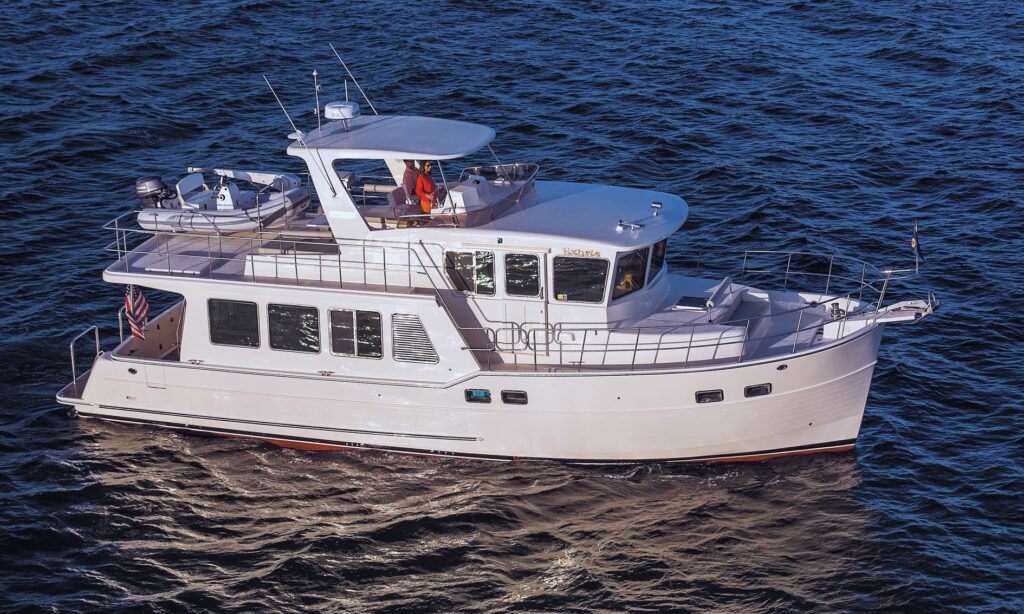
A comparison between North Pacific and Fleming becomes useful when you put particular yachts and your own cruising routine beside one another. Our North Pacific 49 Pilothouse and North Pacific 590 Pilothouse offer different scales and accommodation choices. The current Fleming 55 provides a specific raised-pilothouse example to compare with them.
Think about a full day aboard: who takes the helm, where others sit, how meals are prepared and which spaces need privacy. Then examine the equipment and purchase scope of the actual boat. Those details tell you more than a broad verdict about either brand.
Dimensions, Hull Profiles, and Tankage at a Glance
| Specification | North Pacific 49 Pilothouse | North Pacific 590 Pilothouse | Fleming 55 |
|---|---|---|---|
| Published LOA | 51 ft 4 in | 61 ft 4 in | 60 ft 9 in including swim step and anchor platform |
| Beam | 15 ft 4 in | 18 ft 4 in | 16 ft |
| Draft | 4 ft 10 in | 5 ft 10 in | 5 ft |
| Listed power | Single Cummins QSB 355 hp; alternatives available | Twin Cummins QSL9, 405 hp each; alternatives available | Twin Cummins QSC, 500 hp each |
| Fuel capacity | 700 gal; 920 optional | 1,800 gal | 1,000 gal |
Fleming distinguishes the 55’s 55-foot-9-inch length from its total LOA including projections. Confirm the applicable overall dimensions for every yacht and the requirements of your intended berth; a model number does not provide a moorage measurement.
Beam and tankage help you frame an inspection, but they cannot establish equal interior volume, a handling winner or a comparable range. Ask for performance evidence tied to the installed engines, loading, speed and reserve. Our 49’s range charts include explicit configuration and test conditions; do not transfer those conditions to our 590 or the Fleming.
Living Spaces, Deck Flow, and Cabin Routing
The North Pacific 49: Layout Flexibility
Our 49 has a full-beam salon with customizable furniture arrangements and a galley in the salon. Accommodation choices include two or three staterooms, or two staterooms and an office. Most arrangements provide access from the salon; full-beam midship master designs with access from the pilothouse are also available.
Compare those routes on the plan you prefer. A different master location can change how people reach shared spaces, but the exact doors, passages and privacy relationships need to be understood for that arrangement. Do not assume that pilothouse access creates a separate guest route in every design.
The North Pacific 590: Master and Helm Choices
Our 590 offers a full-beam master with a nearly-king bed and flexible guest-room arrangements. The 590 offers two or three staterooms forward and optional quarters in the lazarette. Choices in the guest space can include an office/bunk arrangement or space allocated to a more expansive master.
The helm configuration is a separate decision. The standard lower pilothouse is forward of the galley. Selecting the Skylounge removes that lower helm and encloses the upper steering and gathering area, with a sliding door to the aft flybridge. Consider how that choice changes your daily movement between the helm and living spaces.
The Fleming 55: Forward Master and Guest Options
The current Fleming 55 has a forward master with an en-suite head and a central passage serving the accommodations. Its port guest cabin offers single- or double-bed choices; the starboard cabin can also be configured as an office. These details provide specific alternatives to examine against our available arrangements.
Look at the actual sleeping and work spaces, including berth access, storage, head access and the routes used when someone is resting. The current 55 is the model discussed here; features of larger Fleming models should not be attributed to it.
Helm Configurations and Machinery Spaces
Pilothouse Ergonomics
The Fleming 55 has a dedicated pilothouse helm seat, a raised L-shaped companion settee and an internal connection to the flybridge. Our 49 has room for two helm seats with an L-shaped settee and table aft. Our 590’s standard lower pilothouse has a central helm seat, while the optional Skylounge has dual helm seats.
Those are different arrangements to try with your regular companion. Sit in the positions you would use, check seated and standing views, and consider conversation, reflections, ventilation and access to the controls. Open the actual doors and follow the deck routes while secured. The useful choice is the arrangement that suits your crew.
Machinery Layouts and Engine Access
The standard single-engine package of our 49 differs from the twin packages listed for our 590 and the Fleming 55. Engine choice changes which equipment and service points you need to review; it does not by itself establish better access, lower fuel burn or redundancy performance for a particular installation.
Inspect working clearance around the installed engines and generator. Check access to filters, pumps, belts, strainers, electrical equipment and routine inspection points. For a used yacht, compare the service records and modifications with the original specification. A qualified surveyor or marine technician can help assess the actual machinery and maintenance requirements.
Joinery, Finish Detail, and Construction Documentation
Our 49 interior uses handcrafted teak paneling, bookmatched cabinetry, dovetailed drawers and real teak-and-holly floors. Our 590 offers traditional teak or a more modern treatment with horizontal teak, wenge accents and fabric panels. Fleming’s 55 uses teak joinery and teak-and-holly soles, with its own furniture and accommodation choices.
Inspect these finishes across the rooms you use every day. Open drawers, examine cabinet faces and look at the transitions between the salon, galley, pilothouse and heads. A finish preference is personal; it does not establish a construction-quality or longevity ranking.
Request the applicable structural and equipment documentation for each yacht. Review construction details, hardware attachments and service access with appropriate professional help. The condition and installation on an individual boat matter alongside the builder’s current materials.
Evaluating Value: Used Surveys vs. New-Build Specifications
A buyer considering Fleming may also be weighing buying a brokerage trawler or building new. Keep that purchase choice separate from a blanket brand comparison. A used boat’s asking price, condition and equipment are different inputs from a new-build specification and quotation.
For a brokerage yacht, review survey findings, maintenance records, modifications and likely refit needs. Ask qualified specialists about machinery, decks, tankage, electronics and domestic systems. Do not assume that age alone determines an overhaul or that a particular brand guarantees resale value.
For a new build, compare the actual cabin arrangement, equipment, options, allowances, delivery scope and warranty terms in writing. Confirm which requested changes are feasible and included. A proposal should identify the yacht being purchased rather than promise that every detail can be changed.
Neither a price-parity claim nor an interior-volume equivalence is needed to make a useful comparison. Evaluate what each specific yacht offers, what work or options it requires and how those choices fit your budget and intended use.
Preparing for Your Aboard Inspections
Use a common walkthrough for the Fleming 55 and our pilothouses:
- Follow the route from the helm to the deck while secured. Operate the doors and inspect clearances and line-staging locations.
- Sit with the person who regularly joins you at the helm. Check views, seating support and the space available for navigation and conversation.
- Inspect machinery access with qualified help where appropriate. Review the actual equipment and its service records or proposed specification.
- Visit the berths, heads and galley. Check storage, access and the routes people will use during an ordinary day and night aboard.
When you talk with our team, bring the layout, equipment and purchase questions that matter most. We can discuss our current 49 and 590 choices and help you identify what should be confirmed on the proposed plan or actual yacht.