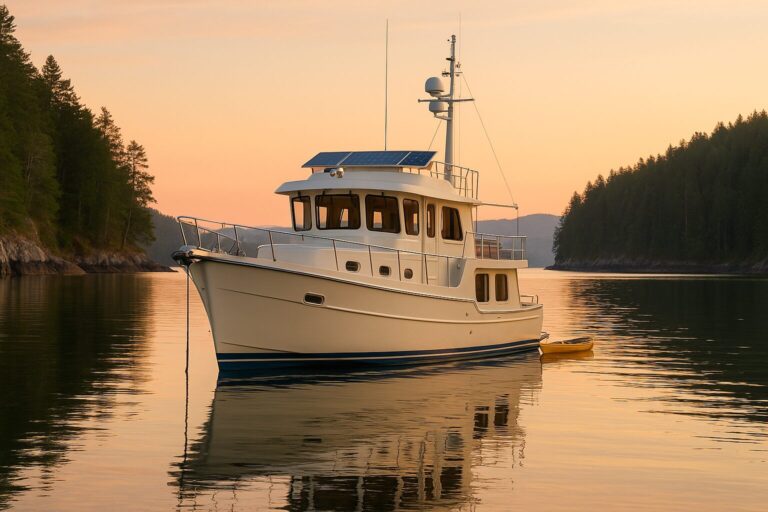
Living off-grid on a trawler is not an escape from domestic chores; it is the deliberate choice to run your own private utility company. When you drop anchor and cut ties with the marina slip, you trade monthly slip fees and shore cords for daily power budgeting, tank monitoring, and weather analysis.
True independence on the water is cyclical rather than permanent. Every vessel operating away from the dock operates on a finite loop determined by fuel capacity, freshwater storage, waste containment, and pantry space. Understanding how those interdependent systems function over weeks at anchor—rather than weekend getaways—determines whether the lifestyle feels liberating or exhausting.
Defining Real Independence at Anchor
Off-grid trawler living exists on a spectrum of self-sufficiency, measured by how long you can safely remain anchored in a cove without outside assistance. The interval between harbor runs depends on the particular boat, crew, weather, and available services.
Living aboard while traveling or swinging on a mooring places continuous, around-the-clock demands on your boat. When a trawler sits in a slip, shore power buffers domestic consumption. The water heater stays hot, battery chargers hum continuously, and water may be available at the dock.
Once that shore cord is stowed, every comfort requires a mechanical transaction. Refrigeration runs continuously to protect provisions. Running lights, communications equipment, water pumps, and entertainment draw from a finite house battery bank. Living off-grid means your boat must generate, store, and regulate every amp and gallon you intend to consume, all while preserving enough diesel to relocate safely when conditions deteriorate.
Managing the Interdependent Resource Budget
Off-grid living relies on three linked resources: energy, water, and food. Choices about one resource can affect the others. Making freshwater requires electrical energy, cooking meals draws on propane or your battery bank, and running a generator to replenish power burns fuel reserves. A sensible cruiser treats these three commodities as a single, combined balance sheet.
Electrical Demand and Generation
Domestic power consumption at anchor is usually higher than newcomers expect. Inverters convert direct current from your house battery bank into alternating current to run induction stoves, microwaves, coffee makers, and laptop chargers. Meanwhile, baseline DC loads run silently in the background: refrigeration compressors, bilge pumps, freshwater pressure pumps, marine electronics, and ventilation fans.
A realistic energy budget separates continuous baseline loads from intermittent, high-draw appliances:
- Continuous baseline draw: Measure refrigeration, freezer, communications, and instrument demand on the actual boat, accounting for temperature and use.
- Intermittent domestic loads: Cooking appliances, water heaters, hair dryers, and air conditioning can place substantial demands on generation and storage; their compatibility depends on the installed system.
- Charging strategies: Solar, generators, and engine alternators may contribute in different proportions. Their useful contribution depends on equipment, weather, and demand; plan how essential loads will be supplied when one source is unavailable.
Living comfortably without a shore connection means learning the discipline of power timing. You run watermakers, do laundry, and heat domestic water during peak solar generation or while running the generator to charge the house bank, avoiding heavy battery draws during the night.
Freshwater and Resupply
Water consumption dictates your time at anchor just as strictly as battery capacity. Measure your crew’s drinking, cooking, dishwashing, and shower consumption rather than adopting a generic daily allowance.
Usable tank capacity and actual consumption help determine when to replenish water. A watermaker may extend that interval, but its operating limits, power demand, maintenance, and source-water requirements still matter. Follow its manufacturer’s instructions and keep a replenishment alternative. Brief showers and daily tank checks can help make consumption easier to manage.
Pantry planning demands equal attention. Successful long-term provisioning requires balancing refrigerated proteins, fresh produce with varying shelf lives, and shelf-stable dry goods. Bulky packaging gets stripped at the dock to conserve locker space and minimize the trash you must carry aboard. When you live off the dock, a missed grocery run means adjusting your diet to what remains in the deep pantry, not running down the street to a supermarket.
Waste, Connectivity, and Maintenance Routines
The operational work of off-grid living goes well beyond keeping the lights on and the tanks full. Daily life centers around managing waste streams, securing reliable remote communications, and staying ahead of preventative mechanical maintenance.
Sewage and Environmental Regulations
Managing blackwater is one of the most rigid constraints on anchor time. In United States coastal waters, federal law prohibits the discharge of untreated sewage within three nautical miles of shore. In designated No-Discharge Zones (NDZs)—which encompass many popular cruising harbors, inland sounds, and coastal estuaries—the discharge of both treated and untreated sewage is prohibited entirely.
Skippers must verify the boundaries of their cruising grounds directly against current state and local marine regulations, as federal informational maps do not serve as final legal boundary authority. When anchored inside an NDZ or within the three-mile line without an approved marine sanitation device, your stay is strictly limited by the size of your blackwater holding tank. Plan access to an operating pump-out facility before the tank reaches its usable limit; do not assume moving beyond a nearby boundary makes discharge lawful.
Solid Waste Management
Trash accumulation surprises many first-time liveaboards. Every container, food scrap, and paper towel you bring aboard stays aboard until you visit a marina or town dock with disposal facilities. Off-grid cruisers manage trash deliberately:
- Compressing plastics and cans to minimize volume in lazarette storage.
- Washing empty food containers thoroughly in salt water to prevent bad odors and insect problems in warm anchorages.
- Separating food waste from other trash and retaining it for appropriate disposal ashore.
Remote Connectivity
Satellite and cellular services may support remote work or weather updates, but coverage, the service plan, installation, and local conditions must fit the intended cruising area. Test the connection for the work you actually need to do and retain appropriate independent weather and emergency communication arrangements.
However, connectivity comes with an electrical cost. Use the particular terminal’s specifications and measured consumption in your electrical budget. Off-grid liveaboards quickly learn to power down high-draw communication equipment overnight or when offshore work shifts conclude.
Daily and Weekly Maintenance Checks
When you live off the grid, your boat’s systems run continuously. Pumps, charging equipment, refrigeration, and ground tackle all need attention as use and conditions change. Preventative maintenance shifts from an occasional Saturday chore to a morning operating routine.
Build routine checks around the manuals for your installed equipment, including fluid levels, cooling-water arrangements, and the bilge where appropriate. Make checks in the required safe state, with professional guidance for anything unfamiliar. You monitor battery state of charge before brewing morning coffee. A leak or chafed hose deserves prompt assessment; some problems require professional help or a change in plans.
Evaluating the Routine Before Making the Move
Transitioning to an off-grid liveaboard routine works best as a stepped process rather than an abrupt leap. Before giving up your slip or severing land ties, evaluate your readiness through a self-contained trial run.
Start with a manageable trial cruise, suitable conditions, and access to services if needed. Work your regular hours where practical, cook aboard, manage your trash, and track water and electrical use. Extend the trial only as the boat and crew are ready; replenishment, pump-out access, and weather should shape the plan.
This test quickly reveals your actual baseline needs versus theoretical calculations. You will learn whether your battery bank handles your true electrical usage, how quickly your crew fills the holding tank, and whether your galley arrangement supports continuous, self-contained food preparation.
Vessel design plays a major role in how comfortable this lifestyle feels over months at anchor. For instance, our North Pacific 49 Pilothouse is built with an enhanced galley containing residential-style appliances, high ceilings, large windows, an island queen master stateroom, and a flexible guest stateroom. Those architectural choices matter because living off-grid is not just an endurance exercise in resource rationing; it is your home. During a walkthrough, consider whether the counter space, ventilation, light, and resting areas meet your household’s needs when weather keeps you indoors.
If you are exploring whether extended cruising away from marinas suits your goals, reviewing fundamental liveaboard feasibility through Can You Live on a Trawler? will help frame your financial, mechanical, and logistical readiness.
Your next practical step should be a thorough consumption audit. Measure your household’s actual daily water, power, and waste footprint over a typical week on the water. Once you know your real numbers, you can configure your boat’s tankage, generation systems, and storage around realistic operating needs.
Sources