
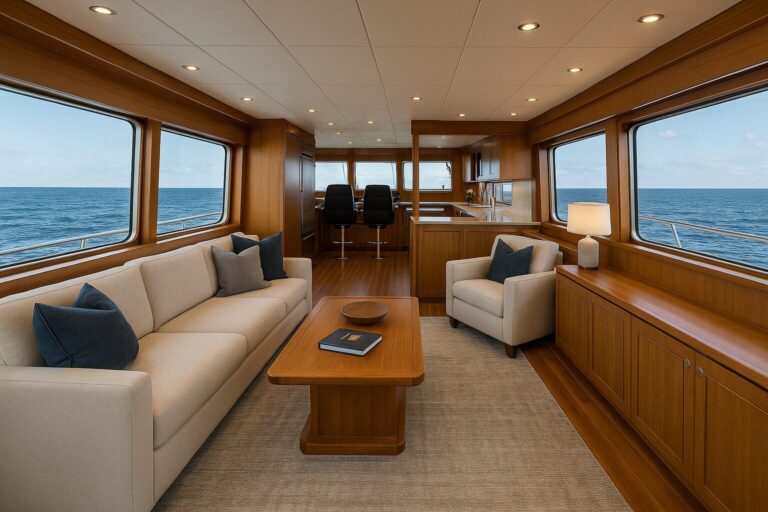
For sailors with a passion for exploration, the idea of setting off into remote waters aboard a long-range trawler is both thrilling and comforting. These vessels are designed to combine fuel efficiency, solid construction, and spacious living areas, allowing you to cruise longer distances with fewer stops. In 2025, the market offers a diverse array of trawlers that cater to different styles of cruising, from rugged, go-anywhere steel hulls to lightweight composite designs built for speed and efficiency. Today, we’ll unpack what makes the leading models so capable, share practical advice for choosing the right boat, and offer tips on outfitting your vessel for extended adventures far from the nearest marina.
Top Long-Range Trawlers for 2025
Among the standout offerings this year, there are multiple options you can discover, and some of them are as follows:
Grand Banks 65
The Grand Banks 65 represents the pinnacle of modern trawler design. Stretching nearly 72 feet in length, it blends a carbon-fiber–reinforced superstructure with an aluminum hull, creating a lightweight yet strong platform. This combination, along with its patented V-Warp stepped hull, cuts through waves with remarkable efficiency. With fuel tanks holding up to 1,500 gallons, the Grand Banks 65 easily covers over 600 nautical miles at a comfortable 10 knots, and some seasoned owners have even logged more than 1,800 nautical miles at slower speeds in calm conditions. On the inside, the main-deck master stateroom, dual guest cabins below, full-size galley, and dedicated laundry space make life aboard feel like home, while twin helm stations offer excellent visibility in all weather.
Swift Trawler 54
In contrast, the Beneteau Swift Trawler 54 brings French flair and smart engineering to the table. At just over 54 feet, it makes use of Volvo Penta IPS pod drives to achieve both impressive top-end speeds of 24 knots and efficient displacement cruising at around 8.5 knots. Its 634-gallon fuel capacity delivers a practical range of roughly 700 nautical miles, making it well suited to coastal hops or longer offshore passages. Inside, the raised pilothouse, open-plan salon, and full-beam owner’s cabin aft create a bright, airy living space, while forward crew quarters offer flexibility for family cruises or charters.
Numarine 22XP
For cruisers seeking robust seakeeping and true expedition capability, the Numarine 22XP is a standout. This 22-meter explorer yacht sports a steel hull with an aluminum superstructure and carbon reinforcements, allowing it to handle higher sea states without sacrificing comfort. Its 1,320-gallon fuel capacity and semi-displacement hull form translate into a range of around 1,700 nautical miles at 9 knots under power. An optional hybrid drive system reduces generator runtime at anchor, while four cabins, a beach-club swim platform, and a dual-station bridge ensure both luxury and practicality for extended voyages.
Sirena 68
The Sirena 68, built in Turkey, offers a steel-and-aluminum hybrid hull that balances weight, strength, and thermal insulation. Its 1,320-gallon tanks support voyages of roughly 1,000 nautical miles at 10 knots in typical conditions. On deck, wide walk-around sidedecks and an open-plan main deck foster easy movement and socializing, while below decks, four roomy staterooms and an enlarged engine room simplify maintenance tasks. The Sirena’s attention to detail, from noise-reducing insulation to high-quality joinery, gives it a reputation for rugged luxury in offshore environments.
Stevens 1600 Dutch
Meanwhile, traditionalists often turn to the Stevens 1600 Dutch Steel Trawler for unmatched durability. With a 52.5-foot steel hull and a conservative fuel capacity of 380 gallons, it may only register a theoretical range of 1,200 nautical miles at 7 knots, but its true strength lies in its simplicity. Teak decking, classic joinery, and straightforward Vetus–Deutz engines mean you can carry spares and tools aboard and tackle repairs yourself in even the most isolated ports. This trawler’s sturdy build and easy-access engine room have made it a favorite for multi-year expeditions in high latitudes.
Great Harbor N40
For those who prize nimble handling without sacrificing range, the Great Harbor N40 turns heads. At just 40 feet, it can be trailered to inland lakes before setting off on ocean passages. Its composite hull and foam-core topsides keep weight down, while 300 gallons of fuel deliver up to 650 nautical miles at 8 knots. Inside, two cabins and a compact but efficient galley and salon provide comfortable accommodations for a couple or small family, making it a versatile choice for a wide range of cruising grounds.
Choosing the Right Trawler
Selecting the ideal long-range trawler begins with understanding where and how you plan to cruise. If you envision crossing oceans and tackling rough seas, a steel or steel–aluminum hull like those of the Stevens 1600 or Sirena 68 will give you peace of mind and strength against the elements. Steel’s durability allows for DIY repairs almost anywhere, though you’ll carry a weight penalty and potentially higher fuel burn. Aluminum offers a middle ground: lighter than steel yet still robust, though repairs require specialized welding skills.
For cruisers who prioritize fuel economy and speed, composite or carbon-infused superstructures atop efficient hull forms can make a big difference. The Grand Banks 65 and Numarine 22XP both leverage advanced materials and stepped or semi-displacement hulls to reduce drag. Pair these designs with modern engines or pod drives, and you’ll achieve better nautical miles per gallon. Hybrid propulsion systems, becoming more common, allow you to run silently at anchor and recharge batteries with solar panels, extending your time off-grid and reducing generator noise and wear.
Beyond hull and propulsion, onboard comfort plays a crucial role in long passages. Large living spaces, ample storage, well-ventilated heads, and reliability in high-use areas like the galley and laundry make life aboard more enjoyable when you’re weeks from the nearest town. Consider the layout: do you need a full-beam master stateroom, or would a two-cabin arrangement suffice? How much storage will you require for spare parts, tools, and provisions? Think through your lifestyle, whether you’ll cruise solo, as a couple, or with family, and factor in crew cabins if needed.
Finally, account for serviceability. Even the most dependable yacht will require routine maintenance and occasional repairs. Brands with global networks, such as Grand Banks, Beneteau, and Numarine, offer parts availability and trained technicians in many regions. If your itinerary takes you far from established dealerships, choose simpler systems with widely available components. Carry a well-stocked inventory of filters, belts, hoses, and essential tools, and document your major systems so you or a local mechanic can diagnose issues quickly.
Preparing for Remote Cruises
Outfitting your trawler for extended offshore passages demands careful planning. Begin with communications and navigation upgrades: dual chartplotters on independent power sources, AIS transponder, and offshore radar help you monitor traffic and weather, while satellite systems Iridium or VSAT keep you connected for forecasts and emergency calls. Safety gear should include a liferaft sized for your maximum capacity, PLBs or life‐item GPS beacons, and an EPIRB linked to COSPAS-SARSAT.
Energy independence is another priority. Installing at least 1 kW of solar panels and a lithium-ion battery bank of 400–600 Ah can dramatically reduce generator hours. Coupling this with LED lighting, efficient DC refrigeration, and a high-capacity watermaker (5–8 gph) ensures you’ll remain comfortable and self-sufficient. Don’t forget freshwater storage: carrying 200–400 gallons gives a valuable buffer when watermaker output is low or you encounter unexpected delays.
Stocking provisions and spares rounds out your preparation. Plan for at least two weeks of non-perishable food like freeze-dried meals, canned goods, grains, plus fresh items you can rotate easily. Keep critical spares on hand for engines, generators, pumps, and plumbing systems, and learn basic repairs before you depart. A bench vise, crimping tools, electrical spares, epoxies, and hose clamps can save you from minor malfunctions that otherwise might force an early return to port.
Conclusion
Modern long-range trawlers offer a remarkable blend of tradition and innovation, from steel-hulled workhorses to composite-enhanced cruisers with hybrid power. By evaluating hull materials, propulsion systems, living layouts, and service networks, you can narrow your choices to the vessels best suited for your cruising ambitions. Equipping your yacht with robust communications, safety gear, energy solutions, and essential spares will further ensure that you are prepared for life far from civilization. With the right trawler and thoughtful preparation, the remote corners of the North Pacific or any waters in the world are within your reach, promising adventures that live long in memory.
We turn your cruising dreams into reality by developing bespoke trawler and pilothouse yachts built for comfort, safety, and performance. From the initial hull design to the final varnish, our experienced naval architects and craftsmen collaborate with you every step of the way, integrating fuel-efficient engines, ergonomic deck layouts, and beautifully appointed living spaces. With industry-leading warranties and personalized support, we make sure your new yacht feels like home the moment you step on deck. Reach out to us by email at info@northpacificyachts.com for personalized responses to all your inquiries. If you’d prefer a conversation, we invite you to give us a call at 1-877-564-9989.