

Hull labels do not make a vessel seaworthy. A yacht’s behavior in difficult conditions depends on its design and loading, its present condition, the people aboard and the sea itself. Comparing trawlers with planing yachts is useful when it leads to better questions about those factors.
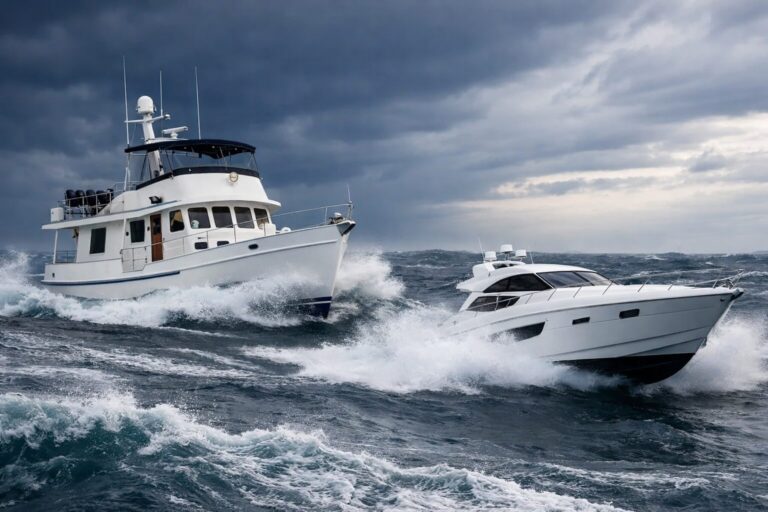
A trawler is not automatically stronger or safer, and a fast yacht cannot be assumed to outrun deteriorating weather. The useful distinction is how the particular hull operates across its speed range and what its documented limits mean for your plans.
Start with Sea State, Loading and Condition
Wave height, period and direction describe different aspects of the sea state. NWS guidance also explains that multiple wave systems can occur together. A height figure by itself cannot predict the demands on a boat and crew.
Significant wave height is an average of the highest one-third of waves, rather than a maximum. Marine forecasts and advisories need to be read for the relevant area and time. NWS does not give “small craft” a universal size definition; a protected wheelhouse or a larger length does not make an advisory irrelevant.
Loading and condition belong in the same assessment. Added equipment, fluid levels and modifications can affect the vessel. Steering faults, unreliable machinery or unresolved leaks cannot be offset by the reputation of a hull type.
How Operating Speed and Hull Form Change Behavior
Displacement operation relies on buoyant support. Planing operation involves substantial dynamic lift at speed. Boats described as semi-displacement combine characteristics and may operate across a wider speed range. These descriptions are starting points, not complete accounts of geometry or behavior.
A planing yacht continues to float and can operate below planing speed. Its response at those speeds should be assessed for that hull; slowing down does not automatically make it unstable. A trawler likewise needs suitable speed choices as conditions change. Neither description supplies a universal rough-water speed.
Head and Opposing Seas
Heading into waves can produce pitching, spray or impacts. The shape of the bow and underwater sections, loading, speed and wave characteristics affect the response. Rather than assume that one category slices through waves and another pounds, ask how the particular yacht behaves and what guidance its builder and experienced operators provide.
Visibility is part of that question. Observe the view from the intended operating position and ask how trim, spray, window clearing and lighting affect it. A sheltered helm can reduce exposure while still requiring attention to the useful view outside.
Beam and Following Encounters
Waves approaching from the side can create rolling. Following or quartering waves can affect heading and steering demands. These are reasons to understand the vessel’s behavior and limits, not instructions to hold a particular speed or position on a wave.
A keel or other appendage can influence tracking, but cannot be treated as a guarantee against loss of control. Stabilization also has equipment-specific limits. Discuss those details for the exact boat rather than infer them from its silhouette.
Evaluate Controls and Design Limits
Ask for available operating guidance, design information and records relevant to your intended cruising. The important questions include how steering and propulsion perform across the intended speed range, which openings need attention, and how the boat is maintained and loaded.
Drainage, doors, windows, machinery ventilation and underwater fittings deserve boat-specific assessment. There is no universal door-sill height or equipment package that this article can declare sufficient for heavy seas. A survey addresses present condition; passage suitability may require additional advice about design and use.
Our Rough Weather on a Trawler: Preparation, Early Decisions and Recovery guide covers preparation and reassessment. Keep that operational planning separate from the question of which yacht to buy.
Questions for a Sea Trial and Professional Review
A suitable sea trial can clarify behavior within the conditions encountered. It should not deliberately seek severe weather or use a prescribed sequence of wake crossings to prove capability. Agree the scope with the captain and survey team.
| Question | Evidence to discuss |
|---|---|
| What speeds suit the proposed operation? | Builder guidance and observations on the actual boat |
| How does loading affect the assessment? | Loading information and records of modifications |
| What could restrict steering or visibility? | Operating guidance, condition checks and trial observations |
| What remains untested? | Trial conditions and limits of the inspection |
| Does the intended route exceed what has been assessed? | A route-specific review of vessel and crew |
A buyer-commissioned marine survey helps establish condition. Agree whether haulout and specialist machinery inspection are included; a general inspection is not a warranty of performance in every sea state.
Compare candidate yachts through this evidence. If you want to Plan Your Yacht with us, bring your intended waters, preferred passage lengths and crew experience so the conversation addresses your proposed use rather than a category-wide promise.