

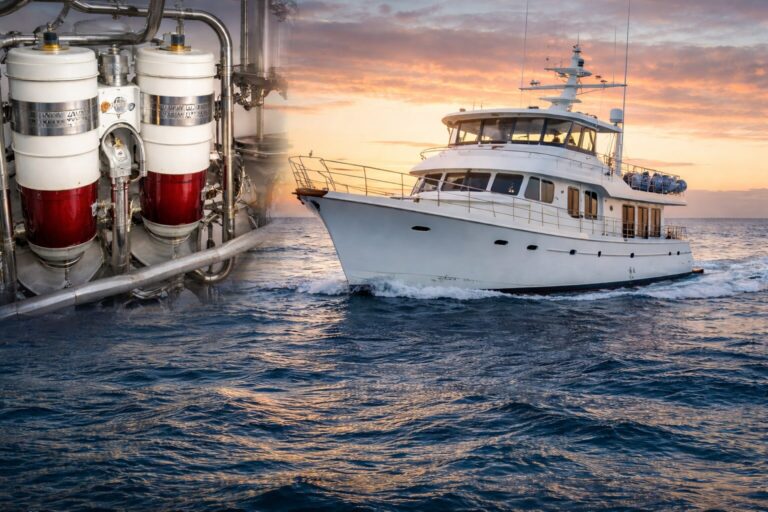
A fuel polishing system is not mandatory equipment for every long-range trawler. While marketing often presents onboard polishing as an essential safeguard for serious cruising, clean fuel delivery depends primarily on tank design, fuel turnover rates, and disciplined engine filtration. Deciding whether to install an offline polishing system requires understanding what polishing actually does, evaluating physical evidence from your fuel supply, and recognizing the structural limits of your fuel tanks.
Polishing Loops vs. Engine Filtration Circuits
Fuel polishing is an offline recirculation process, not a substitute for the engine’s primary and secondary fuel filters. The two systems serve different mechanical functions and operate under entirely different conditions.
Engine filtration protects the fuel delivered to the engine, while a separate polishing circuit recirculates stored fuel independently. The actual order of pumps, filters and return connections varies by engine and installation. A running engine may return fuel to the tank, but that does not establish that it reaches and cleans all stored fuel.
- Engine supply: installed filtration protects the fuel going to the engine.
- Separate polishing: a dedicated circuit circulates stored fuel through its own filtration and water-separation equipment.
- Tank access: either approach is limited by the fuel and contamination its pickup can reach.
A dedicated fuel polishing system operates independently of the engine. It draws fuel from the tank using an independent electric pump, pushes it through an external filter and water separation unit, and discharges it back into the same tank. As documented in technical literature for Parker Racor marine filtration, a separate tank recirculation circuit removes particulate matter and free water upstream of engine delivery.
Filtration can remove material within its designed particle and water-separation capabilities. It cannot certify that chemically degraded fuel meets the engine’s requirements. Suspected deterioration needs an appropriate fuel assessment and a maintenance response that addresses its cause.
Gathering Evidence: When Is Fuel Quality Actually Compromised?
Storage duration, fuel turnover, water entry and the condition of the fuel supply all affect the assessment. Tank size alone does not tell you whether contamination exists or whether an installed polishing system would solve it.
Before committing to equipment changes, inspect the system for tangible evidence of contamination:
- Filter and water-separator findings: Keep records of water, debris and unusual deposits observed during the installed equipment’s inspection routine. Appearance is a reason to investigate, not a conclusive diagnosis.
- Restriction trends: Interpret gauge readings using the filter manufacturer’s limits and the operating conditions. A change may warrant checking filters and fuel supply.
- Service history: Detailed fuel filter records reveal repeated plugging and unexplained changes in service demand.
- Sampling and testing: When contamination or degraded fuel is suspected, ask a qualified provider where and how to sample the tank and which tests answer the actual question. A sample from one location may not represent all compartments.
Tank Architecture and System Circuit Limitations
A fuel polisher is only as effective as the fuel it can physically reach. Installing a 60-gallon-per-hour polishing pump on a large marine tank does not guarantee clean fuel if internal tank structures trap sediment away from the polishing suction point.
Baffles affect fuel movement and access inside a tank. For example, our 49 Pilothouse has two baffled fiberglass fuel tanks. Inspect the exact boat’s drawings and access arrangements before assuming a polishing pickup reaches every compartment. The North Pacific 49 equipment resource also helps you consider machinery access.
A circuit that repeatedly draws from and returns to one area may leave other pockets poorly reached. Water and settled material may require a different removal method. Ask the installer how the circuit reaches low points and communicates across the actual tank geometry, and what contamination it cannot address.
For an onboard polishing system to provide practical value, confirm:
- Pickup and return locations: How do they reach the intended fuel and avoid simply recirculating the same small volume?
- Tank access: Can water and sediment be assessed and removed where necessary?
- Performance and maintenance: What flow, filtration, water-separation limits and service routine does the selected system require?
- Verification: What observations or tests will show whether the maintenance goal has been met?
Matching Maintenance Strategies to Reality
An installed fuel polisher is one option among several maintenance strategies. Depending on your operational patterns, other interventions may offer better reliability and lower complexity.
| Maintenance strategy | Useful question | Limits to establish |
|---|---|---|
| Installed polishing | Does recurring storage contamination justify an independent circuit? | Tank coverage, operating supervision and filter service |
| Professional tank/fuel work | Does settled contamination or degraded fuel require direct intervention? | Access, sampling, removal method and disposition of fuel |
| Engine supply filtration | Is the installed filtration maintained and appropriate for the engine? | Protects the supply stream; does not establish whole-tank cleanliness |
A chemical treatment may be part of an assessed contamination response, but it does not remove settled water or debris by itself. Follow the engine, treatment and equipment requirements, and agree on how contaminants and spent filters will be handled. Do not substitute additive dosing for investigating repeated filter plugging.
Keeping a boat-specific spare parts inventory means identifying the exact filter elements, seals and other consumables specified for the installed equipment. Choose ratings and compatibility from those requirements rather than a generic micron hierarchy. Keep the change procedure and required tools with the parts.
Determining Your Next Step
If fuel history and inspections reveal no recurring storage problem, weigh the additional system against the maintenance need it would actually serve. Repeated water or debris findings, long storage periods or uncertain fuel quality warrant investigation. The answer may involve correcting water entry, tank cleaning, appropriate filtration, polishing or a combination—not automatically another pump.
Every cruising plan and hull layout presents different equipment priorities. If you are evaluating fuel system design, machinery access, or mechanical specifications for long-range cruising, talk with us about your yacht configuration and cruising plans.