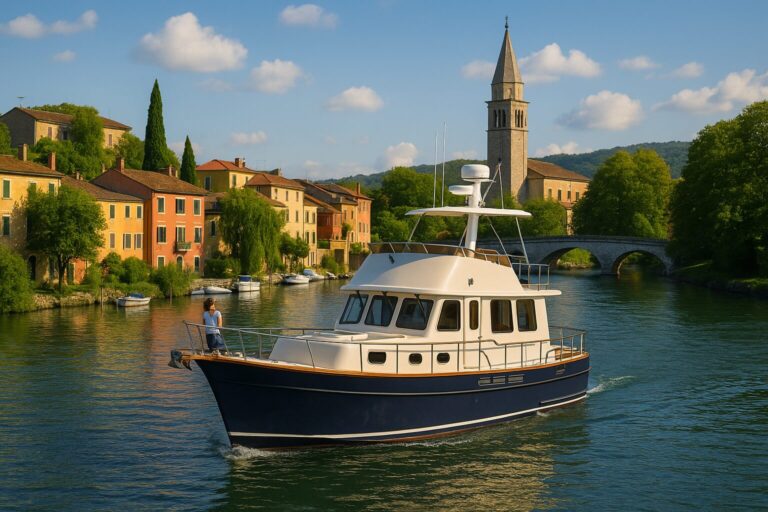
Choosing a European cruising area brings together the places you want to visit and the waters your particular yacht can access. Inland canals, Scandinavian sounds, and Mediterranean archipelagos offer very different experiences.
Air draft and loaded water draft are hard physical barriers on Europe’s historical canal systems. Centuries-old stone arch bridges and shallow canal beds will not yield for a flybridge, radar arch, or deep keel. Coastal and fjord itineraries also need checks for local restrictions, bridges, and the conditions between destinations. Deciding between an inland passage and an open-water cruising ground is the first, non-negotiable step in planning an extended European itinerary.
French Waterways: Infrastructure Limits and Operating Windows
France’s inland waterways offer unmatched access to historic towns, but their infrastructure severely restricts motor yacht dimensions. The Canal du Midi illustrates the physical constraints of historical systems. Official VNF (Voies Navigables de France) 2026 Sud-Ouest notices list channel characteristics on the Midi that include a charted water depth of 1.40 meters and a center-channel clearance between 3.30 and 3.55 meters. Because these bridges are curved stone arches, clearances drop significantly toward the channel banks.
These figures describe infrastructure characteristics at the stated water level, rather than guaranteeing vessel clearance. A yacht’s loaded displacement—accounting for fuel reserves, full water tanks, and gear aboard—can push operational draft past safe limits for a 1.40-meter channel. Silt accumulation, lock maintenance schedules, and seasonal water management also constrain passage. For vessels whose dimensions fit these tight profiles with sensible margins to spare, the rewards ashore are exceptional: tying along quiet banks beneath plane trees, walking into stone villages for morning markets, and unhurried days spent exploring rural wine country. Any inland journey requires verifying your loaded profile against exact sector notices before committing to a route.
Norwegian Fjords: Scenery with Coastal Legs
Cruising Norway is about exploring massive sea arms rather than attempting an exhausting continental tour. These fjords are deep, saltwater ocean arms carved into the mountainous mainland. Deep water is part of the fjord landscape, but yacht access still depends on the particular route, harbor, and any overhead obstructions.
Rather than trying to transit the entire western coast, choosing a defined focal region—such as the waters between Bergen and the Sognefjord—creates a practical, rewarding itinerary. Here, the experience balances dramatic passages along sheer rock walls with relaxed time tied to village quays. Ashore, walking trails lead directly from seaside docks into pine forests, quiet orchards, and hillside viewpoints overlooking the inlets. Moving between fjord regions may involve exposed coastal legs along the outer shoreline. Motor yacht owners should treat Norway as a dedicated destination that demands thoughtful route planning between sounds, rather than an incidental leg of a broader European trip.
Croatian Islands: Select a Region Rather than a Coastline
The Croatian coast is best explored by dedicating your time to one island cluster rather than attempting to run the entire length of the Adriatic. Trying to see every island along the Dalmatian coast can turn an enjoyable holiday into a tiring delivery schedule.
Structuring your journey around a regional base—such as Split in central Dalmatia or Korčula farther south—helps you choose nearby stops instead of linking distant destinations. Marina directories published by the Croatian ministry list facilities at both Split and Korčula, but slip space and supported vessel dimensions are never guaranteed in advance. Skippers should confirm berth services, maximum draft, and length limits directly with individual harbor operators well ahead of arrival.
Ashore, Dalmatian island towns offer a rich walking environment. Polished limestone alleys wind through medieval Venetian architecture, opening onto quiet courtyards, seaside footpaths, and waterfront konobas. Approaching Split and Korčula as distinct staging grounds keeps daily legs manageable, leaving ample time to enjoy the local culture and quiet anchorages.
Göta Canal: A Different Inland Proposition
Sweden’s Göta Canal provides a classic inland passage, operating on a far more generous scale than the shallow canals of southern Europe. The Göta Canal itself runs from Sjötorp on Lake Vänern across to Mem on the Baltic Sea. Cruising completely between the North Sea and the Baltic requires transiting additional connecting waters, including the Trollhätte Canal and Lake Vänern, meaning the Göta Canal alone is not a coast-to-coast route.
Published infrastructure dimensions for the Göta Canal permit vessels up to 30 meters in length, 7 meters in beam, 2.82 meters in draft, and 22 meters in air draft, with a maximum speed of 5 knots. While these limits accommodate many trawlers that cannot fit into French canals, they do not grant automatic access. Real running draft, antenna clearances, and lock-handling procedures must still be measured carefully against current waterway publications.
Life along the canal moves at a deliberate, peaceful pace. The route cuts through open pastures, dense pine forests, and wide inland lakes. Grassy towpaths provide ideal routes for morning walks or bike rides alongside the boat, while small canal-side communities offer quiet evenings alongside wooden docks. Operating schedules vary from year to year, making it essential to consult current official notices when planning lock flights.
Choose One European Cruising Area and Prepare the Boat
Successful cruising in Europe begins by matching your vessel’s true dimensions to the physical reality of a single region. The shallow stone arches of France, the deep salt fjords of Norway, the historic island quays of Croatia, and the freshwater lock flights of Sweden each deliver a distinct travel experience. Attempting to stitch them into a single fast-paced season creates logistical friction and eats into time spent enjoying life ashore.
Before finalizing travel dates or booking berths, measure your boat’s actual working figures—loaded draft, maximum air draft, and beam—and compare them against official waterway notices. At North Pacific Yachts, we believe that the best journeys start with clear, realistic planning. If you are evaluating how your setup aligns with these destinations, review your vessel’s specifications and contact us to discuss how our yachts match your European cruising goals.
Sources
- VNF2026 dimensional characteristics and operating notices
- Norwegian fjord identity and regional scenery
- Official directory lists Split/Korcula facilities
- Canal maximum vessel dimensions/speed