

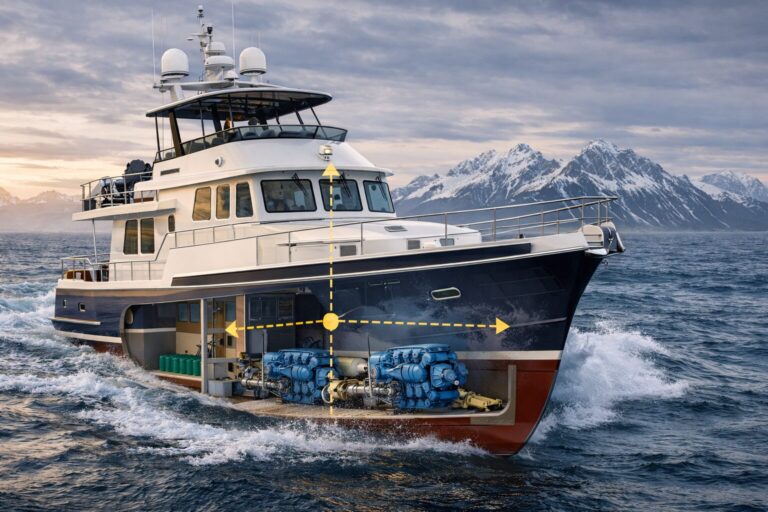
Standing at a raised pilothouse helm gives you command over your immediate surroundings. Your view changes with the helm height, but the bow, windows and your operating position still determine what you can actually see.
That commanding view often creates a false sense of physical security. An elevated vantage point does not mean the hull beneath you possesses superior stability. In naval architecture, height is never free. Where you stand to run the boat is an operational layout decision; how the vessel behaves in a cross-sea is a mathematical calculation of mass, volume, and balance across the entire hull.
Understanding what a raised pilothouse actually does—and does not do—to vessel dynamics helps you evaluate real boats objectively instead of relying on dockside impressions.
Sightlines Are Not Stability
A higher helm position changes your perception of motion without improving the underlying physics of the hull. Our guide, Why Raised Pilothouse Yachts Are Worth the Investment, explores layout considerations. Those questions should be assessed separately from vessel-specific stability.
The center of gravity represents the point through which the vessel’s combined weight acts. The center of buoyancy represents the point through which the buoyant force acts. Their relationship and the hull’s shape contribute to the vessel’s response when heeled. When the yacht heels, the underwater shape shifts, moving the center of buoyancy outward to create a righting arm that pushes the hull upright.
Your eyes might be twelve feet above the waterline, but the righting forces are working down near the keel and the turn of the bilge. A pilothouse that feels tall and formidable in a slip tells you nothing about the magnitude of that righting arm at fifteen, thirty, or forty-five degrees of heel.
Looking at the Whole Hull’s Weight Distribution
Adding weight high on a vessel can raise its vertical center of gravity. The effect of a raised structure depends on its weight, position and the complete vessel design.
General guidance on weight and vessel stability explains why adding high weight and changing loading can affect stability reserves. The cited Transport Canada material concerns fishing vessels; it supports these physical principles, not a certification or regulatory conclusion for a particular recreational yacht.
To maintain proper stability reserves, weight aloft must be accounted for across four distinct categories:
-
Superstructure construction: Using solid fiberglass layups on high structures adds dead weight where it hurts most. Material choices and their weight should be assessed within the whole vessel design.
-
Permanent bridge equipment: Heavy sliding doors, thick glass, helm seating, and hardtop framing accumulate weight quickly at eight to twelve feet above the waterline.
-
Tankage and fluids: Fuel and water tanks positioned low in the hull help pull the overall center of gravity down. However, wide, shallow tanks that are partially full introduce the free surface effect, allowing liquid to shift toward the low side during a roll and degrading stability when you need it most.
-
Variable payload: Provisions, stores, tools, and spare parts loaded over years of cruising add up. If stowage areas sit high in the hull or inside pilothouse bench risers, they gradually erode design margins.
The Difference Between Stability and Motion Comfort
A boat’s response to a small load shift at the dock does not show how it will behave in waves. Stability and motion comfort are related but different questions. Hull form, loading, wave conditions and other factors influence the experience underway.
A raised position can change the motion a person feels, but helm height alone cannot predict roll amplitude, period or offshore suitability. Ask what vessel-specific evidence is available and what an appropriate sea trial can help you assess.
Engineering Aloft: The NP49 Construction Approach
Managing weight above the waterline requires deliberate engineering decisions before the hull mold ever closes.
For example, our 49 Pilothouse exterior includes a superstructure cored primarily with lightweight closed-cell foam to reduce weight and lower the center of gravity.
Keeping upper structures light holds the vertical center of gravity lower in the hull. This construction practice does not serve as a performance guarantee, a roll prediction, or an offshore sea-state rating. It is simply sound naval architecture: you cannot add volume aloft without aggressively managing the mass of that volume.
Ask for Evidence Before Modifying Roof Loads
Aftermarket additions deserve a vessel-specific assessment, especially when they add weight high on the boat.
Items to include in a proposed weight assessment may include:
-
A tender and its associated handling equipment on the boat deck.
-
Heavy hydraulic crane assemblies mounted off-center.
-
Commercial-grade satellite domes, steel light bars, and radar arrays.
-
Large solar banks mounted on steel frames above the canvas or hardtop.
Before adding significant weight above the sheerline, consult the builder or a naval architect for a vessel-specific assessment. Avoid the common dockside temptation to offset new rooftop gear by casually throwing lead ballast into the bilges. Adding uncalculated low ballast changes total displacement, lowers the vessel’s operating freeboard, alters trim, and can induce unexpected structural stress or snappy, fatiguing roll periods.
Practical Questions for Your Next Helm Inspection
When you step aboard a raised pilothouse yacht to evaluate its engineering and arrangement, look past the electronics and examine the physical realities of the platform:
-
What materials are used above the deck line? Ask whether the pilothouse roof, flybridge structure, and hardtop are solid laminate or cored with closed-cell foam.
-
Where does the builder mount heavy auxiliary gear? Check whether air conditioning compressors, inverters, and house battery banks are mounted deep in the machinery space or tucked into mid-level cabin joinery.
-
What is the rated capacity of the boat deck? Ensure the designated tender storage area was engineered for the crane and dinghy combination you intend to carry, rather than assumed after the fact.
-
How is loading accounted for? Ask how fuel, water, stores and the intended equipment are included in the vessel’s relevant loading information.
If you are weighing the operational trade-offs of a raised helm or want to review how our hulls balance living volume with proper weight distribution, talk with us. Ask us about the available construction and specification information for the model and configuration you are considering.