

A pilothouse yacht does not age along a single, predictable timeline. The interior can look inviting while equipment needs attention; sound machinery can coexist with a layout that no longer suits its owner. Assessing long-term ownership means distinguishing appearance, condition, functional fit and market value.
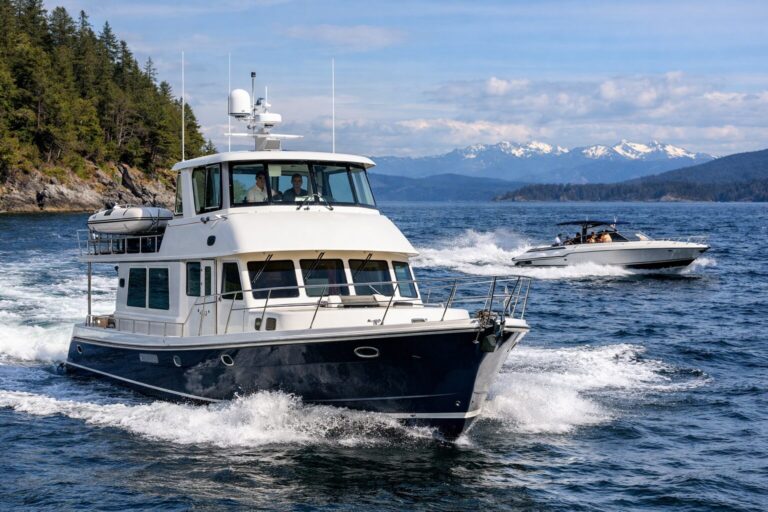
The objective is to understand whether a particular boat can remain useful and serviceable for your plans. An enclosed helm does not establish that it will outlast an open boat or retain more value.
Separate Four Questions About Aging
Physical condition concerns the structure, machinery and systems. Functional fit concerns how easily your crew can operate and live aboard. Cosmetic condition concerns finishes and appearance. Market value concerns what buyers will pay at a particular time.
These assessments interact without being interchangeable. A cosmetic defect may be minor, or it may be evidence of a leak needing investigation. A carefully maintained boat can still be unsuitable for a buyer’s routines. New finishes alone do not establish either structural health or a future resale price.
Yacht Build Quality, Service Access, and Long-Term Resale Value considers that relationship in more detail. Here, focus on the features and records that help you continue using the yacht.
Examine Surfaces, Windows and Openings
A pilothouse introduces glazing, seals, doors and equipment that deserve care. Inspect for signs of leakage, damaged finishes and ineffective operation. Ask which maintenance instructions apply to the installed products and what work has already been done.
Do not assume a fixed replacement interval for every window seal or enclosure. Exposure, materials, installation and maintenance differ. A history of recurring leaks is more useful evidence than an age-based rule.
Fiberglass repair and maintenance guidance also makes clear that composites can need attention. A solid laminate, foam-cored panel or wood-cored panel presents different inspection questions, but none should be declared immune to water-related damage simply from its label.
Our 49 Pilothouse has a solid hand-laid fiberglass hull, a superstructure and decks cored primarily with closed-cell foam, and teak interior finishes. Use those specifications to understand the construction you are inspecting, while assessing the actual condition and any modifications separately.
Look for Service Access and Adaptability
Routine access and eventual replacement access are different questions. A filter may be easy to reach while the component behind it is difficult to remove. Ask how technicians access important equipment and what must be moved to replace it.
For the helm, consider how a future equipment change would be accommodated. Are wiring routes accessible? Are circuits labeled? Is there room to service the existing instruments? There is no universal electronics replacement cycle, but inaccessible installations can complicate whatever change you eventually choose.
Your own requirements may change too. Evaluate stairs, handholds, seating adjustment, door operation and routes through the boat. Focus on the movement your crew finds manageable rather than assume that age alone predicts physical ability.
Use a Long-Term Inspection Framework
| Area | What to notice now | What to request |
|---|---|---|
| Windows and doors | Leakage signs, damaged seals, smooth operation | Product care instructions and repair history |
| Structure and deck fittings | Damage or persistent water-entry concerns | Construction information and professional assessment where needed |
| Machinery | Access for service and component removal | Maintenance records, equipment manuals and specialist findings |
| Helm systems | Labels, wiring access and usable mounting space | Diagrams and records of alterations |
| Everyday movement | Steps, handholds and transitions your crew uses | An opportunity to assess the actual layout |
This is a way to organize questions, not a schedule of predicted failures. Avoid assigning a five- or ten-year failure date to systems without evidence for the particular equipment and use.
Validate the Boat and Its Records
A buyer-commissioned marine survey can help establish present condition. Agree its scope and whether specialist machinery work and haulout are included. Survey findings and limitations should be understood before using them to make long-term assumptions.
Look for equipment lists, manuals, service invoices and records of modifications. Ask about obtaining replacement parts and technical documentation for what is actually installed. Do not assume that an original builder’s reputation resolves the condition or support needs of a used yacht.
Then consider the work and support you are prepared to arrange. A boat ages usefully through a combination of design, care and fit with its owner’s routines. Bring those questions to us when you Plan Your Yacht, so current model choices can be discussed against your ownership horizon.