

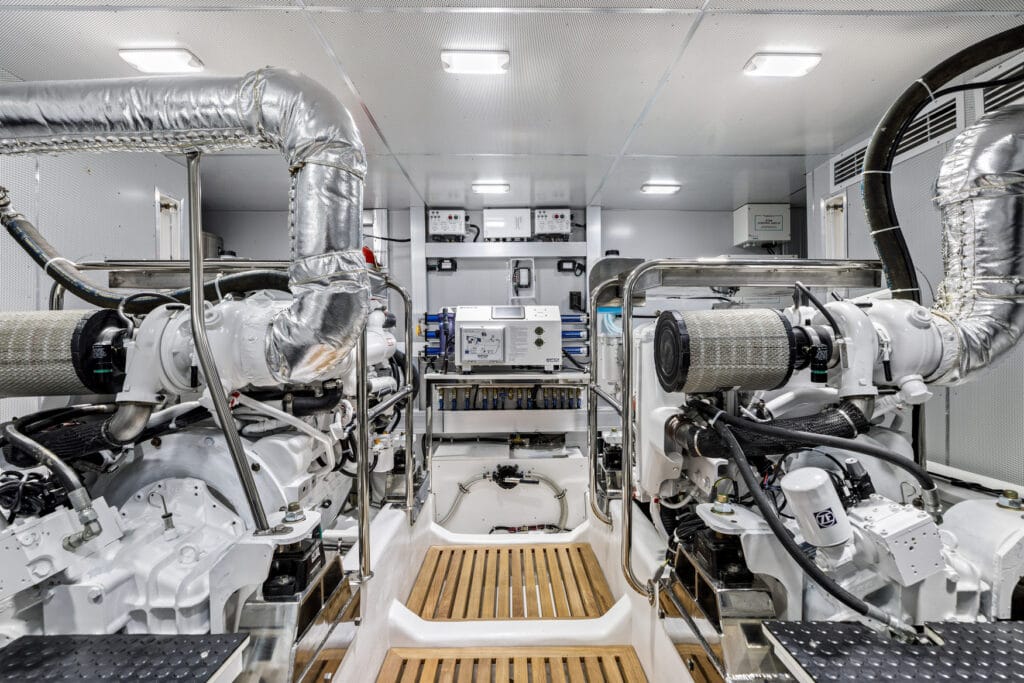
A clean bilge is encouraging, but a buyer also needs to understand how that space will be reached after cruising stores come aboard. A hatch hidden under luggage, a valve visible but out of reach, or a strainer with insufficient service clearance can turn an ordinary inspection into a project.
During a showing, your job is to observe access and ask precise questions. The surveyor assesses condition and the installation. Our broader guide to how to evaluate serviceability before you buy covers wiring and future changes; this walkthrough focuses on water-related service points.
Inspect the Access Path as You Will Use It
Ask permission before opening intended inspection hatches or panels. Consider what would occupy the nearby space during a cruise: tools, provisions, spare lines, guest bags, or furniture. Which items must move, where does the panel go, and can the opening remain safely supported?
Look for light, sightlines, stable footing, and room for the person who will perform the actual task. Being able to see a component does not establish that its fasteners, connections, or removable parts are reachable.
Use engine-room access as a buying test for the complete machinery-space view. For bilges and seawater fittings, add specific notes about the paths beneath the sole and into lockers. Avoid climbing onto equipment or forcing a panel simply to complete a showing checklist.
Locate Bilge Collection Points and Pump Access
Ask where water collects and how it moves between spaces. Some areas drain toward another low point; others have their own collection or pumping arrangement. Identify the accessible inspection points and any area whose condition cannot be seen during the showing.
Look for access to pump intakes, sensors, hoses, and connections, while leaving testing and disassembly to the agreed survey or service scope. A clean compartment does not prove that a pump or alarm works.
The Rule automatic bilge pump manual illustrates a key limit: this equipment is intended for normal bilge water in an intact craft, rather than damage control after hull damage. The installed arrangement and its instructions remain the authority for the particular yacht. Our bilge pumps and high-water alarms guide develops the separate readiness-check questions.
Identify Through-Hulls, Seacocks, and Shared Intakes
A through-hull is a fitting through the hull. A seacock controls a connected water path. A sea chest or intake manifold may organize supply to several systems, while other yachts use separate intakes. Do not assume every consumer has its own opening or that a shared arrangement has the same isolation options as another boat.
Ask what each identified fitting serves and how the water path is documented. Can the appropriate person reach the control, read its label, and inspect the connected hose? Does storage obstruct the intended access?
Do not operate unknown valves during a showing. Note unclear identification, restricted movement space, visible leakage, or damage for the surveyor. A visual walkthrough cannot certify the mounting, material, or suitability of a fitting.
GROCO service identification is a useful example of matching product identity to the correct service sheet and replacement parts. That does not establish that GROCO hardware is installed on the yacht you are viewing.
Evaluate Strainer Clearance and Service Access
A raw-water strainer intercepts debris in its part of the intake circuit. During a showing, concentrate on access: can the service provider reach the lid, remove the basket by its intended path, see the seals, and manage water released during the prescribed service?
The right clearance depends on the actual product. A threaded cap, removable cover, or different basket arrangement may require a different working path. GROCO ARG strainer maintenance provides a product-specific example, rather than a universal lid or seal procedure.
Also consider nearby electrical equipment and surfaces when asking how service is performed. Leave opening, draining, valve operation, and flow tests to the agreed instructions and service scope. Our guide to seawater strainers, raw water flow, and overheating prevention on cruising yachts explains why strainer condition is only part of cooling readiness.
Give the Surveyor Specific Observations
Separate access from condition in your notes. “Valve handle visible, but stored equipment blocks the approach” describes an access issue. “Visible staining beneath the fitting” records a condition for assessment. Neither observation identifies a failed component.
Useful questions include:
- Which intended inspection points could not be opened or reached?
- What equipment or stored gear restricts access?
- Which fittings or water paths remain unidentified?
- What further access does the surveyor need, and who arranges it?
- Can the relevant routine service be demonstrated or explained for this boat?
Our 49 Pilothouse has gas-assisted salon-floor engine-room hatches and removable access panels for equipment, wiring, and plumbing. That is a concrete access feature to consider during a comparison; it does not prove the condition or reachability of every fitting on every hull or configuration.
Take photographs with permission and discuss unresolved access before deciding how much the survey can cover. If you want to compare available layouts or ask about service paths aboard a North Pacific yacht, contact us with your cruising plans and the particular access questions you have identified.