

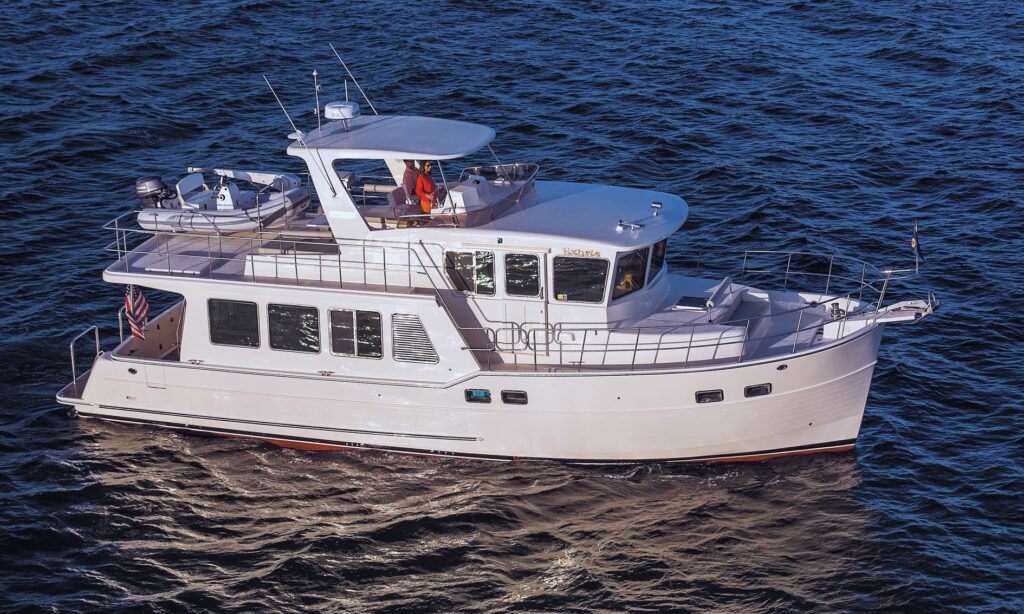
Ground tackle selection begins with your vessel’s fully loaded displacement and superstructure windage, not bare factory weights or generic length-based formulas. A semi-displacement trawler carries high forward freeboard, pilothouse volume, and extended bridges that act as a sail in heavy gusts. Sizing an anchor simply by “one pound per foot of boat” ignores the massive horizontal loads generated when twenty or thirty tons of boat surge against the gear.
Different anchor families require dedicated sizing curves. Sizing charts for modern scoop anchors like Rocna map length overall directly against displacement brackets for each specific model profile. Boats of the same length can fall into different recommendations because displacement and intended use also matter.
Manufacturer charts provide a sound baseline for general coastal anchoring in moderate sea states, but they are not universal safety ratings or safe-wind operating limits. For intended use beyond a chart’s assumptions, ask the manufacturer for a vessel-specific recommendation and verify the resulting physical fit.
Physical Bow Fit: Shank Geometry, Rollers, and Clearances
A ground tackle design that calculates well on an engineering sheet can fail completely on the foredeck if the anchor cannot clear the stem or seat properly in the roller assembly. Holding capability must be separated from physical hull fit.
Modern anchors feature distinct physical profiles: roll bars, sweeping shanks, and wide-fluked scoops. Before purchasing, verify how the shank articulates over your bow roller and how the fluke rests against the hull.
-
Anchor profile: Check roll-bar, shank and fluke clearance through the approved deployment and recovery path.
-
Hull and deck clearance: Check how the anchor sits and moves around the stem, roller and nearby fittings.
-
Handling fit: Confirm whether the roller arrangement supports the chosen anchor without awkward manual handling.
Anchor manufacturers provide full-scale dimensioned templates and printable cutouts. Trace these onto stiff cardboard or plywood and physically place them into your bow roller assembly. Verify clearance against the deck, the hawse pipe exit, the hull stem, and any forward deck lockers before committing to an anchor model.
All-Chain vs. Mixed Rode: Weight, Storage, and Gypsy Calibration
Rode selection balances the holding advantages of heavy ground tackle against hull trim, locker space, and abrasion resistance.
| Rode consideration | All-chain | Mixed rope and chain |
|---|---|---|
| Weight | Usually adds more weight for a comparable deployed length | Can reduce weight, depending on the selected components |
| Storage | Check locker capacity and chain fall | Check space for both materials and the transition |
| Wear | Inspect chain and connectors; chain is not immune to damage | Inspect rope for chafe as well as chain and connectors |
| Windlass handling | Exact chain must fit the chainwheel | Windlass and rope/chain combination must be compatible |
Maxwell emphasizes chain size, grade and fit to the exact chainwheel. Similar nominal diameters do not prove compatibility. Use the installed chainwheel specification and verify the proposed chain before ordering.
Chain weight affects rode behavior, but it does not guarantee holding. Anchor design, seabed, scope, conditions and installation remain relevant. A stronger-looking package still needs appropriate anchoring judgment.
Windlass Working Loads and Locker Fall Depth
A windlass is an electric or hydraulic retrieval device, not a high-load mooring bit. Windlasses manufactured by companies like Maxwell are chosen by cross-referencing vessel displacement, windage profile, and total suspended ground tackle mass.
Select the windlass for the vessel, anchor and rode, using the manufacturer’s capacity and installation guidance. It should support the intended recovery job; it is not a substitute for the approved equipment that carries anchoring loads.
Maxwell’s selection guidance considers vessel size, displacement, windage, ground tackle, locker space and depth of fall. Confirm the correct chain stopper, snubber or securing arrangement for the actual installation. Do not use a general article as instructions for breaking out an anchor or rigging loaded deck hardware.
The locker also needs enough room for the selected rode to feed and stow properly. Ask the installer to demonstrate the arrangement and confirm required fall distance, drainage and access. A generic footage threshold cannot establish when a particular locker will jam.
Scope, Seabeds, and Real-World Installation
Proper ground tackle requires active operator judgment. No single scope ratio guarantees holding across anchorages. Consider bottom conditions, depth through the tidal range, bow height, weather, swell and available room. If the arrangement cannot support a suitable anchoring plan, choose another location rather than assuming better hardware compensates.
On our 49 Pilothouse, we install a Maxwell windlass, G4 chain and a Rocna anchor. Assess the exact installation and equipment specification for the boat you are considering. The presence of those components does not establish a storm rating or remove the need to evaluate the anchorage.
Evaluating ground tackle comes down to matching every element—from the seabed to the windlass motor—as a single connected system. If you are refining your offshore anchoring setup or planning the build specifications for an upcoming cruising vessel, talk with us.