

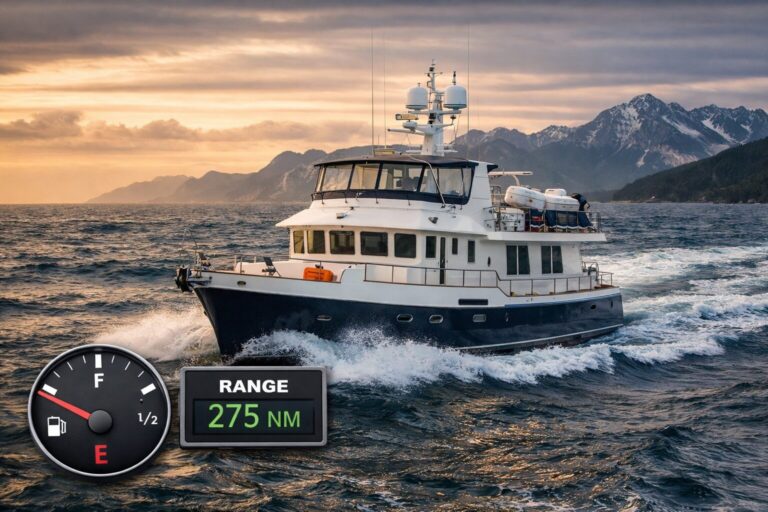
For many long-range cruisers, range anxiety is not just a phrase borrowed from electric cars. At sea, it is a very real concern that can shape routes, limit exploration, and affect confidence on extended passages. When cruising the North Pacific, where distances are long, weather windows are narrow, and fuel docks can be few and far between, understanding true trawler endurance becomes essential.
On paper, most trawlers look capable of impressive ranges. Brochures often highlight numbers that suggest thousands of nautical miles between refueling stops. In reality, actual endurance depends on many variables that are easy to overlook. Calculating real-world range is less about marketing figures and more about understanding how your yacht behaves in changing conditions. Today, we will break down what range anxiety really means at sea, how trawler endurance should be calculated, and why thoughtful design and realistic planning make all the difference for confident long-distance cruising.
What Range Anxiety Really Means on the Water
Range anxiety at sea is not simply the fear of running out of fuel. It is the uncertainty that comes from not knowing how your vessel will perform once conditions change. Wind, waves, currents, load, and crew habits all influence fuel burn. Unlike driving on land, there are no guaranteed refueling points along a straight line.
In the North Pacific, this uncertainty is amplified. Long stretches of coastline can be sparsely populated. Harbors may be closed due to weather. Fuel availability can change seasonally. A trawler skipper must be prepared not only for the planned passage but also for detours, delays, and unexpected conditions. True peace of mind comes when the owner understands their vessel’s real operating envelope. This means knowing how far the boat can travel at different speeds, how fuel consumption changes with sea state, and how much reserve is truly needed for safety.
Understanding Fuel Capacity Versus Usable Range
One of the most common mistakes in range planning is assuming that total fuel capacity equals usable range. In practice, this is never the case. Fuel tanks are designed with safety margins. Not all fuel in the tank is usable due to pickup locations, tank shape, and sediment management. Most experienced operators assume that 10 to 15 percent of total fuel should never be counted as available range fuel.
For example, a trawler with 4,000 liters of fuel does not truly have 4,000 liters for passage planning. Once reserves are accounted for, the usable fuel may be closer to 3,400 to 3,600 liters. This reserve is critical in the North Pacific, where unexpected head seas or adverse currents can significantly increase consumption. Beyond tank design, onboard systems also consume fuel. Generators, heating systems, and hydraulic equipment all add to total burn. On extended voyages, these loads become meaningful. A real endurance calculation always includes hotel loads, not just main engine consumption.
Speed, Hull Design, and the Reality of Fuel Burn
Trawlers are prized for efficiency, but efficiency is not constant across all speeds. Most displacement and semi displacement hulls have a sweet spot where fuel burn per nautical mile is minimized. Operating outside this range can dramatically reduce endurance. Many owners assume that slowing down always improves range. While this is often true, it is not universal. Running too slowly can sometimes increase consumption per mile if the engine is operating outside its optimal load range. Likewise, pushing slightly above the most efficient speed can quickly increase burn without meaningful gains in arrival time.
Hull design plays a major role here. A well-designed trawler with balanced displacement, proper propeller sizing, and efficient underwater geometry will maintain predictable fuel curves. This consistency is especially valuable in real offshore conditions where maintaining steady speed is more difficult. In the North Pacific, sea state often dictates speed more than preference. Head seas can force throttling back, while following seas may allow efficient cruising at slightly higher speeds. Knowing how your specific hull responds in these conditions is far more valuable than relying on flat-water test numbers.
Environmental Factors That Change Everything Offshore
Even the most carefully calculated range can change once the yacht leaves protected waters. Wind, waves, and current all have measurable impacts on endurance. Headwinds and head seas are the most obvious factors. They increase resistance, reduce speed over ground, and raise fuel burn. A moderate head sea sustained over several days can reduce effective range by 20 percent or more. In the North Pacific, where weather systems are large and persistent, this is a common reality rather than an exception.
Currents can work for or against you. Favorable currents can extend range significantly, while adverse currents quietly erode endurance mile by mile. Route planning that considers seasonal current patterns is essential for long passages. Temperature also plays a role. Cold water and air increase fuel density and engine efficiency slightly, but they also increase heating loads onboard. In northern latitudes, diesel heaters and generators may run for extended periods, contributing to total fuel consumption in ways that are easy to underestimate. Load is another critical factor. Fuel, water, provisions, spare parts, and personal gear all add displacement. A fully equipped expedition trawler can sit noticeably lower in the water than during factory trials. This added weight directly affects resistance and fuel burn, especially in rough conditions.
Building Confidence Through Real-World Endurance Planning
The most effective way to eliminate range anxiety is not by installing larger fuel tanks alone. It is by designing and operating a trawler with real-world endurance in mind from the beginning. Custom trawlers built for the North Pacific benefit from thoughtful fuel system design, efficient hull forms, and propulsion systems matched precisely to intended cruising speeds. Redundancy in filtration, accurate fuel monitoring, and reliable range data displayed at the helm all contribute to informed decision making.
Equally important is owner education. Sea trials should include fuel measurements at multiple speeds and loads, not just a single advertised cruising number. Recording fuel burn in various conditions builds a personal data set that becomes invaluable over time. Conservative passage planning is also key. Experienced cruisers plan routes assuming worse-than-expected conditions. This mindset turns fuel reserves into comfort rather than emergency margins. When delays occur, there is confidence rather than stress. In the end, range anxiety fades when numbers become familiar and predictable. A trawler that consistently delivers known performance allows owners to focus on the experience of cruising rather than constantly watching fuel gauges.
Why Realistic Range Matters More Than Maximum Range
It is tempting to focus on maximum range figures. These numbers look impressive and are easy to market. However, maximum range is rarely how trawlers are actually used. What matters more is realistic range at comfortable cruising speed, in typical sea conditions, with full cruising load onboard. This is the range that determines whether a passage feels relaxed or tense.
In regions like the North Pacific, where self-reliance is part of the cruising culture, realistic endurance is not a luxury. It is a foundation of safe and enjoyable voyaging. A well-designed custom trawler or pilothouse yacht does more than travel far It travels predictably. It gives its owner confidence that when the coastline stretches on and weather changes, the vessel has the capability to keep going without compromise. Understanding real-world trawler endurance is the first step toward that confidence. When range anxiety disappears, true long-distance cruising begins.
We turn your cruising dreams into reality by developing bespoke trawler and pilothouse yachts built for comfort, safety, and performance. From the initial hull design to the final varnish, our experienced naval architects and craftsmen collaborate with you every step of the way, integrating fuel-efficient engines, ergonomic deck layouts, and beautifully appointed living spaces. With industry-leading warranties and personalized support, we make sure your new yacht feels like home the moment you step on deck. Reach out to us by email at info@northpacificyachts.com for personalized responses to all your inquiries. If you’d prefer a conversation, we invite you to give us a call at 1-844-922-4877.
Frequently Asked Questions
1. What is the average cruising range of a trawler yacht?
The average cruising range of a trawler yacht typically falls between 1,000 and 3,000 nautical miles, depending on fuel capacity, cruising speed, hull design, and onboard systems. Real-world range is usually less than brochure numbers because factors like weather, currents, generator use, and fuel reserves must be included in planning. For long-range cruising, experienced operators calculate endurance based on realistic conditions rather than maximum range figures.
2. How do you calculate real-world trawler endurance?
Real-world trawler endurance is calculated by dividing usable fuel by average fuel burn per hour, then multiplying by expected speed over ground. Usable fuel excludes safety reserves, usually 10 to 15 percent of total capacity. Accurate calculations also account for generator usage, heating systems, sea state, wind, currents, and vessel load. Sea trials at multiple speeds provide the most reliable endurance data.
3. Why does fuel consumption increase in offshore conditions?
Fuel consumption increases offshore due to added resistance from waves, wind, and current. Head seas force the hull to work harder, reducing speed while increasing engine load. Additional weight from fuel, water, and cruising supplies also raises displacement, which further affects efficiency. In colder regions, extended use of onboard heating and generators adds to overall fuel use during long passages.
4. How much fuel reserve should a trawler carry for safe passage planning?
Most experienced trawler operators plan to keep at least 10 to 20 percent of total fuel capacity as a reserve. This reserve accounts for unexpected weather changes, detours, fuel dock closures, or mechanical inefficiencies. In remote areas such as the North Pacific, conservative fuel reserves are essential for maintaining safety and reducing stress during extended voyages.
5. Are custom-built trawlers more efficient for long-range cruising?
Custom-built trawlers are often more efficient for long-range cruising because they are designed around specific operating speeds, cruising regions, and owner preferences. Proper engine selection, optimized hull form, balanced displacement, and tailored fuel systems all contribute to predictable fuel consumption and reliable endurance. This level of customization is especially valuable for offshore cruising where real-world performance matters more than theoretical range.