

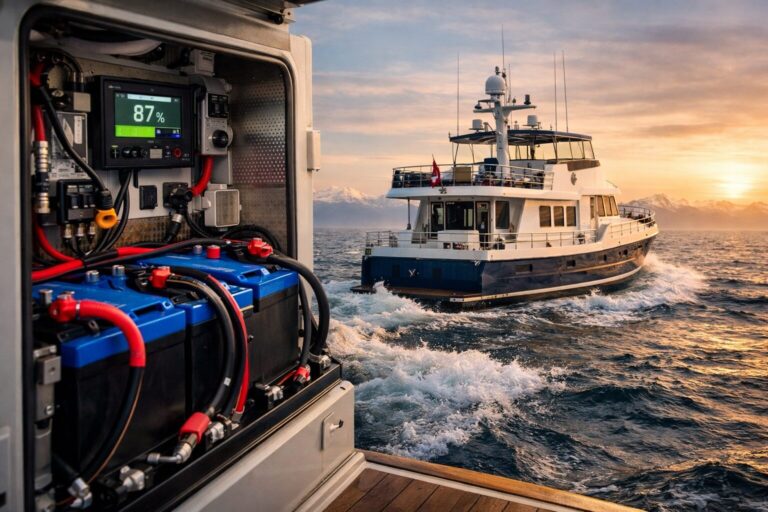
Amp-hour ratings alone do not tell you how long a trawler can sit at anchor without running an engine or generator. Evaluating a house bank by its amp-hour capacity assumes an identical electrical baseline across every boat, obscuring differences in system voltage, usable chemistry thresholds, and conversion inefficiencies.
To build an electrical system that supports your time away from the dock, you must plan your battery capacity in usable watt-hours (Wh) or kilowatt-hours (kWh) and pair that capacity with a charging system engineered to replenish it efficiently.
Translating House Loads Into a Measured Daily Energy Budget
An accurate energy budget starts with calculating actual consumption in watt-hours rather than estimating daily amp-hours. Watt-hours account for the relationship between current, voltage, and operational time:
Watts × hours of operation = watt-hours (Wh)
A 120V refrigeration compressor drawing 60 watts that runs 12 hours a day consumes 720 Wh. A 24V macerator pump drawing 150 watts for 10 minutes (0.17 hours) consumes 25.5 Wh. Calculating every consumer in watt-hours normalizes DC components operating at different voltages alongside AC components powered through an inverter.
Load labels are a starting point, but cycling equipment, inverter standby demand and conversion losses affect actual consumption. Measure representative use and use the installed inverter’s data at relevant loads. Include its idle demand only for the hours it will remain energized.
| Load type | Input to measure or confirm | Budget treatment |
|---|---|---|
| Refrigeration | Actual cycling and consumption in expected conditions | Account for duty cycle |
| Inverter idle demand | Selected model’s energized idle draw and hours | Add it once to the budget |
| Inverted AC loads | AC energy and inverter efficiency at relevant loads | Divide AC energy by efficiency expressed as a decimal |
| Intermittent pumps | Power, start demand and actual run time | Include energy and check peak demand separately |
| Electronics and lights | Power and operating hours | Include sustained loads over the full day |
Directly monitoring house loads with a calibrated shunt or battery monitor during sea trials yields better design data than static equipment lists. While tracking state-of-charge over an extended cruise belongs in your daily battery routine, sizing the bank during a build or refit requires establishing an accurate, measured baseline in total watt-hours per 24-hour period.
Comparing Battery Capacity Across System Voltages and Chemistries
A battery bank’s storage volume must be measured by total energy, calculated as nominal voltage multiplied by amp-hour capacity:
Nominal voltage (V) × amp-hour capacity (Ah) = nominal energy (Wh)
This calculation prevents misleading comparisons between 12-volt and 24-volt architectures. For example, a 24V bank rated at 200Ah stores 4,800 nominal Wh (24 × 200). A 12V bank rated at 400Ah also stores 4,800 nominal Wh (12 × 400). Both banks contain the exact same amount of energy, but the 24V system moves that energy at half the amperage.
As outlined in principles of Victron DC wiring, halving the current reduces resistive voltage drop and allows for smaller cable cross-sections across long trawler wire runs. When high-power consumers like windlasses, thrusters, or large inverter/chargers run on 24V, smaller wire gauges reduce installation weight and heat buildup. Lower-voltage house equipment can then be supported through dedicated DC-to-DC converters.
- 12V System at 1,200 Watts:
- Current = 1,200W / 12V = 100 Amps
- Requires heavy cabling to mitigate voltage drop
- 24V System at 1,200 Watts:
- Current = 1,200W / 24V = 50 Amps
- Permits smaller cable cross-section with lower resistive heat loss
Nominal energy does not equal usable energy. Usable capacity is determined by the battery chemistry, manufacturer-specified voltage limits, and the safety reserve required to preserve cycle life:
-
Absorbent Glass Mat (AGM): Usable energy depends on the manufacturer’s discharge guidance, load, temperature, age and the reserve you choose to retain. Voltage can inform an assessment under appropriate conditions, but resting voltage alone is not a universal capacity limit.
-
Lithium Iron Phosphate (LFP): These banks often allow a larger usable share of nominal energy than lead-acid alternatives, but the actual figure comes from the battery requirements and system settings. Include operating reserve and the consequences of a BMS disconnect; do not budget to a protective shutdown as the normal endpoint.
When configuring series and parallel connections, the principles of Victron battery bank wiring illustrate that series strings increase system voltage while keeping amp-hours constant, whereas parallel connections scale capacity at the same voltage. In all cases, system comparisons should be evaluated in total usable kilowatt-hours rather than faceplate amp-hours.
Matching Bank Sizing to Charging Systems and Acceptance Rates
A large house bank without commensurate charging capability creates an unbalanced system. Sizing storage capacity requires assessing how quickly your power generation sources can restore the energy consumed over a standard operating cycle.
Charging rate changes through the charge cycle. Lead-acid charging commonly includes an absorption stage, so replacing the last portion of the energy can take longer than a simple bulk-current calculation suggests. Use the exact battery’s charging profile and measured recovery time to assess whether short charging periods are sufficient.
LFP batteries can accept substantial charging current within their specified limits, but the battery, alternator, charger and wiring must all be compatible. A high acceptance rate is useful only if the charge sources can supply it without exceeding their own limits.
- Charging sources must suit the battery and their own operating limits.
- BMS and charge/load controls must work together.
- Wiring and protection must suit continuous and peak loads.
- Monitoring should make energy use and recovery visible.
Victron lithium system design treats the battery, BMS, charging sources and load controls as an integrated system. An alternator must be protected against excessive demand and unsafe disconnect behavior using a suitable arrangement for that installation. The solution may involve regulation, current limiting or other controls; no single regulator/converter arrangement applies to every boat.
Ensuring proper cable torque, checking termination temperatures, and inspecting thermal sensor connections are essential components of ongoing electrical system maintenance.
Aligning Storage Capacity With Cruising Plans
Compare the time and loads between realistic charging opportunities. Marina access does not remove the need for an adequate bank, and remote anchoring does not prescribe a particular chemistry. Capacity and recovery should be calculated for your routine and contingency needs.
For example, our 49 Pilothouse offers an AGM bank with a Victron inverter/charger and lithium options. North Pacific 49 equipment is a useful starting resource when discussing the selected configuration. Ask us how its capacity, charging sources and access fit your measured budget rather than inferring runtime from the presence of a particular battery chemistry.
| Configuration | What to evaluate |
|---|---|
| AGM | Usable energy at expected load, full-charge time and service support |
| Lithium | Usable energy, compatible BMS/charging controls and service support |
Compare actual parts and service support for the battery and control equipment in the places you intend to cruise. AGM and lithium options differ in usable energy, charging behavior, weight and control requirements; neither guarantees worldwide availability or a simple replacement.
Next Steps
Balancing a trawler’s electrical system requires matching your daily domestic energy consumption to a realistic storage volume and a robust recovery source. If you are configuring a new build or evaluating refit options, review your appliance load profiles and determine your expected time between recharge cycles.
We encourage you to talk with us about your cruising itinerary, onboard equipment plans, and the optimal electrical configuration for your North Pacific yacht.