

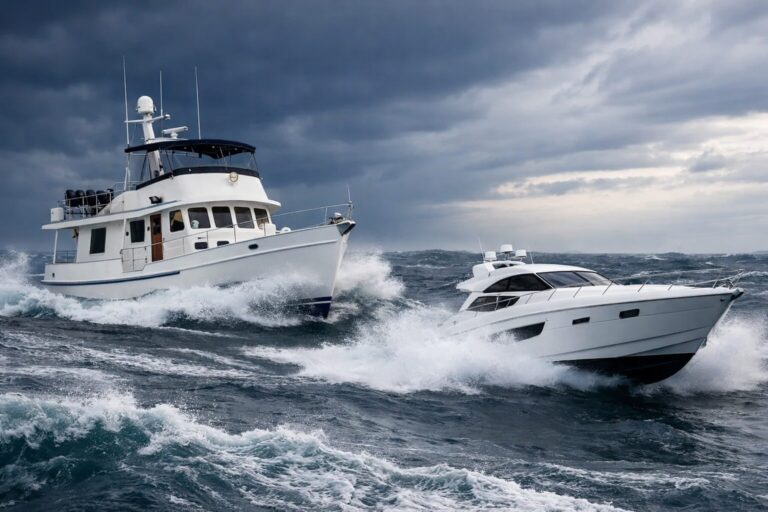
Anyone who has spent serious time on open water knows that not all yachts react the same way when the sea turns rough. Swell direction, wave spacing, wind, and hull design all come into play. In the North Pacific especially, where conditions can change quickly and waves are often long and powerful, the way a yacht handles heavy seas matters far more than speed or styling. Two common yacht types approach these conditions very differently. Trawlers are designed to work with the ocean, while planing yachts are designed to move quickly across it. Both have their place, but their behavior in heavy seas highlights some fundamental differences in philosophy, construction, and performance. Understanding those differences helps owners choose the right vessel for their cruising goals and the waters they plan to explore.
Hull Design and How It Meets the Water
The biggest difference between trawlers and planing yachts begins below the waterline, especially when comparing shallow-draft and deep-draft trawlers. Trawlers use displacement or semi displacement hulls. These hulls push water aside as they move forward instead of trying to climb on top of it. The shape is usually deeper, rounder, and heavier, allowing the hull to settle into the water rather than skip across the surface. In heavy seas, this design allows a trawler to move in rhythm with the waves. Instead of slamming into oncoming swells, the bow tends to rise gradually and fall smoothly. The hull slices through water instead of bouncing off it. This reduces sudden impacts, keeps motion predictable, and helps maintain control even when waves are steep or confused.
Planing yachts are built very differently. Their hulls are flatter aft and lighter overall. At higher speeds, they generate lift and ride on top of the water. This is efficient and exciting in calm or moderate conditions, but in heavy seas it can work against comfort and safety. When waves grow taller and closer together, a planing hull often meets the water with more force, leading to hard impacts and rapid vertical motion. In rough conditions, planing yachts typically need to slow down significantly. Once they drop off plane, the hull shape is no longer operating in its ideal range, which can make handling less stable compared to a trawler that was designed to remain in displacement mode at all times.
Motion Comfort and Crew Fatigue
Comfort in heavy seas is not about luxury finishes or cabin size. It is about motion. The way a yacht rolls, pitches, and heaves has a direct impact on crew fatigue, seasickness, and long term enjoyment on board. Trawlers excel here because their weight and hull form naturally dampen motion. A deeper hull, combined with a lower center of gravity, slows down roll cycles and reduces sharp movements. In beam seas, a trawler typically rolls more slowly and predictably, giving the crew time to adjust and maintain balance. This slower motion is easier on the body and far less exhausting over long passages.
Pitching in head seas is also more controlled. Instead of lifting abruptly and slamming down, a trawler follows the shape of the wave. This means less stress on the structure and a quieter, calmer ride inside the vessel. Over hours or days at sea, this difference becomes very noticeable. Planing yachts, by contrast, often have quicker and sharper motion in rough water. When running at reduced speed, their lighter weight and flatter sections can lead to more pronounced pitching and rolling. The motion tends to be faster, which can tire crew members quickly and make tasks like cooking, resting, or navigating more difficult. While active stabilizers can help both yacht types, they work best when paired with a hull that already favors steady motion. On a trawler, stabilizers enhance an already comfortable platform. On a planing yacht in heavy seas, they often feel more like a correction than a solution.
Speed Control and Seamanship in Rough Conditions
Speed management is another key area where trawlers and planing yachts differ significantly in heavy seas. Trawlers are designed to operate efficiently at lower speeds, often between seven and ten knots. These speeds are well matched to rough water, allowing the vessel to maintain steady progress without fighting the sea. Because trawlers do not rely on speed to perform well, the captain has more flexibility. Slowing down slightly or adjusting course by a few degrees can dramatically improve comfort without sacrificing safety or control. The vessel remains predictable, responsive, and balanced even when conditions deteriorate.
Planing yachts depend on speed for their best handling characteristics. In rough seas, captains are often forced to choose between running fast enough to stay on plane or slowing down to avoid discomfort and impact. Staying on plane in heavy seas can be physically demanding on the vessel and uncomfortable for those on board. Slowing down too much, however, can place the hull in an awkward operating zone where it neither planes nor behaves like a true displacement hull. This narrow comfort window makes seamanship more demanding. Course selection, throttle control, and timing waves require constant attention. In long stretches of rough water, this can increase stress for both captain and crew. Trawlers, by contrast, reward patience and planning. Their predictable behavior allows crews to focus on navigation, weather, and safety rather than constantly reacting to wave impact.
Structural Strength and Long Range Design Philosophy
Trawlers are traditionally built with long range cruising and offshore passages in mind. This philosophy shows clearly in how they handle heavy seas. Heavier displacement, thicker laminates, and reinforced framing are common features. These elements are not about excess but about durability and resilience over thousands of miles. In heavy seas, this strength translates into confidence. Doors, windows, bulkheads, and deck fittings are designed to withstand repeated wave loads. The hull flexes less, noise is reduced, and systems remain secure even when the boat is working hard.
Planing yachts, especially those designed primarily for coastal cruising or shorter trips, often prioritize weight savings and performance. While they are still built to high standards, the focus is different. Structures are optimized for speed and efficiency rather than continuous exposure to rough offshore conditions. This does not mean planing yachts are unsafe. It simply means their ideal operating environment is different. In heavy seas over extended periods, the constant impact loads can accelerate wear and increase crew fatigue. For owners who plan to travel long distances, cross open stretches of ocean, or operate regularly in challenging regions like the North Pacific, the trawler approach offers a margin of comfort and reliability that is hard to match.
Living Aboard While the Sea Is Moving
One of the most overlooked differences between trawlers and planing yachts in heavy seas is how livable they remain while underway. Trawlers are often designed so that daily activities can continue even when conditions are less than ideal. Wide side decks, protected pilothouses, and well placed handholds allow safe movement around the vessel. Interior layouts are usually optimized for balance, with galleys, seating, and berths positioned near the center of motion. This makes it easier to rest, prepare meals, or stand watch without constantly bracing against sudden movement.
Planing yachts, with their emphasis on speed and open layouts, can feel more challenging in rough water. Large open spaces and higher deck levels amplify motion, and activities below deck often become uncomfortable when seas build. For long passages or extended time offshore, this difference has a major impact on overall experience. Comfort is not a luxury when conditions are tough. It is a key part of safety, decision making, and endurance.
Choosing the Right Tool for the Water Ahead
Heavy seas reveal the true character of a yacht. Trawlers and planing yachts are designed with different priorities, and those priorities become most obvious when waves grow larger and conditions demand respect. Trawlers meet heavy seas with patience, stability, and strength. Their hulls work with the ocean rather than against it, providing steady motion, predictable handling, and long range confidence. Planing yachts offer speed and excitement in suitable conditions but often require compromise when the sea turns rough. For owners planning to cruise the demanding waters of the North Pacific or anywhere that weather and swell are serious considerations, understanding these differences is essential. The right yacht is not just about reaching a destination quickly. It is about arriving safely, comfortably, and ready for whatever the next horizon brings.
We turn your cruising dreams into reality by developing bespoke trawler and pilothouse yachts built for comfort, safety, and performance. From the initial hull design to the final varnish, our experienced naval architects and craftsmen collaborate with you every step of the way, integrating fuel-efficient engines, ergonomic deck layouts, and beautifully appointed living spaces. With industry-leading warranties and personalized support, we make sure your new yacht feels like home the moment you step on deck. Reach out to us by email at info@northpacificyachts.com for personalized responses to all your inquiries. If you’d prefer a conversation, we invite you to give us a call at 1-844-922-4877.