

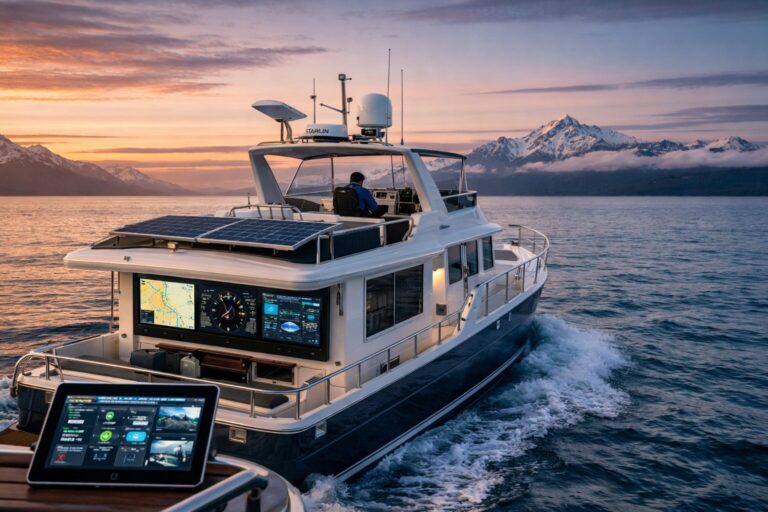
Smart marine technology should reduce your physical workload and give you unambiguous data while underway or at anchor. When an onboard system adds more administrative overhead, battery drain, and troubleshooting steps than the manual task it replaces, it fails the basic test of cruising equipment.
Selecting the right electronics suite requires looking past marketing promises and evaluating every component against two criteria: the specific problem it solves on the water and the dependencies it introduces to your vessel’s electrical and network backbone.
Matching Technology to Daily Passage Routines
Electronics must serve actual operations at the dock, in coastal passages, and at remote anchorages. A long-range trawler functions as both a passage-maker and an independent home, meaning equipment priorities differ sharply from day boats or dockside entertainment platforms.
Useful technology can automate data collection and flag changes that warrant investigation; detection depends on the installed sensors and settings. Useful installations typically focus on four routine tasks:
- Machinery monitoring: Identify which engine and equipment readings matter to your operation and which sensors are actually installed.
- Electrical monitoring: Compare battery and charging information with the measurements needed to understand your daily demand.
- Anchor awareness: Consider how configured depth, position and weather information supports your own checks.
- Passage monitoring: Choose useful radar, AIS and chart information for the conditions you expect.
Features that exist purely to provide digital novelties—such as controlling salon accent lighting exclusively through a tablet or automating tasks easily handled by a manual valve—introduce failure points without adding safety or utility. Start by defining your routine operating habits, then select systems that directly support them.
Helm Layout, Human Factors, and Redundancy
A well-designed pilothouse presents critical operational data in your direct sightline without cluttering your view or flooding the bridge with visual noise. Glass bridges with integrated multi-function displays (MFDs) consolidate radar, chart plotting, sonar, and vessel data onto clean, configurable screens, but consolidation brings its own risks if interface design is ignored.
Alarm management requires careful attention. A system that sounds identical chimes for a low-priority shallow-water boundary and an overheating engine creates alarm fatigue. When everything chirps, watchstanders tune out alerts. Ensure your helm displays allow custom alert thresholds and distinct visual warnings so you can distinguish urgent alarms from advisory information without disabling a warning you need.
Ask how important controls remain available if a display or network fails. Review navigation lights, horn, wipers and pump controls with the installer, including the fallback arrangements for the exact equipment.
For an in-depth breakdown of helm electronics selection, read our guide to navigation systems for trawler owners. We also explore the emerging capabilities and realistic boundaries of machine-vision lookouts in our look at AI-assisted navigation.
Technological sophistication does not alter your statutory obligations on the water. Under USCG navigation rules, specifically Rules 5 through 7, the skipper must maintain a proper lookout by sight and hearing at all times, travel at a safe speed appropriate to the conditions, and use all available means to determine collision risk. Automated tracking tools, radar target acquisition, and smart charting software assist your situational awareness, but they never discharge the watchstander’s legal and practical responsibility to keep a visual watch.
Remote Vessel Monitoring and Telematics Realities
Remote monitoring systems allow owners to verify vessel health from home or an office, tracking parameters such as bilge pump cycles, battery voltage, shore power connection status, high-water alarms, and geofence position. The Garmin OnDeck system serves as a practical example of optional telematics hardware that interfaces with a boat’s sensors to relay data back to a smartphone app.
Understanding what telematics can and cannot do prevents misplaced confidence. These systems do not fix problems; they only report them. A high-water notification received while you are two hours away needs investigation; its meaning depends on the sensor, threshold and actual conditions aboard.
Remote monitoring depends on working sensors, power to the relevant devices and network, the monitoring service connection and a way for the recipient to receive an alert. Confirm which values and alarms the installed system can report. A lost connection may delay notifications; arrange who will respond locally when an alert arrives.
Electrical integration must be handled correctly. Use the Garmin OnDeck installation instructions and a qualified installer to establish compatible sensors, network power, circuit protection and standby demand. Ask what continues to operate when normal boat circuits are switched off, and how long the monitoring setup can remain powered.
Balancing Connectivity with the Electrical Budget
Starlink maritime service is one option for ocean connectivity. Check the applicable service plan, compatible hardware, coverage and installation requirements for the route you intend to cruise. Access and performance depend on the installed equipment, service terms and conditions; plan how you will obtain essential information when the connection is unavailable.
Every connected device adds to your daily DC hotel load. Measure or obtain the demand of the terminal, router and monitoring devices you choose, then include them with refrigeration, pumps, lighting and other loads in the daily power budget.
Our North Pacific 49′ Pilothouse equipment includes an AGM battery bank and a Victron inverter/charger, with lithium battery options available. Discuss the exact battery, charging and load configuration with us rather than assuming a battery change will support every desired appliance or connected device.
Test which local instruments and controls continue to work when the internet connection is lost. Internet access and the onboard navigation network serve different jobs; an outage should be part of the equipment demonstration and operating plan.
Choosing Systems You Can Maintain and Support
Equipment selected for a cruising trawler should be serviceable in distant ports using standard tools and available replacement parts. Highly proprietary, all-in-one black-box systems that combine lighting, switching, power conversion, and entertainment into a single microprocessor board look sleek, but a localized failure can leave you without lights or water pressure until a specialized factory technician arrives.
Before finalizing your electronics specification, evaluate physical access and service documentation:
- Physical serviceability: Ensure wiring chases, terminal blocks, and network backbones are accessible through hinged panels, dedicated access hatches, and removable headliners rather than sealed behind structural fiberglass or glued cabinetry.
- Clear documentation: Require a full, vessel-specific electrical schematic and a line diagram showing every NMEA 2000 drop cable, Ethernet switch port, inline fuse, and breaker assignment.
- Standardized protocols: Prioritize components that communicate via open, industry-standard protocols like NMEA 2000 rather than proprietary interfaces that lock you into one brand for the life of the vessel.
- Component isolation: Ensure individual component failures—such as a failed wind sensor or fish finder transducer—cannot corrupt the high-speed data bus serving your primary autopilot or engine monitors.
Because we work directly with our owners rather than through a third-party dealer network, we can discuss equipment-list choices alongside your cruising goals.
If you are planning an extended coastal voyage or long-range liveaboard cruising, we invite you to discuss your cruising plans with us to consider the equipment, support and operating routines that fit your intended cruising.