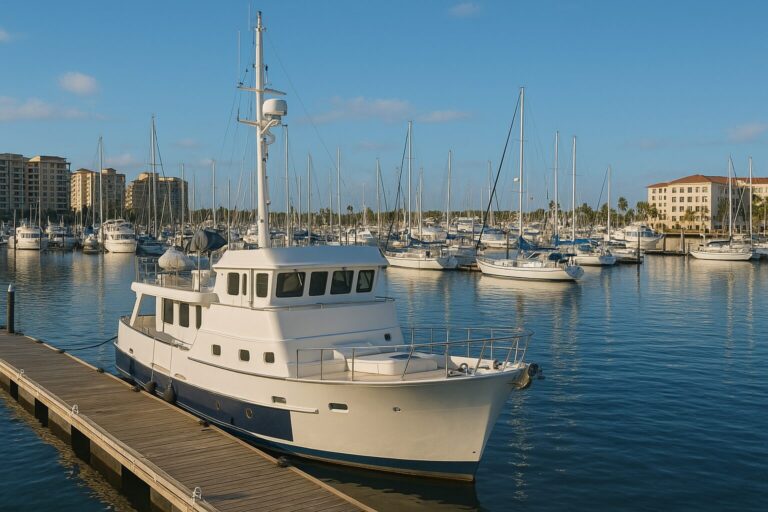
A marina stopover is a functional support base, not just an overnight parking spot. When you bring a displacement or semi-displacement trawler alongside, the facility must match your vessel’s physical footprint, supply clean and compatible electrical power, and give you practical access to fuel, pumpouts, provisions, and technicians.
No single marina fits every passage plan or boat profile. Slip configurations that suit a light dayboat can complicate line handling on a high-freeboard, single-engine trawler with an anchor pulpit and swim-platform davit. Evaluating a stopover requires looking past marketing photos to verify physical berth fit, dockside infrastructure, and local operating conditions.
-
Berth fit: length overall, beam, loaded draft and relevant appendages.
-
Services: confirmed power, water, fuel and waste handling.
-
Shore access: provisions, transport, contractors and stay policies.
Selecting a marina also depends on the purpose of your stay. Preparing for a passage requires different amenities than settling into a home slip for the season. If you are assessing a facility for full-time residential use, local harbor regulations, tenant rights, and waste discharge rules require specialized homework; we explore those factors in Can You Live on a Trawler? What to Verify Before Moving Aboard. Conversely, if you spend most of your cruising calendar at anchor and only duck into a slip when weather degrades or battery banks deplete, your dockside needs center on high-output charging, which connects directly to the principles outlined in Shore Power, Inverters, and Battery Routine: How to Stay Comfortable Between Marinas.
The following three international facilities illustrate how berth types, regional power standards, and coastal conditions change what you need to confirm before throwing lines to dock staff.
Shilshole Bay Marina: A Seattle Base to Investigate
Shilshole Bay Marina is operated by the Port of Seattle. Its official information provides a marina map, customer handbook, moorage contacts and application details. It is an urban Pacific Northwest example where the berth and shoreside routine deserve attention alongside the cruising itinerary.
Before booking, give the marina your boat’s measured length overall, beam and loaded draft, including relevant platforms or other projections. Ask about the assigned berth, access at the relevant water levels, arrival instructions and available assistance.
Confirm the services that matter to your stay: compatible shore power, drinking-water supply, fuel and pumpout access, and the practical trip ashore for provisions. Treat each as a question about the actual berth and dates, rather than assuming all slips provide the same services. If you intend a longer stay or liveaboard use, ask about the applicable arrangements separately from transient moorage.
Yalıkavak Marina: An Aegean Marina with Shoreside Amenities
Yalıkavak Marina in Türkiye offers berth information alongside hotels, dining and shopping. It provides a contrasting example for an owner comparing a marina stay that includes substantial shoreside activities. Those amenities may matter for guests or an extended stop, but they do not settle the boat’s physical fit.
Ask the marina to describe the actual berth arrangement and boarding access, then check how it works with your boat and crew. Confirm arrival procedures and the assistance available before committing to the reservation.
Power compatibility also deserves a specific conversation. Obtain the assigned supply’s voltage, frequency, capacity and connection details; compare them with the boat’s installed electrical requirements. Do not assume that an adapter or transformer resolves every difference. If compatibility is unclear, resolve it with the appropriate equipment guidance and qualified advice before connection.
Ask separately about the fuel, waste handling, contractor access and formalities relevant to your visit. A resort setting does not establish which support services are available to your exact boat or on your chosen dates.
Marina Bahía Golfito: A Service Example in Pacific Costa Rica
Marina Bahía Golfito is on Costa Rica’s southern Pacific coast. Its official services page lists dockage, fuel bunkering, shore power, potable water and waste-related services. This makes it a useful example for comparing a replenishment stop with a marina chosen primarily for urban access or resort amenities.
For your boat, confirm the assigned berth’s clearances and access, including relevant water levels and any current limitations. Published capacity figures describe the facility generally; they do not guarantee a berth or prove that every approach is suitable.
Ask about the electrical supply at the assigned slip, water availability, fuel arrangements and the waste services your boat needs. Confirm prices and operating status directly for your visit rather than planning around an old fee list.
If the stop includes maintenance, explain the intended work and ask about contractor permissions, parts delivery and available support. Check the applicable entry and clearance procedures with the responsible authorities and service contacts. Keep time in the itinerary for arrangements that may take longer than expected.
Pre-Booking Verification Checklist
Use the operator’s information as a starting point, then confirm the details that affect your boat and stay. Send the harbor office your exact dimensions and requirements, and review these five categories.
-
Physical fit and water access
-
Electrical supply and compatibility
-
Arrival procedures and support
-
Water, fuel and waste services
-
Shore access and stay policies
1. Physical Clearances
Provide your total length including the anchor pulpit, bow roller, swim step, and any dinghy carried on davits. Ask for:
-
The actual length of the finger pier relative to your waterline length.
-
Fairway width between docks (to verify whether you have room to turn your single- or twin-screw trawler into the prevailing wind).
-
Depths at low tide specifically within the assigned slip, not just the main channel.
2. Pedestal and Power Matching
State your vessel’s electrical requirements clearly:
-
Identify whether your electrical system requires 30A 120V, 50A 120/240V, or European 230V/400V.
-
Ask if pedestals use standard twist-lock fittings or IEC pin-and-sleeve connections that require adapters.
-
Confirm if the marina meters power separately or includes it in daily moorage rates, and whether voltage stays stable during peak seasonal demand.
3. Arrival Support
Confirm how the marina handles your initial landing:
-
Identify the working VHF channel monitored by the harbor staff and their operating hours for line-handling assistance.
-
Ask whether the assigned berth requires side-to tying (port or starboard) or stern-to docking, so your crew can hang fenders and set dock lines before entering the breakwater.
4. Critical Fluids and Discharges
Do not assume support services are fully operational:
-
Confirm whether the pumpout facility is located in-slip or requires shifting to a dedicated service dock.
-
Inquire about potable water pressure and whether any seasonal boiling advisories or supply restrictions are in place.
-
If bunkering diesel, verify fuel turnover rates, filtration standards, and payment terms (some facilities place strict credit card limits on large fuel volumes).
5. Access and Shore Regulations
Understand the yard and gate rules before signing a dockage contract:
-
Determine if outside contractors, divers, or local mechanics can board your boat to carry out maintenance, and what insurance coverage they must present to the office.
-
Check gate security protocols, package receiving access for spare parts, and pet regulations if cruising with dogs.
Aligning Vessel Configuration with Your Cruising Grounds
Berth styles, dock heights, power supplies, and shore logistics change with every border and body of water. A vessel configured properly for cruising the tidal waters of the Pacific Northwest needs different shore connections, ground tackle handling, and climate management than one operating along the Mediterranean coast or throughout Central America.
Enclosed helms, wide side decks, accessible line-handling positions, and robust electrical systems make these transitions more manageable. However, no amount of interior volume or bridge comfort overrides the fundamentals of seamanship: matching your boat’s drafts and displacements to local depths, verifying electrical compatibilities, and confirming arrival conditions before entering the fairway.
When reviewing our current models, consider how your intended cruising grounds affect boarding, equipment and dockside needs. If you are configuring a boat for coastal stops or travel farther afield, talk with us about the region, crew and shore-service priorities you want to discuss.